
Ford has specified 5W-50 engine oil for a number of high-performance Mustang applications. That can seem unusual when many modern passenger vehicles use considerably lower-viscosity oils such as 0W-20, 5W-20 or 5W-30.
The reason isn't simply that a Mustang has more horsepower. Engine design, operating temperature, bearing loads, intended use and Ford's own lubricant requirements all contribute to the specified viscosity.
For owners of performance Mustangs, particularly vehicles used enthusiastically or on the track, understanding why the correct oil matters is more useful than simply reaching for the thickest oil on the shelf.
Selected high-performance Mustang engines specify 5W-50 because Ford designed and validated those applications around that lubricant viscosity and performance level. The correct oil must provide suitable flow during startup while maintaining an adequate protective film at high operating temperatures and loads.
What Does 5W-50 Mean?
The numbers in an SAE multigrade such as 5W-50 describe the oil's viscosity behaviour at different temperatures.
The 5W relates to specified low-temperature performance, while the 50 identifies the oil's high-temperature SAE viscosity grade.
This does not mean a 5W-50 oil is simply "thick when hot and thin when cold". It means the lubricant meets defined SAE viscosity requirements at both ends of its operating range.
Compared with a lower high-temperature viscosity grade, an SAE 50 oil maintains greater viscosity at operating temperature. In an engine designed to use it, this can help maintain the lubricant film separating highly loaded components.
Why Would a High-Performance Mustang Use 5W-50?
High-performance engines can expose their lubricants to conditions substantially more demanding than ordinary road driving.
Higher engine speeds, greater cylinder pressures and sustained high-load operation can increase temperatures and loads throughout the engine. Track use can amplify these demands further because the engine may operate at high speed and high load for extended periods rather than for a few seconds during normal acceleration.
Engine oil must continue forming a protective film between components while also carrying heat, controlling deposits, protecting against wear and supplying oil-dependent systems throughout the engine.
Where Ford specifies 5W-50, the viscosity should therefore be treated as part of the engine's design requirements rather than simply a recommendation for owners who drive hard.
Does More Horsepower Automatically Require Thicker Oil?
No. Horsepower alone does not determine the correct engine-oil viscosity.
Two engines producing similar power can specify completely different lubricants because their bearing clearances, oil-pump systems, operating temperatures, valvetrain designs and other engineering characteristics differ.
This is particularly important with modified vehicles. Increasing engine output does not automatically mean moving from 5W-30 to 5W-40 or from 5W-40 to 5W-50 is the correct solution.
Changing to a higher-viscosity oil simply because an engine has been modified can affect oil flow and other characteristics the engine was designed around. Start with the manufacturer's specification and only deviate from it when there is a sound technical reason for doing so.
Why Oil Temperature Matters
Engine-oil viscosity decreases as temperature increases. This is normal and is one of the reasons viscosity selection is so important.
During sustained high-load operation, oil temperature can rise substantially. The lubricant must retain appropriate viscosity and film strength under those conditions while resisting oxidation and deposit formation.
This is one reason an oil specified for a high-performance application may differ from the lubricant used in a less demanding version of the same vehicle family.
Mechanical Shear and Viscosity
Multigrade engine oils must maintain their required viscosity characteristics despite being repeatedly subjected to mechanical forces inside the engine.
High engine speeds and heavily loaded components can place considerable stress on the lubricant. A well-formulated oil must resist excessive viscosity loss in service while continuing to provide the protection expected from its viscosity grade.
For a high-performance 5W-50 application, this is particularly important because the lubricant is expected to provide a broad operating-temperature range while retaining suitable high-temperature performance.
Street Driving vs Track Use
A Mustang driven to work and a Mustang completing repeated track sessions may have the same engine, but their lubricants can experience very different operating conditions.
Track driving can expose the engine oil to sustained high temperatures, high engine speeds and high loads. Oil condition and oil level therefore deserve additional attention when a vehicle is used on the circuit.
Check the manufacturer's recommendations for track or competition use, including any additional inspection, oil-change or fluid requirements. Modified engines may also require maintenance decisions based on the engine builder's specifications and actual operating conditions.
An oil-change interval appropriate for normal road use isn't automatically appropriate for repeated circuit use. High oil temperatures, fuel dilution and other severe operating conditions can affect lubricant life even when relatively few kilometres have been travelled.
What About Ford's Oil Specification?
Viscosity is only one part of selecting the correct Mustang engine oil.
Ford also publishes lubricant performance specifications for its engines. Depending on the model and year, a Mustang requiring 5W-50 may specify a particular Ford WSS engine-oil requirement.
These specifications should not be ignored simply because another oil has the same SAE viscosity. Two 5W-50 oils can be formulated for different applications and may carry different performance claims.
Always check the requirements for the exact model, engine and model year rather than assuming every Mustang using 5W-50 has identical requirements.
Can I Use 5W-50 in a Mustang That Specifies 5W-20 or 5W-30?
The fact that Ford specifies 5W-50 for some high-performance Mustang engines does not make it the preferred oil for every Mustang.
If an engine is designed for 5W-20, 5W-30 or another viscosity, changing to 5W-50 significantly alters the lubricant's high-temperature viscosity.
For a standard road vehicle, use the viscosity and specification recommended by Ford unless the manufacturer provides an alternative for the intended operating conditions.
Can I Use Racing Oil Instead?
A performance road car does not automatically require racing oil.
Dedicated racing lubricants can be formulated around different priorities from oils intended for road vehicles, including different service intervals and specification requirements.
We've covered this distinction in more detail in our guide, Should You Use Racing Oil in a Daily Driver?
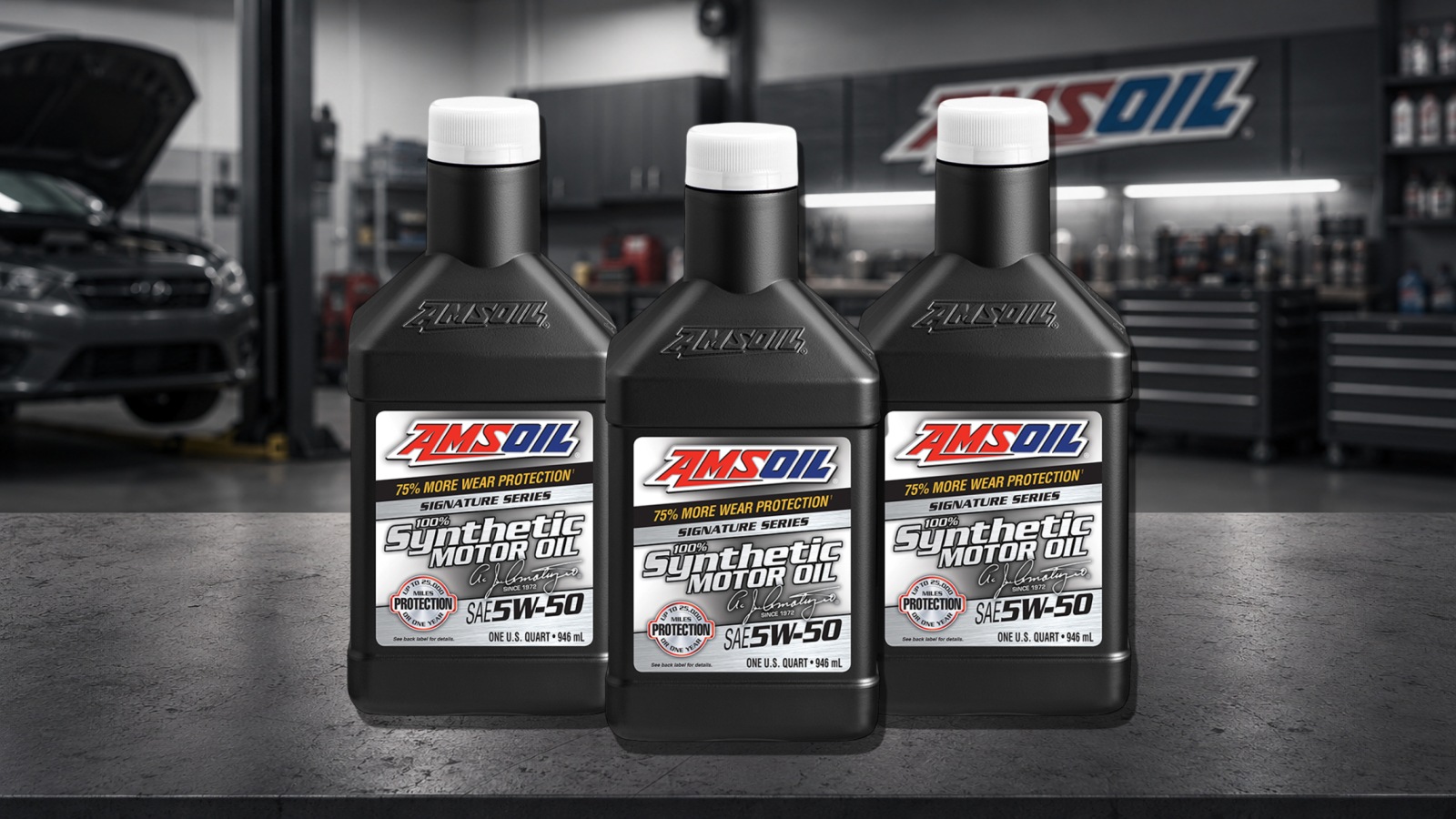
AMSOIL Signature Series 5W-50 Synthetic Motor Oil
AMSOIL Signature Series 5W-50 Synthetic Motor Oil is formulated for compatible high-performance applications requiring a 5W-50 engine oil.
Its synthetic formulation is designed to provide strong wear protection, resist viscosity loss and withstand the high temperatures encountered in demanding performance applications.
As with any engine oil, suitability should be determined using the requirements of the specific vehicle rather than viscosity alone.
How Do I Find the Correct Oil for My Mustang?
Mustang engine-oil requirements vary considerably across generations, engines and performance variants.
Rather than assuming every V8 Mustang uses the same oil, check the exact vehicle and engine. The required viscosity, Ford specification and oil capacity can all vary.
Use the AMSOIL Vehicle Finder to search by vehicle and engine, or refer to the vehicle owner's manual for Ford's original lubricant requirements.
Ford's use of 5W-50 in selected high-performance Mustang engines isn't simply a case of "more horsepower needs thicker oil". The viscosity forms part of the lubrication requirements Ford established for those engines. Use the correct viscosity and specification for the exact Mustang, and pay additional attention to oil condition and maintenance when the vehicle is modified or used on the track.
Want to understand what the numbers on an oil bottle actually mean? Read our Engine Oil Viscosity Guide, or explore API and other lubricant specifications in the Engine Oil Standards Guide.
Oil Information & Technical Guides
Explore our oil knowledge base with practical guides covering oil standards, viscosity, base-oil technology and application-specific specifications.