
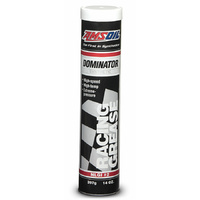
AMSOIL synthetic greases are engineered to provide outstanding wear protection, resist water washout and remain effective under heavy loads, high temperatures and demanding operating conditions. The range includes greases for automotive, commercial, industrial and equipment applications.
Browse the AMSOIL grease range below to find high-performance lubrication for bearings, chassis components, machinery and other grease-lubricated components.
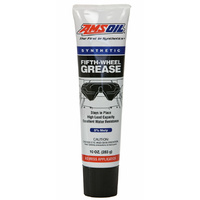
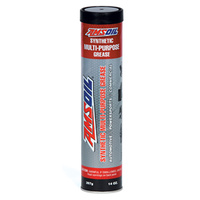
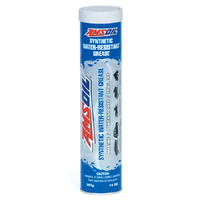
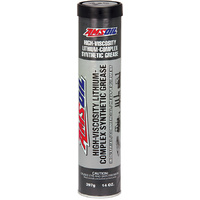
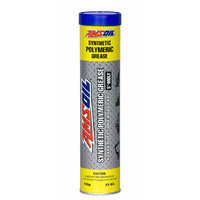
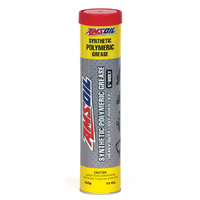
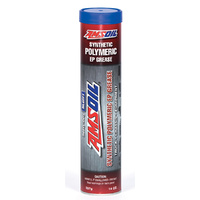
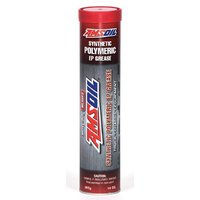
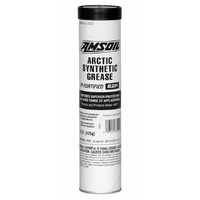
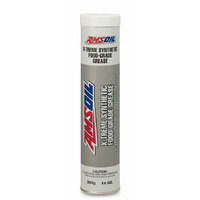
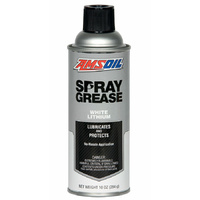
Grease selection can be confusing because customers often ask for an application rather than a specification: wheel-bearing grease, chassis grease, trailer grease, excavator grease, marine grease or simply a good general-purpose grease.
The correct choice depends on more than the colour of the grease or whether it is described as “heavy duty”. Important factors include the component being lubricated, operating temperature, load, speed, water exposure, grease consistency and compatibility with any grease already in the component.
| Application | Recommended Starting Point |
|---|---|
| Automotive wheel bearings and general chassis lubrication | AMSOIL Synthetic Multi-Purpose Grease (GLC) |
| Boat trailers, wet environments and frequent water exposure | AMSOIL Synthetic Water-Resistant Grease (GWR) |
| Racing wheel bearings and chassis components | AMSOIL DOMINATOR Synthetic Racing Grease (GRG) |
| Trucks, U-joints, kingpins, ball joints and chassis components | AMSOIL Polymeric Truck, Chassis & Equipment Grease (GPTR) |
| Construction, agricultural, mining and other off-road equipment | AMSOIL Polymeric Off-Road Grease (GPOR) |
| Fifth-wheel hitches and heavily loaded sliding applications | AMSOIL Polymeric Off-Road Grease (GPOR) |
| Severe industrial and slow, heavily loaded applications | AMSOIL High-Viscosity Lithium-Complex Grease (GVC) |
| Food-processing and pharmaceutical equipment | AMSOIL X-Treme Food-Grade Grease (GXC) |
| Hinges, latches, springs, cables and difficult-to-reach lubrication points | AMSOIL Spray Grease (GSP) |
This table is a general selection guide. Always consider the equipment manufacturer's grease specification, required NLGI grade, operating conditions and compatibility with any grease already in service.
There is no single AMSOIL product that is automatically the best wheel-bearing grease for every application. The operating environment determines which product makes the most sense.
For normal automotive wheel bearings and general chassis lubrication, AMSOIL Synthetic Multi-Purpose Grease (GLC) is the logical starting point. It is a versatile NLGI #2 grease suited to common automotive bearing and chassis applications.
Where wheel bearings are regularly exposed to water, such as on boat trailers or equipment operating in wet environments, AMSOIL Synthetic Water-Resistant Grease (GWR) is generally the more appropriate choice because water resistance becomes a major part of the lubrication requirement.
Competition vehicles can place much greater loads, temperatures and speeds on bearings and chassis components. AMSOIL DOMINATOR Synthetic Racing Grease (GRG) is intended for these higher-performance racing applications rather than as the default recommendation for an ordinary road vehicle.
Heavy trucks and commercial equipment may instead be better suited to AMSOIL Polymeric Truck, Chassis & Equipment Grease (GPTR), which is designed for heavily loaded components including wheel bearings, U-joints, steering components and chassis lubrication points.
NLGI grade describes the consistency of a grease. It should not be interpreted as a quality rating where a larger number means a better product.
NLGI #2 is the familiar consistency used in many general automotive, bearing and chassis applications. NLGI #1 is softer and more pumpable, which can be advantageous in colder conditions, centralised lubrication systems or equipment where the manufacturer specifies a softer grease.
AMSOIL offers both NLGI #1 and #2 versions of its Polymeric Truck, Chassis & Equipment Grease and Polymeric Off-Road Grease. Choose the grade required by the equipment and operating conditions rather than automatically selecting #2.
The thickener gives grease its semi-solid consistency, but the oil contained within the grease performs much of the actual lubrication. The viscosity of that base oil therefore plays an important role in determining whether a grease is appropriate for a fast-running bearing, a slow heavily loaded joint or severe industrial machinery.
A very heavy base oil can provide a strong lubricating film under high loads and relatively low speeds, but that does not make it automatically superior for every bearing application. Conversely, a grease designed for higher-speed bearings may use a lower-viscosity base oil to reduce drag and ensure appropriate lubricant flow.
This is one reason AMSOIL High-Viscosity Lithium-Complex Grease (GVC) should not simply be viewed as a premium replacement for every other grease. Its high-viscosity formulation is particularly suited to severe, heavily loaded industrial and off-road applications where strong film thickness is required.
Commercial vehicles and heavy equipment expose grease to high loads, vibration, shock loading, contamination and long operating periods. Components such as U-joints, kingpins, ball joints, steering linkages, pins and bushes can demand more from a grease than a typical passenger-vehicle bearing application.
AMSOIL Polymeric Truck, Chassis & Equipment Grease (GPTR) is intended for heavy-duty truck, fleet and equipment lubrication. It is available in both NLGI #1 and #2 grades to suit different operating requirements.
For more severe off-road environments, AMSOIL Polymeric Off-Road Grease (GPOR) is designed for applications such as construction, agricultural, mining and other equipment exposed to high loads, shock loading, dirt and demanding operating conditions.
Fifth-wheel hitches present a different lubrication problem from a rolling bearing. They rely heavily on sliding contact, high load-carrying capability and the ability of the grease to remain in place on exposed surfaces.
AMSOIL Polymeric Off-Road Grease (GPOR) is a suitable current choice for heavily loaded sliding applications such as fifth wheels. Existing AMSOIL Fifth-Wheel Grease (FWG) remains appropriate where still available, but it is a legacy product within the AMSOIL range.
Water contamination can displace grease, encourage corrosion and reduce lubrication performance. Boat trailers, marine equipment, agricultural machinery and equipment routinely cleaned with water can therefore benefit from a grease specifically designed to resist water washout.
AMSOIL Synthetic Water-Resistant Grease (GWR) is designed for applications where water exposure is a major consideration. It is particularly useful for boat-trailer wheel bearings and other equipment operating in wet or muddy environments.
Water resistance should still be considered alongside the required NLGI grade, load, speed and temperature rather than being treated as the only selection criterion.
Race vehicles can subject wheel bearings, hubs and chassis components to sustained heat, high rotational speeds and severe loads that differ considerably from ordinary road use.
AMSOIL DOMINATOR Synthetic Racing Grease (GRG) is formulated specifically for demanding racing and high-performance applications. It is also suitable for very low-temperature service and is the current AMSOIL alternative to the discontinued Arctic Grease where appropriate.
Food-processing and pharmaceutical machinery can require lubricants suitable for use where incidental food contact may occur. These applications should not be serviced with ordinary automotive or industrial grease simply because the mechanical component appears similar.
AMSOIL X-Treme Synthetic Food-Grade Grease (GXC) is designed for food-processing and other applications requiring an appropriate food-grade lubricant while still providing wear and water-resistance performance.
Some lubrication points do not require a conventional grease cartridge or grease gun. Hinges, latches, springs, garage-door components, cables and other difficult-to-access mechanisms can be more conveniently lubricated with an aerosol product.
AMSOIL Spray Grease (GSP) is designed to penetrate into hard-to-reach areas before leaving behind a grease film, making it useful for workshop, automotive and general maintenance applications.
Greases should not automatically be assumed to be compatible simply because they have the same NLGI grade or appear similar. Different thickener systems can interact when mixed, potentially changing grease consistency, oil separation, mechanical stability or temperature performance.
When changing from one grease type to another, check compatibility where possible. In critical equipment, purging the existing grease and replacing it with the new product is preferable to repeatedly topping up an unknown or potentially incompatible grease.
Grease colour is often used by manufacturers to identify products, but it does not provide a reliable indication of grease chemistry, quality or suitability. Two greases of the same colour can be designed for completely different applications, while two products designed for similar service can be entirely different colours.
Choose grease according to the application, NLGI grade, base-oil viscosity, thickener system, operating temperature, water exposure and load requirements rather than colour alone.
For most customers, the best starting point is the application. An ordinary automotive wheel bearing, a boat-trailer hub, an excavator pivot pin and a racing hub may all require grease, but they place very different demands on the lubricant.
If the equipment manufacturer specifies a particular grease classification, consistency grade or performance requirement, follow that specification first. Where the requirement is more general, use the application guide above to identify the AMSOIL grease best suited to the operating conditions.


Add your favourites to cart

Select Afterpay at checkout

Log into or create your Afterpay account, with instant approval decision

Your purchase will be split into 4 payments, payable every 2 weeks
All you need to apply is to have a debit or credit card, to be over 18 years of age, and to be a resident of country offering Afterpay
Late fees and additional eligibility criteria apply. The first payment may be due at the time of purchase
For complete terms visit afterpay.com/terms