

Oil viscosity grades can be surprisingly confusing. A 75W-90 gear oil sounds considerably thicker than a 10W-40 engine oil, while an ISO 100 industrial oil sounds thicker again. The problem is that these numbers belong to different viscosity classification systems, so they cannot be compared simply by looking at the number printed on the container.
An SAE 90 gear oil, for example, is not necessarily dramatically thicker than an SAE 40 or SAE 50 engine oil. SAE engine-oil and gear-oil viscosity grades use separate classification systems with different numbering, despite covering overlapping ranges of actual lubricant viscosity.
The AMSOIL Comparative Viscosity Chart provides an easy visual reference for comparing SAE engine oil, SAE gear oil, ISO and AGMA viscosity grades using common viscosity measurements.
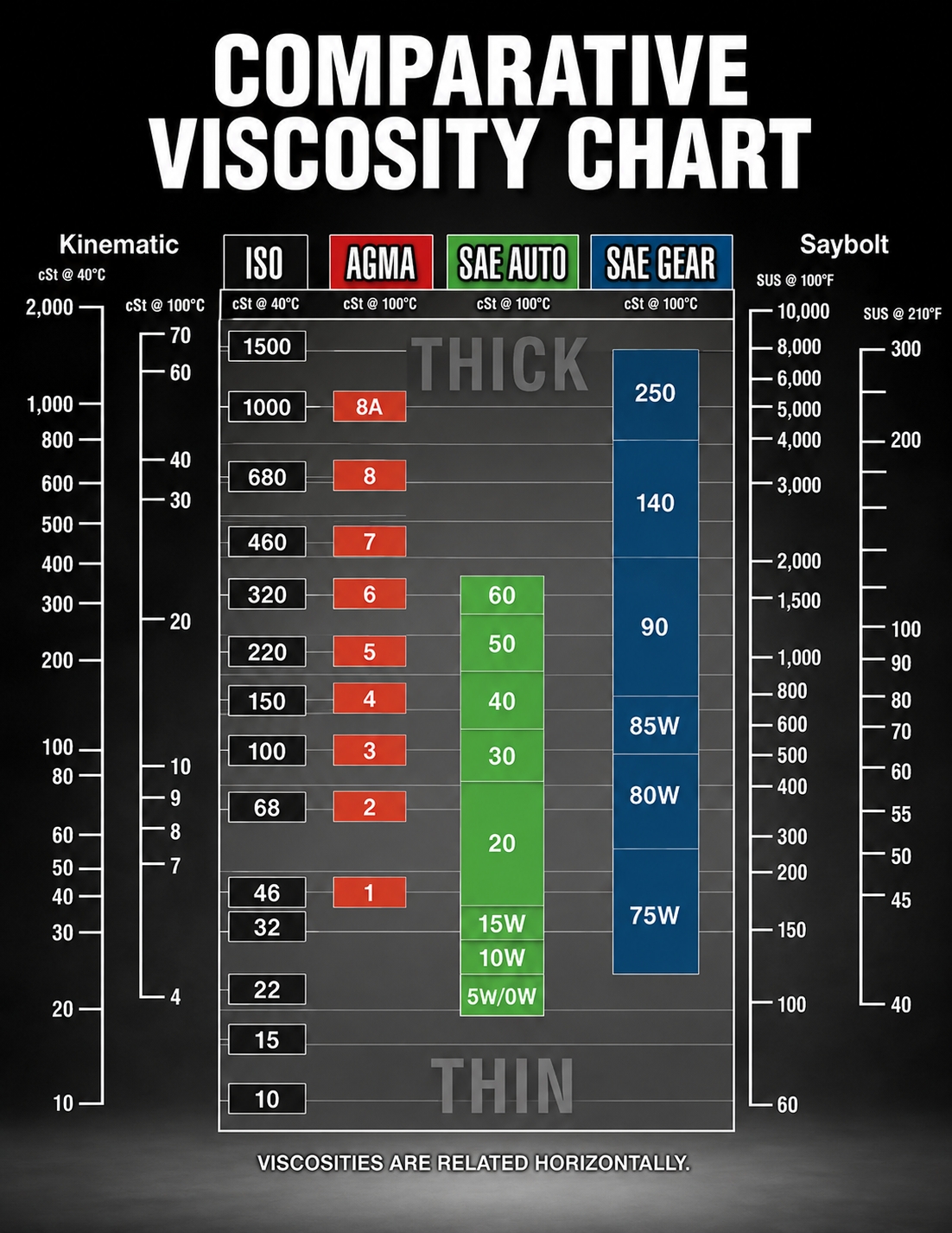
The numbers used by SAE, ISO and AGMA are not directly equivalent. To compare lubricant viscosity grades, find the grade you know on the chart and follow it horizontally across the different classification systems.
How to Read the Viscosity Comparison Chart
The chart places several different viscosity classification systems alongside actual viscosity measurements. This allows grades that may have completely different numbers to be compared according to their approximate physical viscosity.
For example, an SAE 60 engine oil occupies a similar viscosity region to an SAE 90 automotive gear oil, an AGMA 6 industrial gear lubricant and an ISO VG 320 industrial lubricant.
This illustrates why simply comparing the grade numbers can be misleading. SAE 90 does not mean that an oil is “50 points thicker” than SAE 40. The numbers are labels from different viscosity classification systems.
What Does Oil Viscosity Actually Mean?
Viscosity describes a fluid’s resistance to flow. In simple terms, a lower-viscosity fluid flows more readily, while a higher-viscosity fluid offers greater resistance to flowing.
We often describe this difference using everyday terms such as “thin” and “thick”, but lubricant viscosity is measured under controlled conditions so oils can be compared accurately.
One of the most common measurements is kinematic viscosity, normally expressed in centistokes (cSt). Lubricant technical data sheets commonly provide kinematic viscosity measurements at both 40°C and 100°C.
This makes the centistoke scale on the left side of the chart particularly useful. Unlike an SAE, ISO or AGMA grade name, cSt is an actual measurement of the lubricant’s viscosity at a specified temperature.
Understanding the Different Viscosity Systems
Engine oils use the SAE engine-oil viscosity classification system. Familiar multigrade examples include 0W-20, 5W-30, 10W-40 and 20W-50.
Automotive driveline lubricants use a separate SAE viscosity system. Common examples include 75W-90, 80W-90, 75W-110 and 75W-140.
Industrial lubricants commonly use ISO viscosity grades such as ISO VG 32, 46, 68, 100, 150, 220, 320 and 460.
AGMA viscosity grades are commonly encountered with industrial gear lubricants and can be cross-referenced against ISO viscosity grades.
SAE Engine Oil Viscosity
Engine oils such as 0W-20, 5W-30, 10W-40 and 20W-50 use the SAE engine-oil viscosity classification system. The viscosity grade describes how the lubricant behaves within defined temperature and viscosity limits; it does not, by itself, describe the quality of the oil or its additive package.
In a multigrade oil such as 5W-30, the two parts of the grade describe different viscosity requirements. The 5W relates to low-temperature performance, while the 30 identifies the oil’s high-temperature viscosity grade.
The “W” stands for winter. It does not mean “weight”, despite the term “oil weight” often being used conversationally.
A multigrade lubricant is therefore designed to provide suitable flow and pumping characteristics during cold starting while maintaining the required viscosity once the engine reaches operating temperature.
SAE Gear Oil Viscosity
Automotive gear and driveline lubricants use their own SAE viscosity classification. Common grades include 75W-90, 80W-90, 75W-110 and 75W-140.
Because automotive gear oils and engine oils use different numbering systems, their viscosity grade numbers cannot be directly compared.
A 75W-90 gear oil is not more than twice as thick as a 10W-40 engine oil simply because “90” is much larger than “40”. The two products use different SAE viscosity classification systems.
This separation is deliberate. Engine oils and automotive gear oils perform very different jobs and are formulated around different operating conditions, component designs and performance requirements.
ISO Viscosity Grades
Industrial lubricants frequently use an ISO Viscosity Grade, commonly abbreviated to ISO VG, rather than an SAE viscosity grade.
Common examples include ISO VG 32, 46, 68, 100, 150, 220, 320 and 460. These grades are widely encountered with hydraulic fluids, compressor oils, circulating oils and industrial gear lubricants.
This explains why a piece of industrial equipment may specify an oil such as ISO 46 or ISO 220 rather than a familiar automotive viscosity such as 10W-30 or 75W-90.
The comparative viscosity chart allows an ISO grade to be viewed alongside SAE and AGMA grades occupying broadly similar viscosity ranges.
AGMA Gear Oil Grades
The AGMA system is commonly encountered with industrial gearing and gear lubricants. Rather than using automotive-style viscosity grades, equipment literature may specify lubricants using AGMA grades such as AGMA 2, AGMA 4 or AGMA 6.
The chart aligns these grades with ISO viscosity grades and approximate SAE viscosity ranges, which can be particularly useful when interpreting older manuals or comparing lubricant recommendations written using different classification systems.
What is Saybolt Viscosity?
The scales on the far right of the AMSOIL chart show viscosity in Saybolt Universal Seconds (SUS).
Saybolt viscosity is an older method of expressing fluid viscosity and may still appear in older equipment manuals, engineering documentation and lubricant literature. Modern lubricant technical data more commonly expresses kinematic viscosity in centistokes.
The inclusion of both measurements makes the chart particularly useful when working with older machinery where the original lubricant recommendation may pre-date the widespread use of modern viscosity classifications.
Similar Viscosity Does Not Mean Equivalent Oil
An engine oil, automotive gear oil, hydraulic fluid and industrial gear lubricant may occupy similar viscosity ranges while containing completely different additive systems and meeting entirely different performance requirements.
Viscosity is only one characteristic of a lubricant. Anti-wear chemistry, extreme-pressure protection, detergency, oxidation resistance, friction characteristics, corrosion protection and compatibility with seals or friction materials may all be equally important to the application.
For example, two lubricants can have very similar measured viscosity while one is designed for an engine and the other is formulated for a hypoid differential. Their similar viscosity does not make them interchangeable.
Always choose a lubricant according to both the viscosity grade and the performance specification required by the equipment manufacturer.
Why Are There So Many Different Viscosity Scales?
Different viscosity systems developed around different industries and applications. Automotive engines, vehicle transmissions and differentials, hydraulic systems and industrial gearboxes all place different demands on their lubricants.
Rather than trying to memorise conversions between every viscosity system, the important concept is simply to recognise that the numbers used by different systems do not mean the same thing.
When comparing lubricants from different classification systems, compare their measured viscosity — particularly kinematic viscosity in centistokes — or use a comparative viscosity chart rather than comparing the grade numbers printed on their labels.
Choosing the Correct Lubricant
If you are selecting oil for a vehicle, start with the viscosity and lubricant specification recommended by the manufacturer. The correct viscosity is important, but specifications such as API, ILSAC, ACEA and manufacturer approvals provide additional information about the performance requirements an engine oil is expected to meet.
For a detailed explanation of these standards, visit our Engine Oil Standards Guide.
If you are looking for the correct AMSOIL product for a particular vehicle, you can also use the AMSOIL Vehicle Finder to search by make, model and engine.
Oil Information & Technical Guides
Explore our oil knowledge base with practical guides covering oil standards, viscosity, base-oil technology and application-specific specifications.