
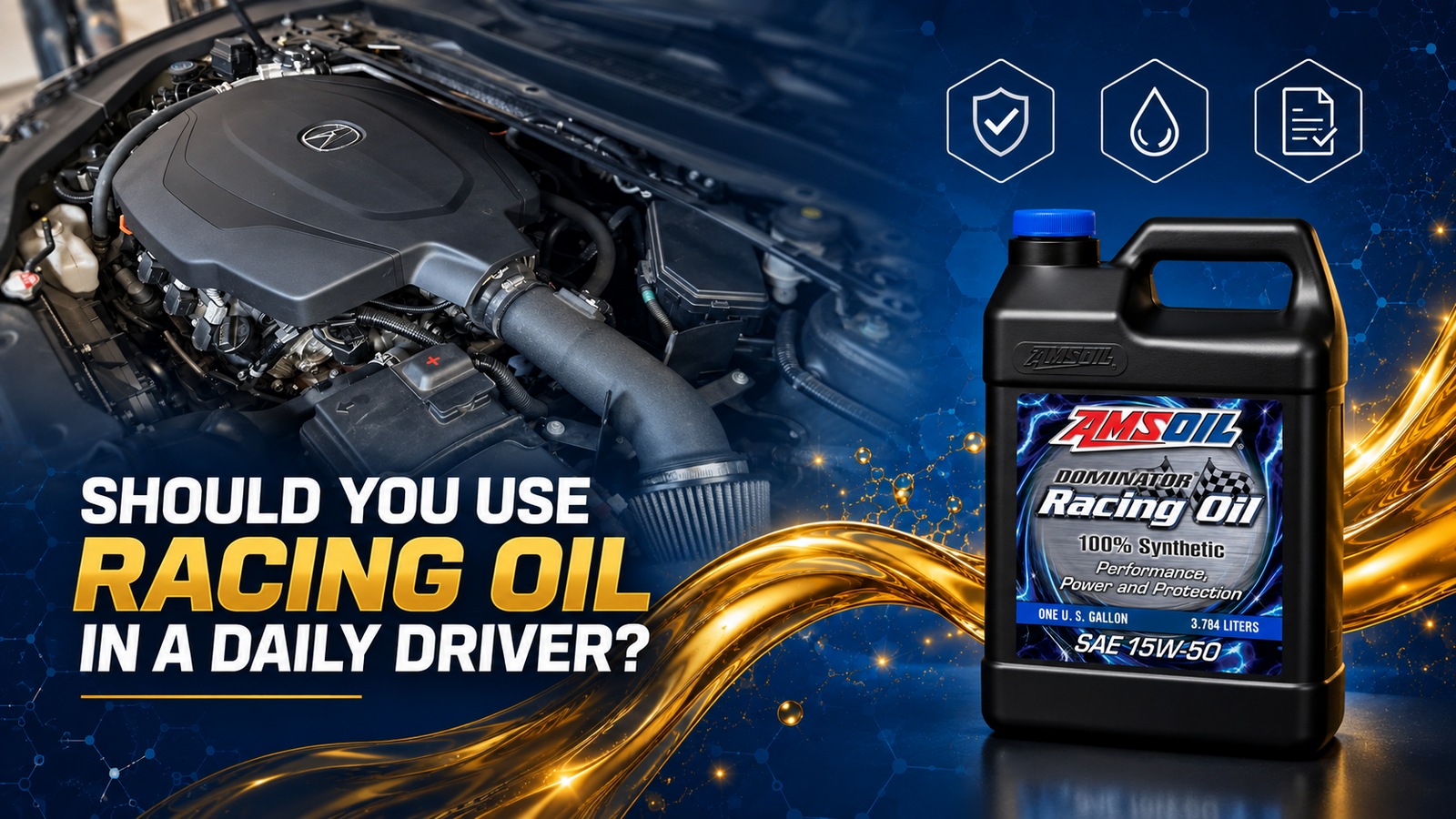
It sounds logical: racing engines operate under extreme conditions, racing engines use racing oil, so using racing oil in your daily driver should provide even better protection.
The problem is that racing engines and road-going engines have very different requirements. Racing oil is formulated around the demands of competition, while passenger-car engine oil must balance wear protection with engine cleanliness, fuel economy, emissions-system compatibility, cold-start performance and much longer service intervals.
Racing oil is not automatically a better engine oil for a road car. Unless your engine or application specifically calls for a racing lubricant, use an oil with the viscosity and specifications required by the vehicle manufacturer.
Why Racing Engines Need Different Oil
Competition engines can expose lubricant to operating conditions far beyond those experienced in normal road use. High engine speeds, increased cylinder pressures, extreme temperatures and heavily loaded valvetrain components can place enormous demands on the oil film separating moving components.
Modified engines may also use components and clearances very different from those found in production engines. Increased power output, aggressive camshaft profiles, higher valve-spring pressures and sustained high-rpm operation can all change what is required from the lubricant.
Racing oils are therefore formulated specifically to provide protection and performance in these extreme environments.
Modern Road Engines Are Demanding Too
A modern passenger-car engine may not spend its life at a racetrack, but that does not mean it is easy on engine oil. Turbocharging, direct fuel injection, emissions-control systems, smaller sump capacities and high specific power outputs have created their own lubrication challenges.
Unlike a competition engine, however, a road engine must operate reliably through cold starts, short trips, extended idling, highway driving and thousands of kilometres between services.
Modern engine-oil specifications have evolved around these requirements, which is why selecting oil by specification is just as important as choosing the correct viscosity.
Racing Oil and Street Oil Have Different Priorities
Every engine oil is a carefully balanced formulation of base oils and additives. These additives can include detergents, dispersants, anti-wear agents, antioxidants, corrosion inhibitors, friction modifiers and other components designed to achieve particular performance characteristics.
A road-going engine oil must perform well across a very broad range of conditions. It needs to protect against wear while controlling deposits and sludge, resisting oxidation, providing reliable cold-start lubrication and remaining suitable for a comparatively long service interval.
A dedicated racing lubricant can be optimised around a narrower set of priorities. Maximum protection under extreme load, high temperature and high engine speed may be considerably more important than fuel economy or extended service life.
A racing oil does not need to be "better" at everything. It needs to be exceptionally good at the things that matter in a racing engine. A road-going oil is designed around a different set of requirements.
Racing Oils Are Often Changed More Frequently
Competition engines are commonly serviced far more frequently than normal road vehicles. Depending on the type of motorsport, oil may be changed after an event, after several events or according to engine hours and oil-analysis results.
That changes the way a lubricant can be formulated. A road-going engine oil may be expected to control contaminants, neutralise combustion by-products and maintain cleanliness over many months and thousands of kilometres. A dedicated racing lubricant may never be required to remain in service for anything approaching that length of time.
For this reason, the fact that an oil performs exceptionally well during competition does not automatically mean it is the ideal lubricant for an extended road-car service interval.
What About Zinc and ZDDP?
Racing oils are often associated with high levels of zinc and phosphorus anti-wear chemistry, commonly referred to as ZDDP. These additives can provide valuable protection in highly loaded areas such as the interface between a flat-tappet camshaft and lifter.
That does not mean that more zinc automatically makes an oil better for every engine. Modern engine oils are formulated as complete additive systems, and current specifications balance wear protection against other requirements including emissions-system compatibility.
Older, modified and competition engines may benefit from lubricants formulated with higher levels of anti-wear additives, particularly where valvetrain design and spring pressures demand them. A modern road engine designed around a current API, ILSAC, ACEA or manufacturer specification should normally use an oil meeting that specification.
For a more detailed explanation, see our guide to high-zinc engine oil and ZDDP.
Racing Oil May Not Meet Your Vehicle's Required Specification
This is one of the most important differences between selecting oil for a competition engine and selecting oil for a modern road vehicle.
Vehicle manufacturers may require an API, ILSAC or ACEA specification, or their own manufacturer-specific lubricant standard. These specifications can include tests covering wear, deposits, oxidation, fuel economy, low-speed pre-ignition, timing-chain wear and compatibility with emissions-control systems.
A purpose-built racing oil may not be designed or certified to meet those requirements. That does not indicate poor oil quality; it simply means the lubricant has been designed for a different application.
Do not assume that a racing oil is suitable for your road vehicle simply because its viscosity matches. Check the lubricant specifications required by the vehicle manufacturer, particularly for modern engines and vehicles fitted with emissions-control equipment.
Can Racing Oil Affect Catalytic Converters?
Some racing and high-zinc oils use additive levels that are not constrained in the same way as oils designed around current passenger-car specifications. Phosphorus from engine oil can contribute to catalytic-converter degradation when oil is consumed and its combustion products pass through the exhaust system.
This is one reason modern passenger-car oil specifications carefully balance anti-wear chemistry with emissions-system durability. In a competition vehicle without road-going emissions requirements, those priorities can be different.
What About Modified Street Cars?
The distinction becomes less clear when a road car is heavily modified or regularly used in competition. Increased boost, higher power output, altered engine clearances, aftermarket camshafts, increased valve-spring pressures and sustained track use can move the engine's lubrication requirements away from those of the original production vehicle.
In these cases, oil selection should be based on the engine build and how the vehicle is used rather than simply following the original factory recommendation or automatically switching to racing oil.
A vehicle that drives to work during the week and competes on weekends may need a lubricant capable of balancing both environments. For extensively modified engines, recommendations from the engine builder and information from used-oil analysis can be particularly valuable.
AMSOIL DOMINATOR Synthetic Racing Oil
AMSOIL DOMINATOR Synthetic Racing Oil is specifically formulated for high-performance and racing engines. It is designed to provide strong protection against wear under extreme loads and temperatures while helping maximise engine performance in competition applications.
That specialised formulation is precisely why DOMINATOR should be selected for the application it was designed to protect rather than treated as an automatic upgrade from a passenger-car engine oil.
For an unmodified daily-driven vehicle, an AMSOIL passenger-car engine oil meeting the appropriate viscosity and performance specification will generally be the more suitable choice.
So, Should You Use Racing Oil in Your Daily Driver?
For most standard road vehicles, no. A dedicated racing oil solves problems created by racing conditions, while a passenger-car engine oil is formulated around the much broader requirements of everyday road use.
If your vehicle is heavily modified, uses an older engine design with particular anti-wear requirements or regularly sees competition use, a racing or specialised high-performance lubricant may be appropriate. The decision should be based on the engine and its operating conditions rather than the assumption that racing oil must be superior because racing is more demanding.
Use the right tool for the job. Racing oil is designed for racing engines. For a daily-driven road vehicle, start with the manufacturer's required viscosity and lubricant specification, then choose the highest-quality oil that meets those requirements.
Not sure what API, ILSAC, ACEA or manufacturer specifications mean? Visit our Engine Oil Standards Guide, or use the AMSOIL Vehicle Finder to find suitable lubricants for your vehicle.
Oil Information & Technical Guides
Explore our oil knowledge base with practical guides covering oil standards, viscosity, base-oil technology and application-specific specifications.