
Choosing engine oil for a diesel vehicle isn't as simple as finding a bottle labelled "diesel oil". Modern diesel engines can have very different lubricant requirements depending on their design, emissions equipment and manufacturer specifications.
A heavy-duty diesel engine in a truck may require an oil meeting specifications such as API CK-4, while a modern diesel car, ute or SUV equipped with a diesel particulate filter (DPF) may require a completely different type of lubricant.
Understanding that distinction is important. The wrong engine oil may have the right viscosity and still be unsuitable for the engine or its emissions system.
An engine oil designed for a heavy-duty commercial diesel is not automatically suitable for a modern light-duty diesel. Always match the required viscosity, industry specification and manufacturer specification for the particular engine.
Light-Duty vs Heavy-Duty Diesel Engines
Diesel engines are used in everything from small passenger cars and SUVs to utes, vans, four-wheel drives, agricultural equipment and heavy commercial vehicles.
Although they share the same basic combustion principle, their lubricant requirements can be quite different.
Heavy-duty diesel engine oils are commonly formulated around specifications developed for commercial diesel engines operating under sustained loads and long service periods. API specifications such as CK-4 are common examples.
Many modern light-duty diesel engines, however, use sophisticated emissions systems and may require oils meeting specific ACEA or vehicle-manufacturer requirements.
Why Modern Diesel Engines Can Need Different Oil
Modern diesel engines produce impressive torque and efficiency from relatively small capacities. Turbocharging, common-rail injection, exhaust-gas recirculation and sophisticated engine management have helped make that possible.
At the same time, emissions-control systems have become increasingly complex. Depending on the vehicle, the exhaust system may include a diesel oxidation catalyst, diesel particulate filter, selective catalytic reduction system and other emissions-control components.
Engine oil therefore has to protect the engine itself while also being compatible with the vehicle's emissions system.
What Is a Diesel Particulate Filter?
A diesel particulate filter (DPF) captures particulate matter from the exhaust rather than allowing it to be emitted directly into the atmosphere.
As soot accumulates, the vehicle periodically performs a process known as regeneration, during which exhaust temperature is increased to burn much of the trapped soot.
However, not everything entering a DPF can be burned away. Certain non-combustible materials derived from engine-oil additives can contribute to ash accumulation within the filter over time.
For this reason, many DPF-equipped diesel engines specify oils formulated with controlled levels of sulphated ash, phosphorus and sulphur.
What Does Low-SAPS Engine Oil Mean?
SAPS refers to sulphated ash, phosphorus and sulphur. These are associated with components of the engine-oil additive system.
Lubricant formulators use additives containing these elements for important functions including wear protection, oxidation control, detergency and corrosion protection. The challenge is balancing engine protection with the requirements of modern exhaust after-treatment systems.
Low- and mid-SAPS oils use carefully controlled additive chemistry to meet the requirements of compatible engines and emissions systems.
A low-SAPS oil isn't automatically correct for every DPF-equipped diesel. The oil must still meet the viscosity and performance specifications required by the vehicle manufacturer.
Understanding ACEA Diesel Oil Specifications
ACEA engine-oil sequences are particularly important for many European-designed diesel engines and other vehicles whose manufacturers specify European lubricant standards.
The ACEA C categories cover catalyst-compatible oils intended for vehicles with exhaust after-treatment systems, but the individual categories are not interchangeable simply because they all begin with the letter C.
Different ACEA categories can have different requirements for viscosity characteristics, emissions-system compatibility and engine protection.
If the manufacturer specifies a particular ACEA classification, use an engine oil suitable for that requirement rather than simply selecting any oil described as suitable for diesel engines.
For more information about ACEA, API and other engine-oil classifications, see our Engine Oil Standards Guide.
Manufacturer Specifications Matter Too
Industry standards are only part of the picture. Vehicle manufacturers frequently publish their own engine-oil specifications based on the requirements of particular engines, service intervals and emissions systems.
Depending on the vehicle, you may encounter specifications from manufacturers such as Ford, General Motors, Mercedes-Benz, BMW, Volkswagen and others.
These specifications can impose requirements beyond a general API or ACEA classification.
Two bottles can both say 5W-30 and be designed for completely different engines. Viscosity describes important flow characteristics of the lubricant; it does not tell you every performance specification the oil meets.
Why Can't I Just Use Heavy-Duty Diesel Oil?
Heavy-duty diesel oils are excellent lubricants when used in applications for which they are designed. The problem isn't their quality — it's application compatibility.
An oil formulated primarily for engines requiring a heavy-duty specification such as API CK-4 may not meet the emissions-system, chemical-limit or manufacturer-specific requirements of a particular light-duty diesel engine.
Likewise, an engine oil formulated for a modern light-duty diesel isn't automatically suitable for a heavy commercial engine requiring CK-4.
The correct question isn't "Which diesel oil is better?" It is "Which oil meets the requirements of this engine?"
DPF Regeneration Can Affect Engine Oil
The DPF doesn't just influence which oil formulation an engine requires. Regeneration strategies can also affect the lubricant while it is in service.
Some engines use additional fuel injection to raise exhaust temperature during active regeneration. Under certain operating conditions, a portion of this fuel can reach the crankcase and dilute the engine oil.
Fuel dilution can reduce oil viscosity and alter lubricant performance. Vehicles that repeatedly make short trips or frequently interrupt regeneration cycles can be particularly challenging applications.
A rising engine-oil level or a strong fuel smell in the lubricant can indicate fuel dilution and should be investigated rather than ignored.
Turbochargers Place Additional Demands on Oil
Turbochargers are common in modern diesel engines and can operate at extremely high rotational speeds and temperatures.
Engine oil may be responsible for lubricating and cooling the turbocharger bearings as well as protecting the rest of the engine. High temperatures can accelerate oil oxidation and contribute to deposit formation if the lubricant isn't suitable for the application or is left in service too long.
A high-quality synthetic engine oil can provide strong resistance to oxidation and viscosity breakdown under demanding operating conditions, but it must still meet the specifications required by the engine manufacturer.
What About Diesel Utes and 4WDs?
Australia's diesel vehicle fleet includes a huge number of turbo-diesel utes, four-wheel drives and SUVs. These vehicles can experience demanding service when towing, touring, driving off-road or operating in hot conditions.
However, being used for heavy work doesn't automatically mean the vehicle should use a heavy-duty truck oil.
A modern diesel ute with a DPF may still require a specific low- or mid-SAPS oil regardless of how hard the vehicle works. The manufacturer's required specification remains the starting point.
Choosing the Correct Viscosity
Modern diesel engines can specify viscosities ranging from very low-viscosity oils such as 0W-20 through to 5W-30, 5W-40 and other grades depending on engine design and application.
Do not assume a thicker oil provides better protection simply because the vehicle is a diesel or is used for towing.
Engine bearings, oil pumps, variable valve systems, turbochargers and other components are designed around particular lubricant characteristics. Use a different viscosity only where the vehicle manufacturer permits it or where there is a sound technical basis for doing so.
AMSOIL Synthetic Diesel Engine Oils
AMSOIL offers several engine-oil families for diesel applications because different diesel engines require different lubricant technologies.
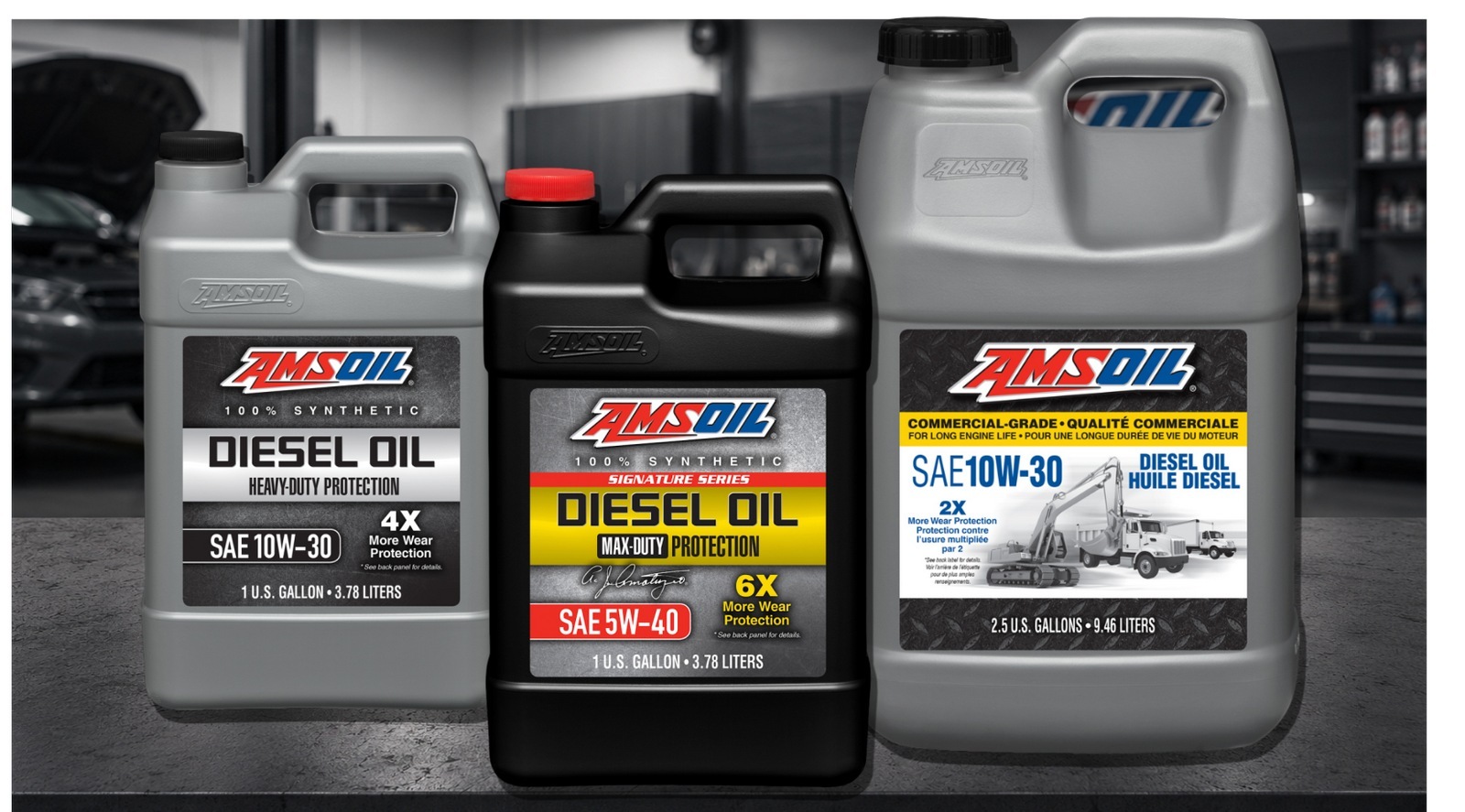
AMSOIL Signature Series Max-Duty and Heavy-Duty Synthetic Diesel Oils are designed for compatible heavy-duty diesel applications, while other AMSOIL formulations cover modern light-duty diesel engines requiring different specifications.
This includes AMSOIL 100% Synthetic Diesel Oil in selected viscosities for compatible light-duty diesel applications, along with AMSOIL European Motor Oils for vehicles requiring applicable European and manufacturer specifications.
Browse our AMSOIL Diesel Engine Oils or use the Vehicle Finder to identify suitable products for a particular vehicle.
How Do I Find the Right Diesel Engine Oil?
Start with the vehicle manufacturer's requirements rather than the word "diesel" on the bottle.
- Check the required SAE viscosity — for example, 0W-20, 5W-30 or 5W-40.
- Check the required industry specification — such as API or ACEA.
- Check for a manufacturer specification — this may be more specific than the general industry classification.
- Consider the emissions system — particularly whether the vehicle uses a DPF.
- Follow the appropriate service interval — including severe-service requirements where applicable.
There is no single "best diesel oil" for every diesel engine. Heavy-duty trucks, modern diesel utes, European diesel cars and DPF-equipped SUVs can require very different lubricants. Match the oil to the engine's viscosity, industry standards and manufacturer specifications rather than choosing an oil simply because it says diesel on the label.
Not sure which oil your vehicle requires? Use the AMSOIL Vehicle Finder to search by make, model and engine, or learn more about lubricant specifications in our Engine Oil Standards Guide.
Oil Information & Technical Guides
Explore our oil knowledge base with practical guides covering oil standards, viscosity, base-oil technology and application-specific specifications.