
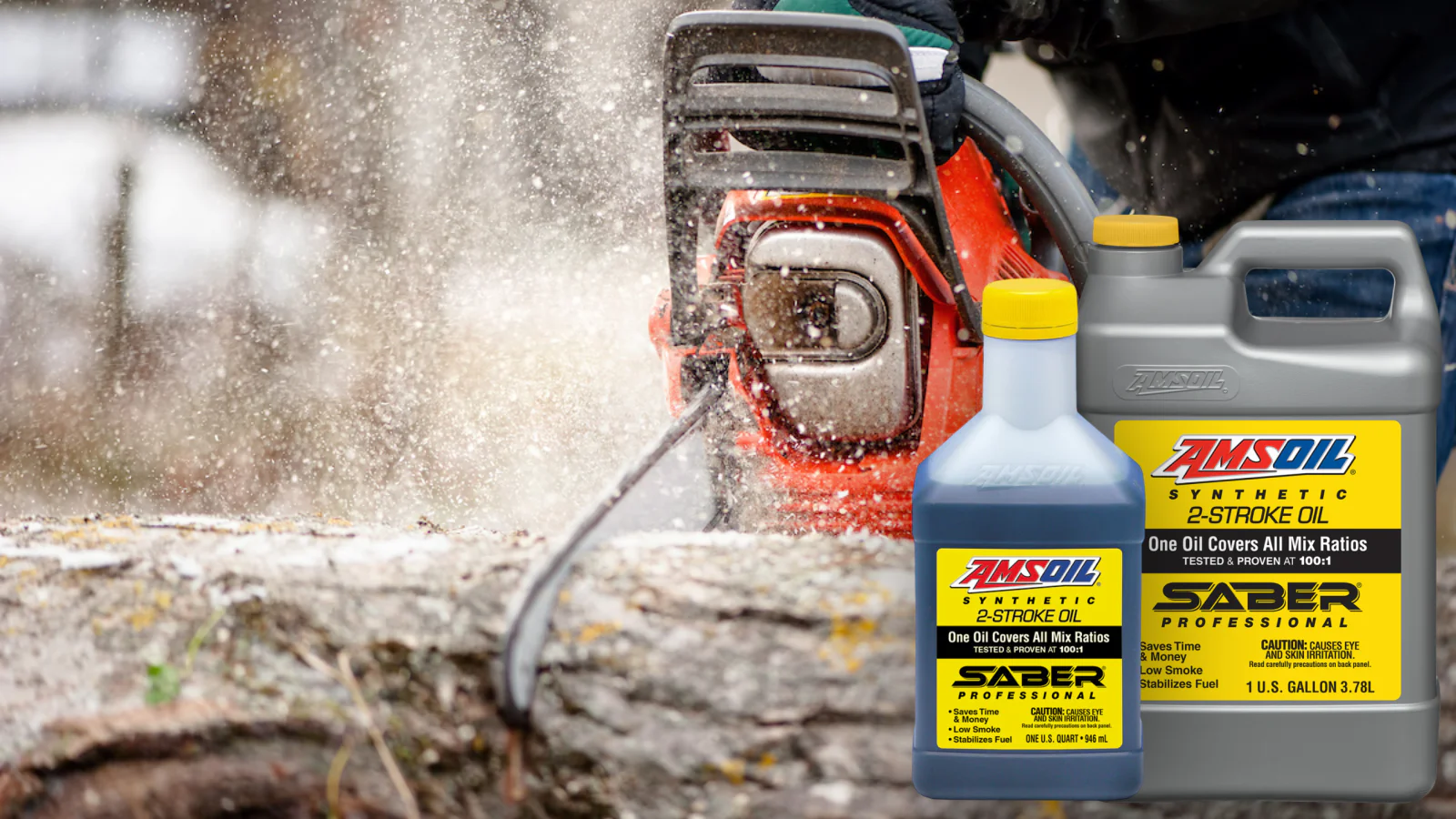
Two-stroke mix ratios have traditionally been treated as a hard rule. If a chainsaw specifies 50:1, you mix it at 50:1. Older equipment may call for 40:1, 32:1 or even richer mixtures. So the claim that AMSOIL SABER Professional 100% Synthetic 2-Stroke Oil can be mixed at ratios up to 100:1 understandably raises a question: how can an engine designed around a richer oil mixture operate with less oil?
The answer is that a two-stroke engine does not simply need a particular quantity of oil. It needs an oil capable of maintaining an effective lubricating film, controlling wear and deposits and burning cleanly under the conditions inside the engine. SABER Professional is specifically formulated for this type of lean-ratio premix use.
What Is AMSOIL SABER Professional?
AMSOIL SABER Professional is a 100% synthetic two-stroke oil designed primarily for premix handheld equipment such as chainsaws, brushcutters, string trimmers, blowers and similar small two-stroke engines.
It is designed for applications requiring API TC, JASO FD or ISO-L-EGD performance and is suitable for many applications from manufacturers including STIHL, Husqvarna, ECHO and Shindaiwa.
Importantly, SABER Professional is a premix oil. It should not be confused with two-stroke oils designed for oil-injection systems or specialised applications such as high-performance racing engines or water-cooled marine engines.
What Does a 100:1 Mix Ratio Actually Mean?
A 100:1 fuel-to-oil ratio means one part two-stroke oil for every 100 parts petrol. Conveniently, this is particularly easy to calculate using metric measurements:
| Petrol | SABER at 100:1 |
|---|---|
| 1 litre | 10 mL |
| 5 litres | 50 mL |
| 10 litres | 100 mL |
| 20 litres | 200 mL |
AMSOIL recommends 100:1 for SABER Professional and has tested the oil for use at ratios up to 100:1. It can also be mixed at a richer ratio if desired.
But My Chainsaw Says 50:1
This is where the 100:1 recommendation can initially seem counter-intuitive. A manufacturer's specified mix ratio is based on providing the engine with adequate lubrication using an appropriate two-stroke oil. It should not be interpreted as a general rule that every two-stroke oil can safely be used at a leaner ratio.
In other words, do not take an ordinary two-stroke oil labelled for 50:1 and simply use half as much of it.
SABER Professional is different because AMSOIL specifically formulates and recommends the product for premix ratios up to 100:1. The leaner ratio is a capability of the oil, not a new universal mixing rule for two-stroke engines.
Does Less Oil Mean Less Protection?
Not necessarily. Looking only at the amount of oil in the fuel ignores the performance of the lubricant itself.
A two-stroke oil has to form and maintain a lubricating film on heavily loaded engine components while being carried through the engine with the fuel. It also needs to control deposits and burn cleanly enough that combustion by-products do not interfere with piston rings, spark plugs, exhaust ports or spark-arrestor screens.
AMSOIL formulated SABER Professional with high lubricity and wear protection specifically for lean premix ratios. Its 100:1 recommendation is therefore based on the performance of the finished lubricant rather than simply reducing the quantity of a conventional two-stroke oil.
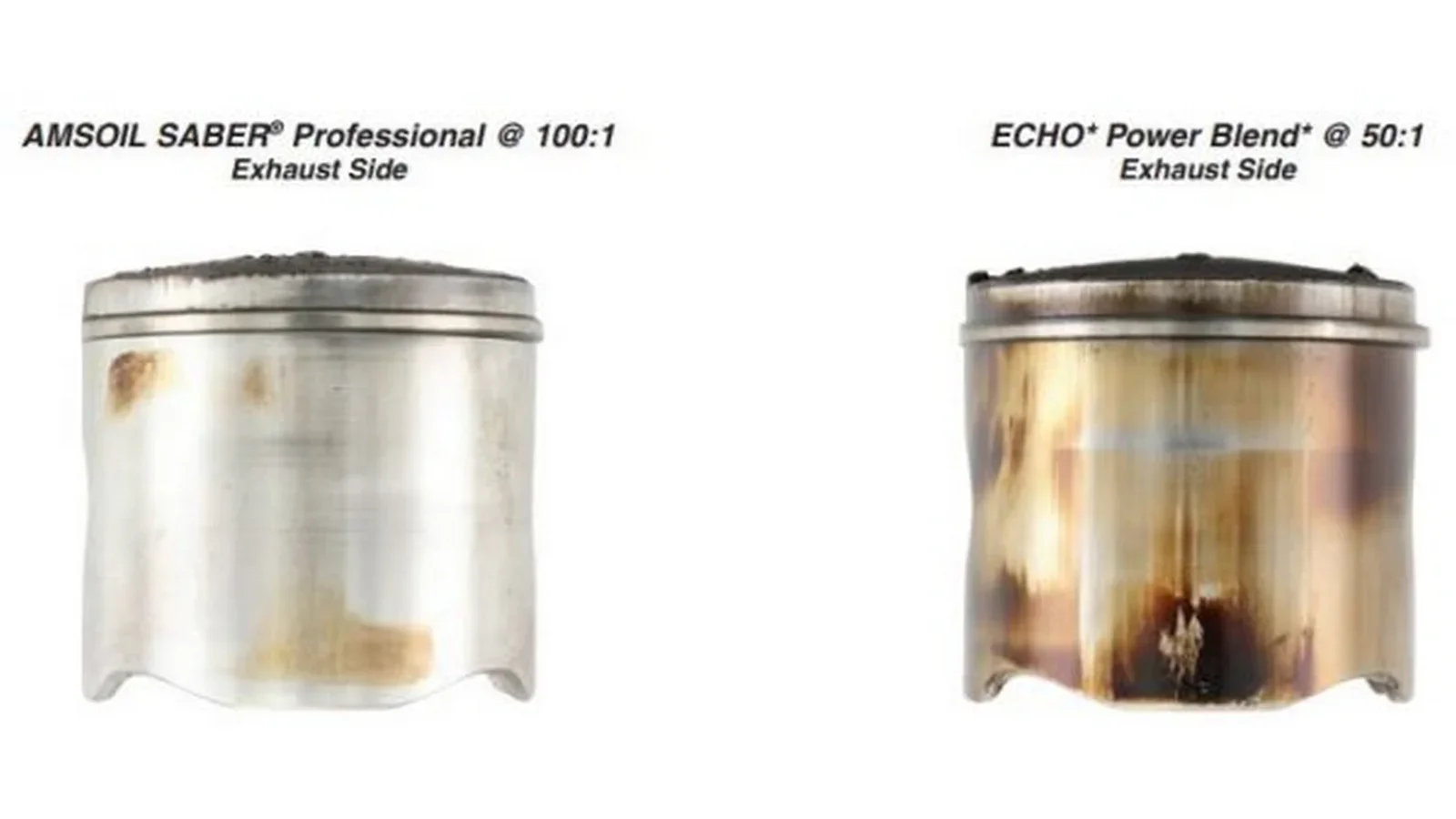
Piston condition and carbon-deposit comparison from AMSOIL SABER Professional testing. Results shown are from AMSOIL testing and may vary by equipment and operating conditions.
More Two-Stroke Oil Is Not Automatically Better
It is tempting to assume that if some oil is good, more oil must provide more protection. Two-stroke lubrication is not quite that simple.
The oil entering the engine ultimately has to go somewhere. Poor combustion or excessive oil can contribute to smoke and deposits on spark plugs, piston rings, exhaust ports and spark-arrestor screens. As deposits accumulate they can interfere with combustion, restrict exhaust flow and contribute to difficult starting or reduced engine performance.
The objective is therefore not to feed the engine the greatest possible quantity of oil. It is to provide enough effective lubrication while keeping the engine as clean as possible.
Why Carbon Deposits Matter
Carbon is particularly important in a small two-stroke engine because the lubricating oil is consumed during operation. Deposits can accumulate around piston rings and exhaust ports, while equipment fitted with a spark-arrestor screen can gradually restrict its own exhaust flow as the screen becomes contaminated.
AMSOIL has conducted comparative testing of SABER Professional at 100:1 against conventional richer-ratio two-stroke lubrication. In published spark-arrestor testing, AMSOIL reports that equipment operated with SABER Professional remained 96 percent carbon-free.
That figure should be understood as the result of AMSOIL's specific test rather than a claim that every engine will remain 96 percent carbon-free. What the test demonstrates is the design objective behind SABER: provide the required lubrication while minimising the deposits produced as the oil passes through the combustion process.
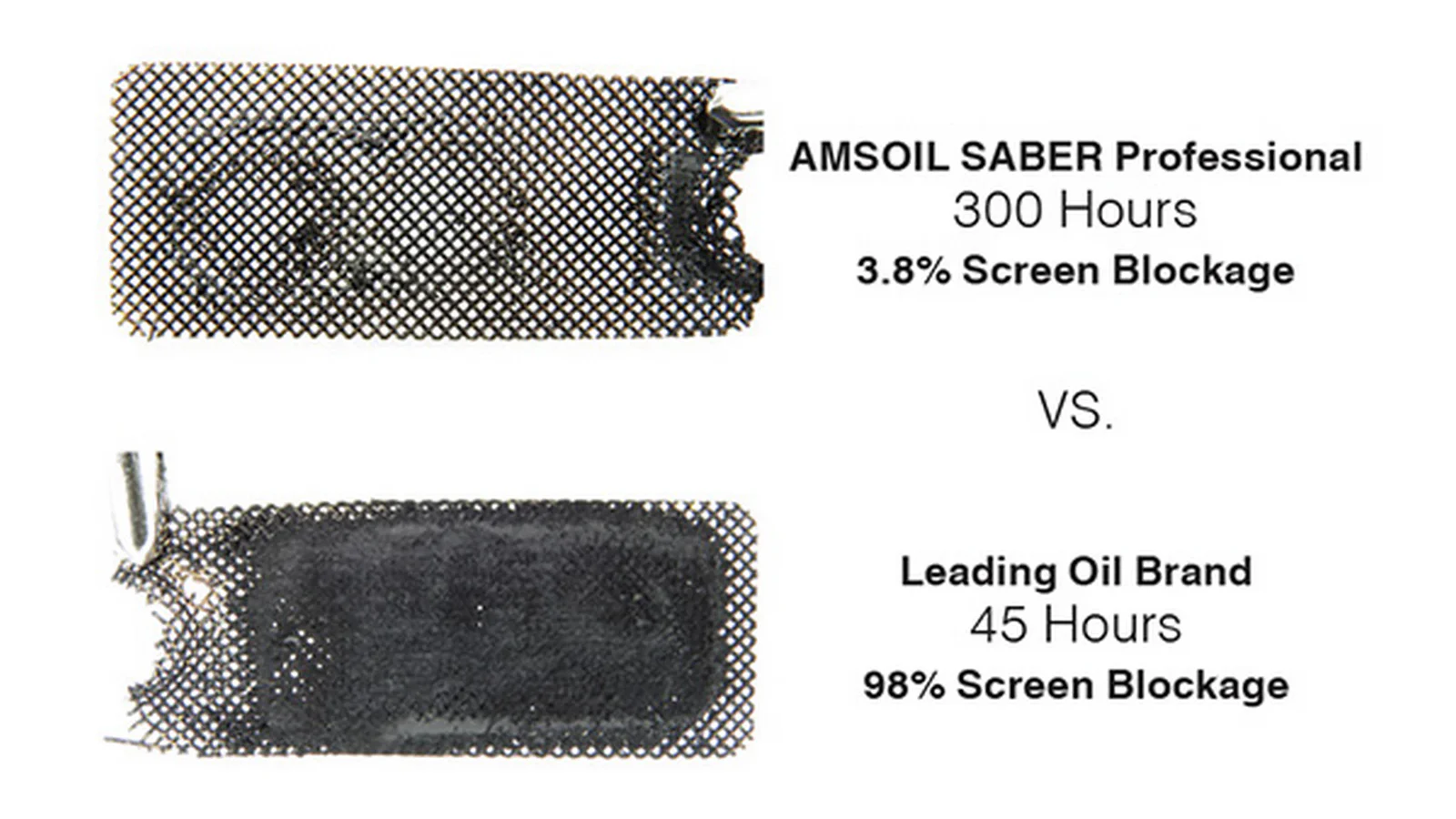
Spark-arrestor screen comparison from AMSOIL testing of SABER Professional. Results shown are from AMSOIL testing and may vary by equipment and operating conditions.
One Mix for Different Two-Stroke Equipment
The 100:1 capability also solves a surprisingly common shed problem.
A household or workshop might have a chainsaw specifying 50:1, an older brushcutter calling for 40:1 and another piece of equipment with a different recommendation again. Traditionally this can mean keeping separate fuel containers or repeatedly calculating different mixtures.
AMSOIL's recommendation for SABER Professional allows compatible premix equipment to use the same SABER mixture at 100:1, even where the original equipment specifies a richer conventional-oil ratio.
What About Equipment Warranties?
One obvious concern is whether using SABER Professional at 100:1 in equipment that specifies 50:1 affects the manufacturer's warranty.
AMSOIL states that using SABER Professional at 100:1 where the equipment manufacturer recommends 50:1 does not void the manufacturer's warranty. As with any lubricant application, the correct product still needs to be selected for the type of engine and lubrication system involved.
Fuel Storage Matters Too
Small-engine fuel often spends much longer sitting in a container or fuel tank than petrol in a road vehicle. A chainsaw or blower may be used intensively for a few days and then sit unused for weeks or months.
SABER Professional includes fuel-stabilising properties designed to help resist fuel deterioration during storage. This complements its deposit-control characteristics, particularly in equipment where difficult starting after storage can otherwise become a recurring problem.
Where Shouldn't SABER Professional Be Used?
SABER Professional should not be treated as AMSOIL's universal two-stroke oil. AMSOIL produces several two-stroke lubricants for different operating environments.
- SABER Professional - premix handheld and small-engine applications, with ratios up to 100:1.
- INTERCEPTOR - injector or premix applications and AMSOIL's preferred choice for engines equipped with power valves.
- DOMINATOR - modified engines and competition applications.
- HP Marine - two-stroke marine applications requiring the appropriate water-cooled marine lubricant.
The important distinction is application. SABER's 100:1 capability is designed around the operating requirements of suitable premix two-stroke equipment; it is not a reason to substitute SABER into every two-stroke engine regardless of its lubrication system or specification.
The Bottom Line
The unusual thing about AMSOIL SABER Professional is not simply that it uses less oil. It is that the lubricant has been specifically formulated to provide wear protection and cleanliness at lean premix ratios.
For suitable equipment, a 100:1 mixture means just 10 mL of SABER per litre of petrol. It can simplify fuel mixing across multiple pieces of equipment, reduce the amount of two-stroke oil consumed and help control the deposits that can cause spark-plug fouling, ring sticking and restricted exhaust flow.
The important point is also the easiest one to remember: 100:1 is not a universal two-stroke mixing rule. It is a capability of AMSOIL SABER Professional.
Small Engine Guides
Practical information for maintaining lawn mowers, generators and other small-engine equipment, from choosing the correct oil to solving common fuel and starting problems.