What happens when a brand-new 1,000 horsepower supercharged crate engine arrives at a lubricant company's mechanical laboratory and needs to be running on an engine dyno within a matter of days?
In the case of Mopar's extraordinary Hellephant engine, the answer involved custom fabrication, improvised hardware, electrical troubleshooting, a failed starter, long nights and a team of AMSOIL technicians determined to make it work.
The project provides an unusual look behind the scenes at the AMSOIL Mechanical Lab — and at the work required before an engine can become a useful platform for lubricant development and testing.
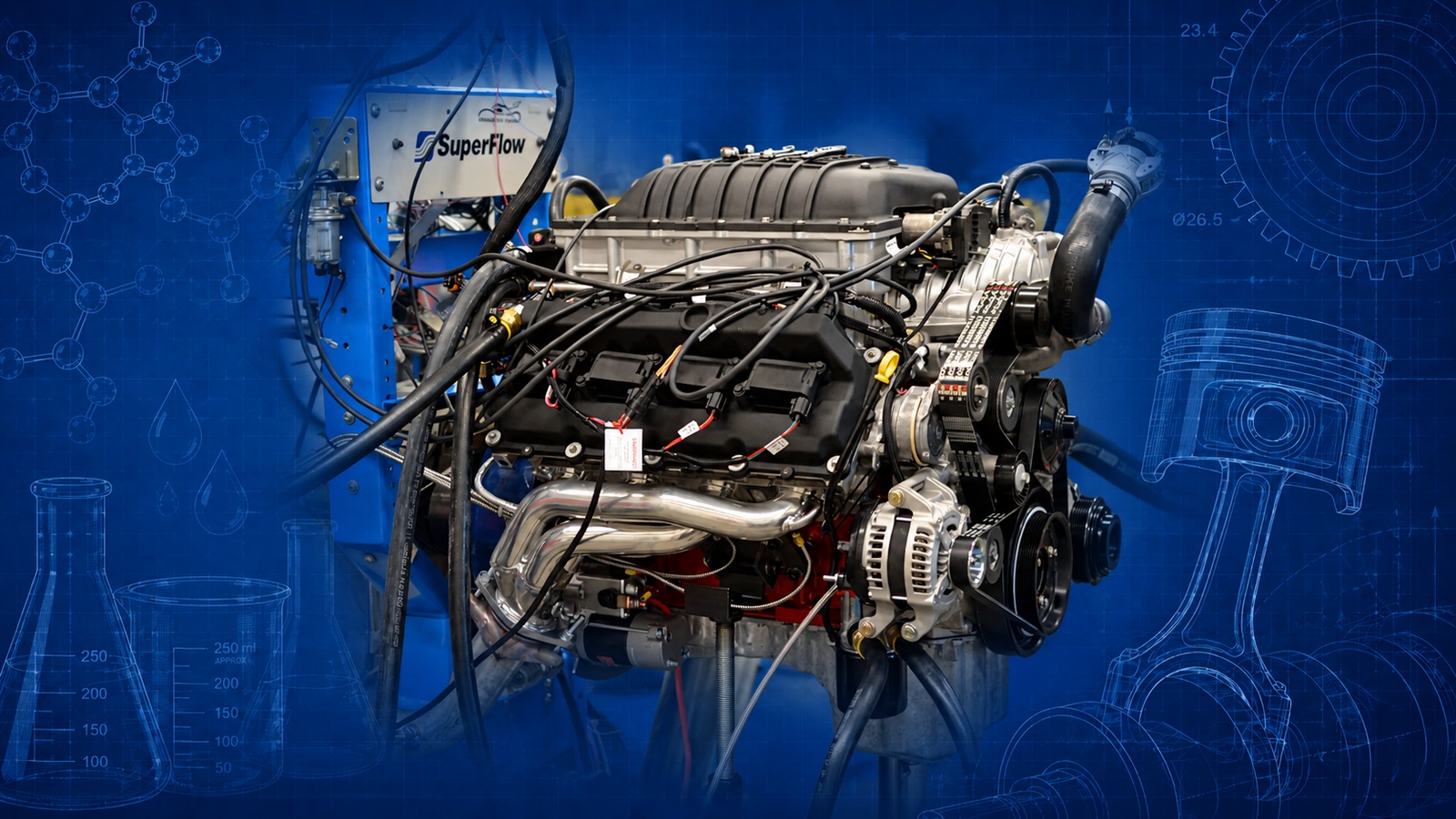
The Mopar Hellephant is a supercharged 7.0-litre (426-cubic-inch) HEMI crate engine developed to produce approximately 1,000 hp and 950 lb-ft of torque. When one arrived at the AMSOIL Mechanical Lab, getting it onto the dyno turned out to be a project in itself.
Why Does AMSOIL Have an Engine Dyno?
Developing and evaluating engine lubricants requires more than simply running an engine and measuring how much power it produces.
For meaningful testing, an engine needs to operate safely, under controlled conditions and — critically — repeatably.
If engineers are evaluating the effect of a lubricant formulation, test procedure or operating condition, they need confidence that changes in the results are caused by the variable being studied rather than uncontrolled differences between test runs.
That makes repeatability one of the most important characteristics of a useful laboratory engine platform.
A spectacular horsepower number makes a great dyno video. A repeatable engine platform makes useful engineering data. For lubricant development, the ability to reproduce controlled operating conditions is essential.
A 1,000 HP Engine Arrives at AMSOIL
The Hellephant engine tested at AMSOIL belonged to custom vehicle builder Kenny Hauk.
At the time, the engine platform was extremely new. AMSOIL Mechanical Lab Manager Chris Orr and his team had little existing information to work from and needed to solve installation and control-system problems as they encountered them.
The first objective sounded simple enough: securely mount the engine to the laboratory's SuperFlow engine dyno.
It wasn't.
Challenge One: Mount the Hellephant to the Dyno
The AMSOIL team first had to fabricate engine mounts to secure the Hellephant to the SuperFlow engine cart.
The clutch plate and bellhousing arrangement could be made to work, but there was no suitable provision for the starter motor. The team modified a factory bellhousing to create the required starter mount.
At the front of the engine, they encountered another problem. The balancer and complete serpentine accessory-drive system had not been installed, and some of the components required to run the engine weren't available.
After additional machining work, the balancer was installed. The team then repurposed the alternator as a belt tensioner and devised a non-standard belt route capable of driving the components required to operate the engine.
By the end of the first day, the Hellephant was physically installed on the SuperFlow dyno.
Now they just had to make it run.
Challenge Two: Make a New Engine Platform Run
The following day, the team installed the supporting systems required to operate the engine, including fuel, cooling, exhaust and charging systems along with a Holley Dominator aftermarket engine-management system.
Then came the first attempt to start it.
The engine cranked, but there was no injector operation and no ignition. The control system wasn't receiving the correct crank signal, while the manifold-pressure signal was also incorrect.
Repeated cranking during the troubleshooting process eventually resulted in an aftermarket starter motor failing spectacularly. High-performance engine testing can involve considerably more diagnosis and fabrication than the final dyno pull suggests.
Troubleshooting the Electronics
The team began systematically working through the engine-management system.
The job was complicated by wiring information that didn't accurately correspond with the custom harness supplied with the engine.
One problem was eventually traced to the drive-by-wire throttle pedal, which was causing a fault in the system. A replacement pedal was sourced and installed.
Another problem remained in the custom four-wire TMAP sensor, which provides pressure and temperature information to the engine-management system. Only one of its four connections had been wired correctly.
Once the wiring was corrected, the engine-management system finally had the information it needed.
The Hellephant Comes to Life
After several days of fabrication and troubleshooting, the 7.0-litre supercharged HEMI finally fired.
With the installation operating correctly, the Mechanical Lab could begin doing what the dyno was actually there to do.
The team conducted a series of horsepower sweeps, using information from each run to refine the engine calibration through the Holley Dominator management system.
The result was 875 hp on the engine dyno.
Why Didn't It Make 1,000 HP?
The Hellephant was designed around a four-figure horsepower target, so an 875 hp result might initially appear disappointing.
But the dyno had identified the limiting factor.
The available fuel pump could not supply enough fuel for the engine at the required output. Continuing to increase load without adequate fuel delivery would not have been an appropriate way to chase a headline number.
The engine itself was running well. The supporting fuel system had simply reached its capacity.
A dyno isn't just a machine for measuring maximum horsepower. It allows engineers to control engine load, monitor operating conditions, identify limitations and repeatedly reproduce demanding conditions. In this case, testing revealed that fuel delivery — rather than the engine itself — was preventing the combination from reaching its intended output.
What Does This Have to Do with Engine Oil?
The Hellephant project wasn't simply about seeing how much horsepower AMSOIL could extract from an exotic engine.
Engine platforms in the Mechanical Lab provide AMSOIL engineers with controlled environments for developing, evaluating and validating lubricant performance.
High-output engines are particularly useful because they can expose lubricants to severe operating conditions including high temperatures, high bearing loads and sustained engine speeds.
But those results are only useful if the test environment itself is controlled. Before engineers can confidently evaluate a lubricant, the engine, instrumentation and supporting systems need to produce reliable and repeatable operating conditions.
The considerable work involved in getting the Hellephant running illustrates something that isn't normally visible on a finished bottle of engine oil: lubricant testing also requires engines, instrumentation, test procedures and people capable of making the entire system work reliably.
Inside the AMSOIL Mechanical Lab
The Hellephant project provides one example of the work carried out inside the AMSOIL Mechanical Lab, but the facility is designed to support a much broader range of lubricant development and testing. Take a look inside the lab to see some of the engines, dynamometers, instrumentation and test equipment used by AMSOIL engineers.
Why Engine Dyno Testing Is Different from a Power Run
Most enthusiasts encounter dynamometers as tools for measuring vehicle power or tuning an engine. The basic concept is similar in a laboratory, but the objective can be very different.
A development dyno can hold an engine at defined speeds and loads, repeat operating cycles and allow engineers to monitor variables under controlled conditions.
That means the valuable result isn't always the highest horsepower figure. For lubricant development, the ability to repeatedly expose an engine and its oil to a known set of operating conditions can be much more important.
AMSOIL Signature Series 0W-40
The Hellephant project also demonstrated the type of demanding high-performance environment in which lubricant quality becomes critical.
AMSOIL Signature Series 0W-40 Synthetic Motor Oil is formulated for high-performance applications requiring a compatible 0W-40 lubricant, providing strong wear protection and resistance to the high temperatures encountered in demanding service.
As always, engine oil should be selected according to the requirements of the particular engine and application rather than horsepower alone.
The Hellephant dyno project is an excellent example of what happens behind the scenes in lubricant development. Before an engine can provide useful test data, engineers need to make it safe, controllable and repeatable. With a brand-new 1,000 hp crate engine, getting to that point required several days of fabrication, troubleshooting and problem-solving — before the real testing could even begin.
Want to learn more about how lubricants are evaluated? Explore our guide to how engine oil is tested and other technical articles in the AMSOIL Knowledge Centre.
Oil Information & Technical Guides
Explore our oil knowledge base with practical guides covering oil standards, viscosity, base-oil technology and application-specific specifications.