
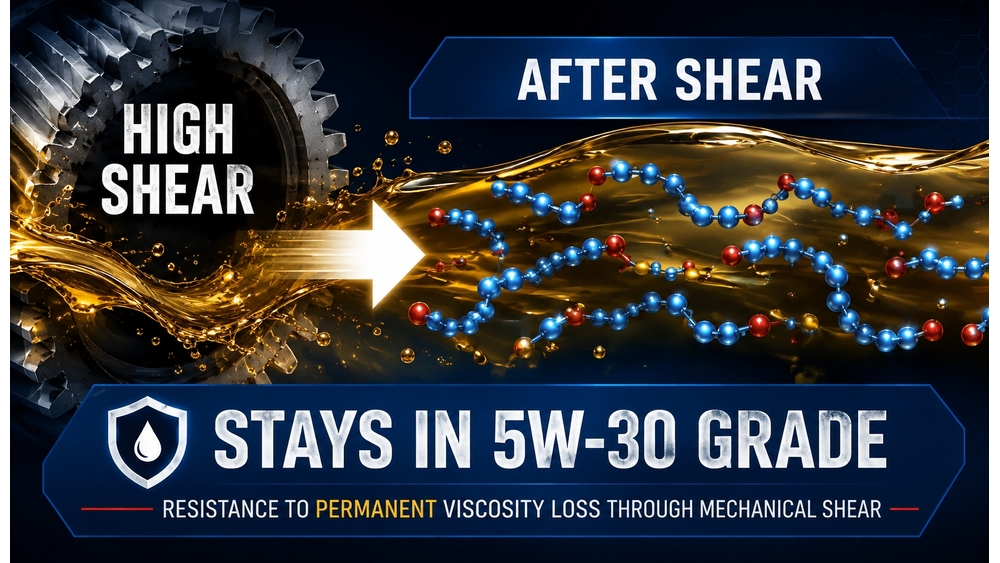
You may have noticed the phrase “stable, stay-in-grade oil” when reading about ACEA engine oil classifications. It appears repeatedly throughout ACEA specifications, but what does it actually mean?
Put simply, a stay-in-grade oil must be sufficiently resistant to permanent viscosity loss through mechanical shear that it remains within its specified SAE viscosity grade after completing a prescribed shear-stability test.
This matters because the viscosity printed on a bottle only describes part of an engine oil’s performance. An oil may begin its service life as an SAE 5W-40, for example, but its formulation must also resist the mechanical stresses encountered during operation well enough to continue providing the viscosity characteristics expected of that grade.
Why Can Engine Oil Lose Viscosity?
Modern multigrade engine oils are formulated to perform across a wide range of temperatures. Depending on the formulation, viscosity-index improvers may be used to help an oil satisfy both its low-temperature and high-temperature viscosity requirements.
These viscosity modifiers are typically polymeric materials. Inside an engine, the lubricant is repeatedly subjected to high mechanical stresses as it passes through areas such as bearings, the valvetrain and oil pump. Under sufficiently severe shear, some polymer molecules can be physically degraded into smaller molecules.
When this happens, part of the viscosity contribution provided by those polymers can be permanently lost and the oil may become less viscous. ASTM International describes its shear-stability test methods as measuring viscosity loss resulting from the physical degradation of polymer-containing fluids under high-shear conditions.
This should not be confused with the normal reduction in viscosity that occurs when oil becomes hotter. Temperature-related viscosity change is reversible: when the oil cools, its viscosity increases again. Mechanical shear can cause permanent viscosity loss.
What Does ACEA Mean by “Stay in Grade”?
ACEA does not merely use “stay-in-grade” as marketing language. It is part of the laboratory performance requirements within the ACEA Oil Sequences.
In the 2023 ACEA Oil Sequences for Light-Duty Engines, shear stability can be evaluated using CEC L-14-93, ASTM D6278 or ASTM D7109. The oil’s kinematic viscosity at 100°C is measured after 30 shear cycles, with ACEA specifying that all grades must remain “stay in grade”.
In practical terms: an oil does not satisfy an ACEA classification simply because it falls within the correct SAE viscosity grade when freshly blended. It must also demonstrate sufficient shear stability to remain within the required grade after the specified laboratory test.
Why Is Stay-in-Grade Performance Important?
Viscosity plays an important role in maintaining an adequate lubricating film between moving engine components. If an oil suffers excessive permanent viscosity loss, that lubricating film may become thinner than the engine and lubricant were designed to provide.
Shear stability can be particularly relevant in demanding operating conditions involving sustained engine loads, high temperatures, turbocharging, long service intervals and other situations where the lubricant is repeatedly exposed to mechanical stress.
This helps explain why ACEA repeatedly describes its engine-oil categories as stable, stay-in-grade oils. The terminology appears across categories with very different applications and viscosity requirements, including A3/B4, A5/B5, A7/B7 and the C-series categories.
Stay-in-Grade Does Not Mean “Thicker Is Better”
A common mistake is to associate shear stability with simply using a thicker oil. They are not the same thing.
A relatively low-viscosity oil can have excellent shear stability, while a higher-viscosity formulation may suffer greater viscosity loss if it relies heavily on viscosity modifiers that are susceptible to mechanical degradation.
ACEA A5/B5 and A7/B7 illustrate this distinction particularly well. These categories are intended for engines designed to use lower-viscosity oils with high-temperature, high-shear (HTHS) viscosity between 2.9 and 3.5 mPa·s, yet ACEA still describes them as stable, stay-in-grade engine oils.
The objective is therefore not to make an oil as thick as possible. It is to ensure the lubricant retains the viscosity characteristics it was designed and specified to provide.
What About Heavy-Duty Diesel Oils?
Stay-in-grade requirements are not limited to passenger-car engine oils.
The 2024 ACEA Oil Sequences for Heavy-Duty Engines also specify shear-stability requirements. Kinematic viscosity at 100°C is assessed after 30 cycles using recognised shear-stability procedures, with the oil required to remain in grade. ACEA also specifies an additional 90-cycle ASTM D7109 assessment for the applicable heavy-duty sequences.
ASTM D7109 is specifically designed to assess shear stability after both 30 and 90 cycles using a European diesel-injector apparatus. ASTM notes that the test measures viscosity loss caused by physical degradation under high shear while minimising thermal and oxidative effects.
What Does This Mean When Choosing an Engine Oil?
Seeing an ACEA specification such as A3/B4, A5/B5 or C3 on an oil tells you considerably more than the SAE viscosity grade printed on the front of the bottle.
An SAE grade such as 5W-30 defines viscosity-related requirements. An ACEA classification adds a much broader set of performance requirements covering areas such as wear, deposits, oxidation, after-treatment compatibility, HTHS viscosity and shear stability.
Stay-in-grade performance is therefore one part of the reason why two oils carrying the same SAE viscosity grade should not automatically be considered equivalent.
European Oil Specifications & Technology
Explore the oil specifications, chemistry and viscosity requirements commonly used in modern European engines.


Want to Understand ACEA Oil Specifications?
Explore our guide to ACEA, API and ILSAC engine oil classifications, including what the different standards mean and how they relate to lubricant selection.
Explore Engine Oil Standards →Independent References
The following independent technical sources provide further information on ACEA shear-stability requirements and the test methods used to evaluate viscosity loss: