
Choosing oil for a motorcycle can seem surprisingly complicated. Some motorcycles use one lubricant for the engine, transmission and wet clutch, while others have separate compartments requiring different fluids. Some V-twin motorcycles can even require separate engine oil, primary fluid and transmission fluid.
This raises an obvious question: why can one motorcycle use the same oil everywhere while another uses two or three different lubricants?
The answer comes down to motorcycle design. Engine components, transmission gears, primary drives and wet clutches place different demands on a lubricant. Where these components share the same oil supply, the lubricant must perform all of those jobs simultaneously. Where they are separated, a lubricant can be formulated specifically for each application.
One Motorcycle, Several Lubrication Systems
Unlike most cars, there is no single lubrication layout shared by all motorcycles. Depending on the design, a motorcycle may use one lubricant across several components or separate fluids for different areas.
There are three important jobs to consider:
- Engine lubrication — protecting bearings, pistons, camshafts and other engine components while controlling heat, deposits and wear.
- Transmission lubrication — protecting heavily loaded gears and bearings while maintaining suitable viscosity under the shearing action of the gearbox.
- Wet-clutch and primary-drive lubrication — protecting chains, gears and other primary components while providing the correct frictional characteristics for wet-clutch operation where applicable.
Whether these jobs are performed by one lubricant or several depends entirely on how the motorcycle was designed.
Shared-Sump Motorcycles
Many motorcycles use a shared-sump design. In these motorcycles, the engine and transmission share the same lubricant, and the wet clutch commonly operates in the same oil.
This means motorcycle engine oil has to perform several very different jobs at once. It must provide the temperature resistance, cleanliness and wear protection expected of an engine oil while also protecting transmission gears against high mechanical loads and maintaining suitable frictional characteristics for the clutch.
The transmission also subjects the lubricant to considerable mechanical shearing forces as the oil passes between loaded gear teeth. Maintaining appropriate viscosity under these conditions is therefore particularly important in a shared-sump motorcycle.
Where a wet clutch shares the engine oil, friction characteristics become important too. An unsuitable lubricant can interfere with clutch operation, which is one reason motorcycle-specific specifications such as JASO MA and JASO MA2 are important.
Separate-Sump Motorcycles
Other motorcycles separate these components and therefore allow different lubricants to be used for different jobs.
Harley-Davidson motorcycles provide a well-known example. Many Harley-Davidson models use separate lubrication systems for the engine, primary chaincase and transmission. Instead of one oil circulating through all three areas, each compartment has its own lubricant supply.
This creates an interesting choice. Where the manufacturer permits it, a suitable motorcycle oil may be capable of performing all three jobs, providing the convenience of keeping one lubricant on the shelf. Alternatively, specialised primary and transmission fluids can be used so each compartment receives a lubricant formulated specifically for its operating requirements.
Always follow the lubricant requirements specified for the particular motorcycle. The fact that one motorcycle can use the same lubricant in several compartments does not mean the same practice is suitable for every motorcycle.
What Does Motorcycle Engine Oil Do?
The engine presents the most familiar lubrication challenge. Engine oil must maintain a protective film between moving components while operating across a wide temperature range. It must also help control deposits, resist oxidation, protect against corrosion and carry contaminants to the oil filter.
Motorcycle applications can add further requirements. In a shared-sump design, the same oil may also be subjected to transmission gears and may need to operate correctly with a wet clutch.
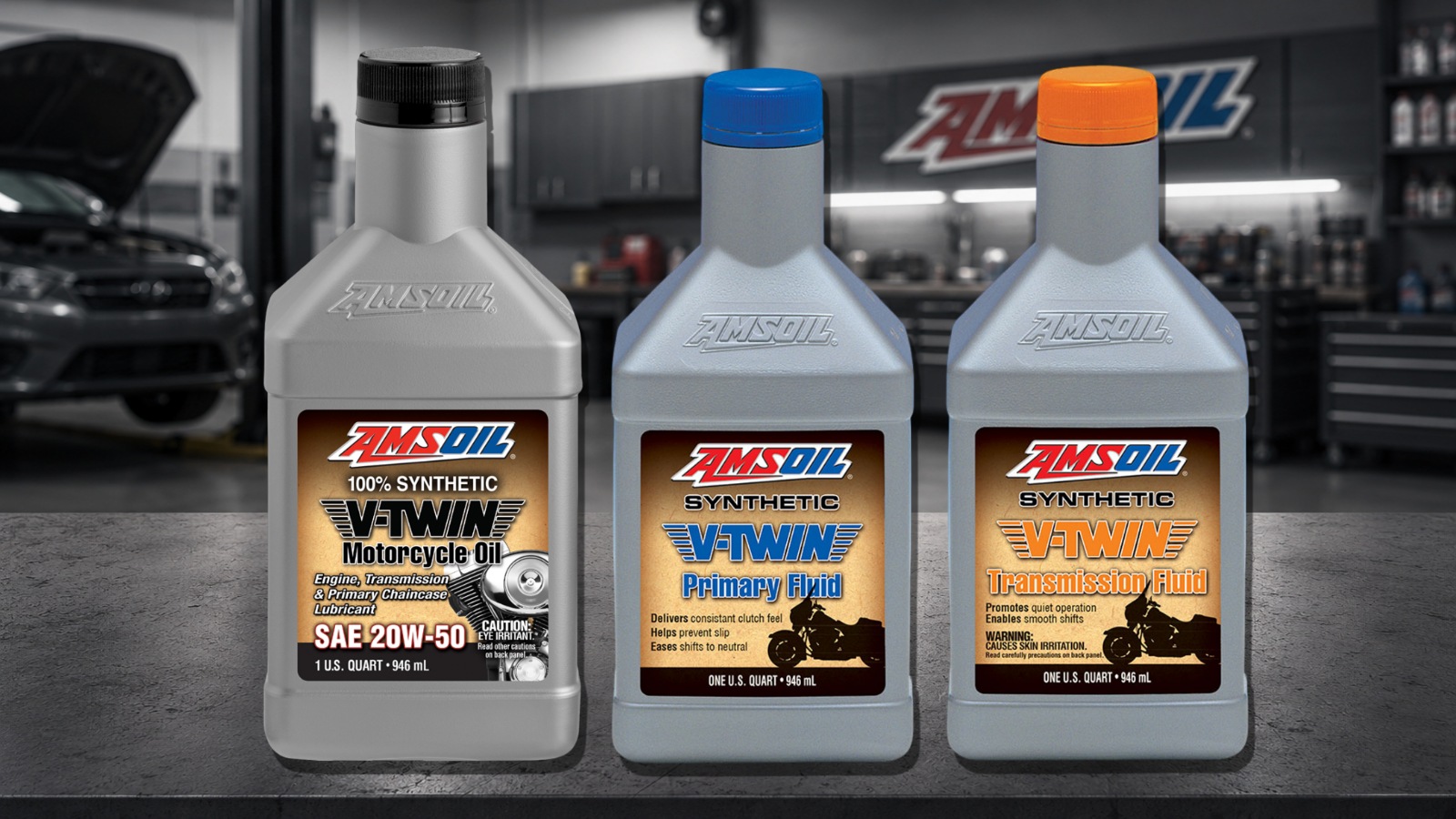
AMSOIL 20W-50 Synthetic V-Twin Motorcycle Oil is formulated for V-twin motorcycle applications and is suitable for engine, transmission and primary-chaincase use in applications where a 20W-50 motorcycle oil of its specification is recommended.
AMSOIL 4T MC5 20W-50 100% Synthetic Performance Motorcycle Oil provides another 20W-50 motorcycle-oil option for compatible applications.
What Is Motorcycle Transmission Fluid?
Where the motorcycle transmission has its own lubricant supply, the fluid no longer needs to perform all the jobs of an engine oil. It can instead be optimised around the requirements of gears, shafts and bearings.
Motorcycle transmission gears operate under substantial loads, and the meshing action of the gears places significant pressure on the lubricant film. The fluid must maintain sufficient film strength and viscosity to keep components separated and minimise wear.
A dedicated transmission fluid may also use a different viscosity from the engine oil. In some V-twin applications, a higher-viscosity transmission lubricant can provide additional cushioning between gear teeth and help reduce transmission noise while maintaining smooth shifting.
AMSOIL Synthetic V-Twin Transmission Fluid is designed specifically for the separate transmissions used in compatible V-twin motorcycles. Its formulation is focused on transmission protection rather than having to simultaneously satisfy the requirements of the engine and primary chaincase.
What Is Primary Fluid?
On motorcycles with a separate primary drive, the primary chaincase transfers power from the engine to the transmission and may contain the primary chain, sprockets, compensator and clutch assembly.
A dedicated primary fluid therefore has a different set of priorities from an engine oil. It needs to protect the chain, sprockets and other primary-drive components while maintaining suitable friction characteristics for correct wet-clutch engagement and release.
The lubricant must resist being displaced from loaded components and provide reliable protection despite the mechanical action of the chain and clutch.
AMSOIL Synthetic V-Twin Primary Fluid is formulated specifically for compatible V-twin primary chaincases. It is wet-clutch compatible and designed to provide wear protection for the chain, compensator and other primary components.
Why Not Just Use Gear Oil in a Motorcycle Transmission?
It can be tempting to assume that a transmission containing gears simply requires conventional automotive gear oil. That is not necessarily the case.
Lubricant viscosity grades can also be misleading because SAE engine-oil viscosity grades and SAE gear-oil viscosity grades use different numbering systems. A gear oil carrying a numerically higher SAE grade is not necessarily dramatically thicker than an engine oil in the way the numbers might suggest.
More importantly, the motorcycle manufacturer determines the lubricant requirements of the transmission. Depending on its design, the specified lubricant could be motorcycle engine oil, a dedicated motorcycle transmission fluid, gear oil or another specified fluid.
Use the required specification rather than choosing a lubricant simply because the bottle says "gear oil".
Why Can 20W-50 Motorcycle Oil Work in All Three Compartments?
On compatible motorcycles with separate engine, primary and transmission compartments, a suitable motorcycle oil can sometimes meet the requirements of all three systems.
This is possible because a motorcycle oil such as AMSOIL 20W-50 Synthetic V-Twin Motorcycle Oil is designed to provide engine wear protection while maintaining viscosity under mechanical shear and providing the frictional characteristics required for wet-clutch compatibility.
For riders whose motorcycle permits this approach, using one lubricant can be extremely convenient. There is only one product to purchase and keep on the shelf, and fewer partially used bottles are left in the garage after servicing.
But the fact that one lubricant can perform several jobs does not mean specialised fluids serve no purpose.
Why Use Separate Primary and Transmission Fluids?
Once the engine, transmission and primary chaincase have separate lubricant supplies, each fluid can be optimised for one particular environment.
A dedicated transmission fluid can concentrate on gear protection, shift quality, viscosity retention and controlling transmission noise. A dedicated primary fluid can concentrate on chain and compensator protection while providing suitable wet-clutch performance. Neither lubricant needs to accommodate the combustion by-products and extreme temperature conditions encountered by engine oil.
This does not automatically make the three-fluid approach "better" than using an approved motorcycle oil throughout. Instead, it provides riders with a choice where both approaches are suitable for their motorcycle.
One Oil or Three?
For compatible V-twin motorcycles, the decision ultimately comes down to the motorcycle's requirements and the rider's preference.
Using a suitable motorcycle oil across the engine, transmission and primary chaincase offers simplicity and convenience. One lubricant can be purchased in sufficient quantity and used throughout the service.
Using dedicated engine, transmission and primary lubricants allows each compartment to receive a product formulated specifically for that application. Riders who prefer this approach may choose AMSOIL Synthetic V-Twin Transmission Fluid and AMSOIL Synthetic V-Twin Primary Fluid alongside the appropriate motorcycle engine oil.
Neither approach changes the most important rule: the lubricant must be suitable for the particular motorcycle and compartment in which it is being used.
The Bottom Line
The difference between motorcycle oil, transmission fluid and primary fluid is fundamentally about the job each lubricant is being asked to perform.
A shared-sump motorcycle asks one lubricant to protect the engine and transmission while often also operating the wet clutch. A motorcycle with separate sumps allows different lubricants to be used for the engine, transmission and primary drive.
Neither design means that one type of lubricant is universally better than another. What matters is understanding how the motorcycle is designed and selecting fluids that meet the requirements of each lubrication system.
When in doubt, check the manufacturer's requirements for your motorcycle before selecting engine oil, primary fluid or transmission lubricant.