
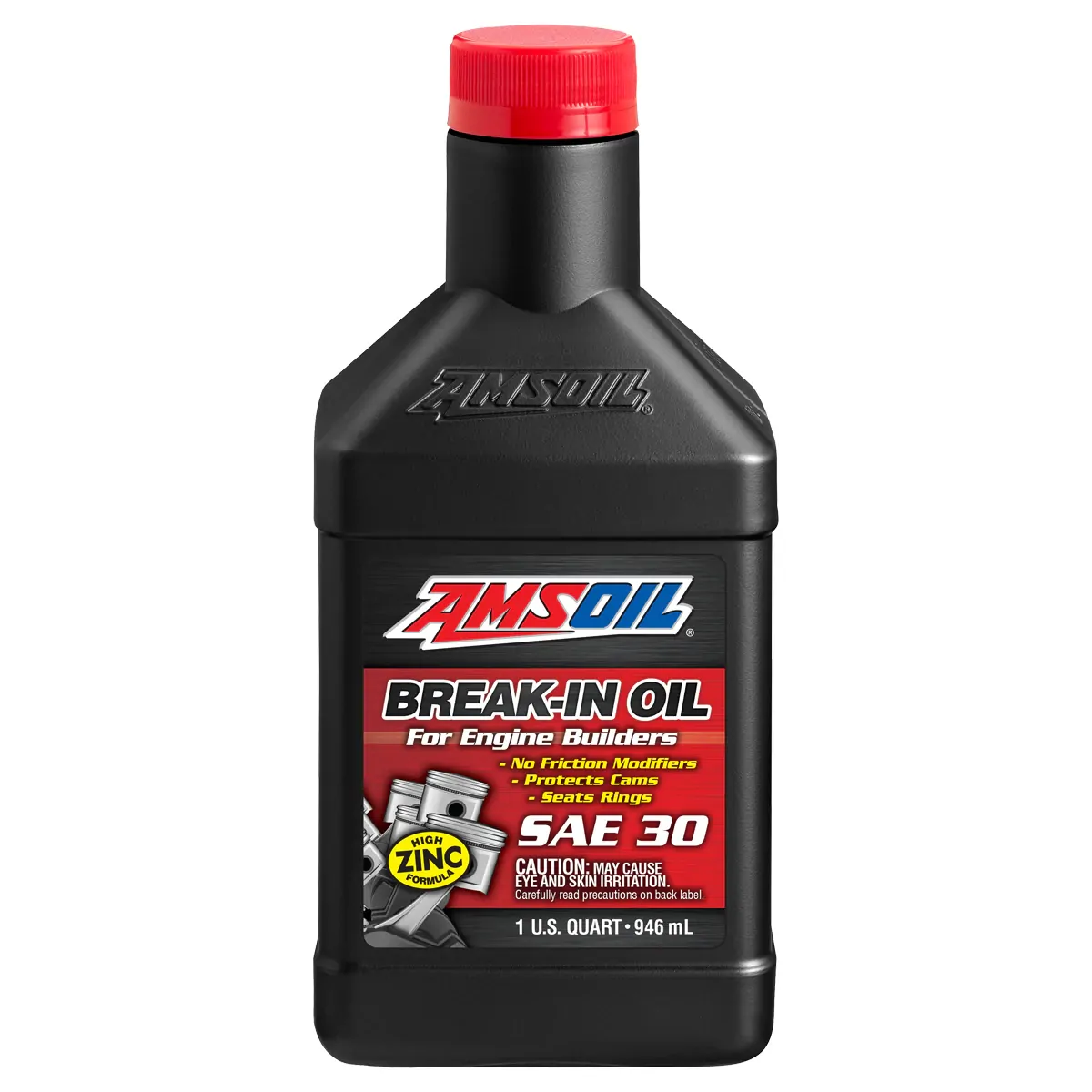
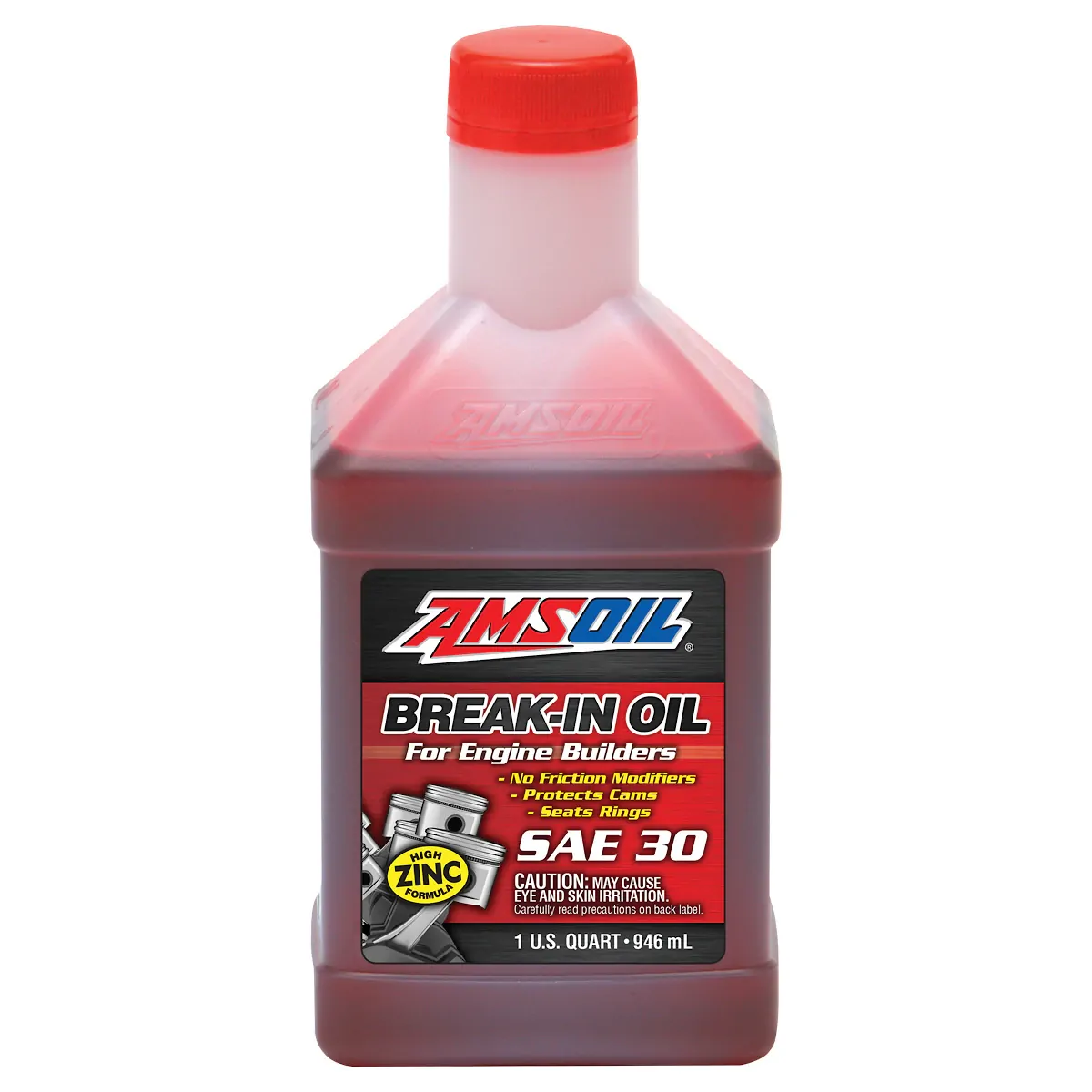
Amsoil Break-In SAE 30 Running-in Oil BRK
Designed for high-performance and racing engines
A freshly built engine needs protection from wear – but at the piston rings, a small amount of controlled wear is essential. AMSOIL SAE 30 Break-In Oil (BRK) is formulated specifically for new and rebuilt high-performance and racing engines, allowing piston rings to seat quickly against freshly honed cylinder walls while protecting the camshaft, valvetrain and bearings during the critical break-in period.
Unlike a conventional engine oil, AMSOIL Break-In Oil contains no friction modifiers. This allows the microscopic peaks left by cylinder honing to partially flatten against the piston rings, creating a larger contact area and helping the rings form an effective seal. At the same time, high levels of zinc and phosphorus anti-wear additives (ZDDP) and strong oil-film protection help prevent damaging wear elsewhere in the engine.
The goal is controlled wear between the piston rings and freshly honed cylinder walls – not uncontrolled wear of the camshaft, lifters, bearings and other critical components.
Why Do Piston Rings Need to Seat?
A freshly honed cylinder wall is not perfectly smooth. Viewed microscopically, its surface contains peaks and valleys. New piston rings initially contact the highest points rather than the entire cylinder surface.
During correct break-in, controlled wear partially flattens these sharp peaks and increases the surface area available for the piston rings to seat against. This helps establish a dynamic seal between the rings and cylinder wall, supporting compression while reducing oil consumption and combustion-gas blow-by into the crankcase.
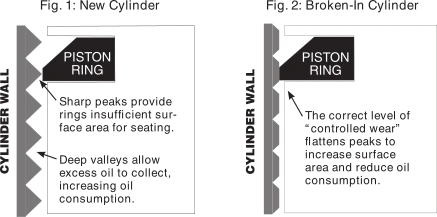
As the engine breaks in, controlled wear partially flattens the microscopic peaks left by cylinder honing, increasing the contact area between the piston rings and cylinder wall.
What Happens if an Engine Does Not Break In Correctly?
Too little wear can leave the peaks of the freshly honed surface standing proud, preventing the rings from developing sufficient contact with the cylinder wall. The deeper valleys can retain excess oil, allowing more oil to pass into the combustion chamber and increasing oil consumption.
Too much wear creates a different problem. The surface can glaze as the peaks roll over into the valleys, reducing the cylinder wall's ability to retain the oil needed for lubrication. Successful break-in therefore requires a balance: enough controlled wear to seat the rings without excessive wear or glazing.
Why Doesn't BRK Contain Friction Modifiers?
Friction reduction is normally desirable in an engine lubricant, but break-in is a special operating period. AMSOIL formulates BRK without friction modifiers so the piston rings and freshly honed cylinder walls can establish the controlled contact required for seating.
Once the rings have seated, the engine can be drained of break-in oil and filled with the appropriate high-performance synthetic engine oil specified by the engine builder or manufacturer.
High-Zinc Protection Where Wear Is Not Wanted
While controlled wear is desirable at the piston ring and cylinder-wall interface, the same is not true for the valvetrain. New flat-tappet camshafts and lifters are particularly vulnerable during break-in because their mating surfaces are not yet seasoned and these components rely on splash lubrication rather than direct pressure lubrication.
AMSOIL Break-In Oil contains high levels of zinc and phosphorus anti-wear additives (ZDDP) to protect cam lobes, lifters, rockers and other heavily loaded components during this critical period.
Zinc dialkyldithiophosphate (ZDDP) is an anti-wear additive used to protect highly loaded metal surfaces. Learn more in our guide to high-zinc engine oil and ZDDP.
Protects Rod and Main Bearings
High-performance and racing engines can place substantial loads on rod and main bearings, particularly where aftermarket components or engine modifications increase torque and horsepower. Under extreme loading, maintaining a strong lubricating film is critical to preventing harmful metal-to-metal contact.
The base oils used in AMSOIL Break-In Oil provide increased film strength to help protect rod and main bearings while the engine completes the break-in process.
How Long Should Break-In Oil Stay in the Engine?
There is no single break-in distance that applies to every engine. Engine design, cylinder preparation, piston-ring material, clearances and the engine builder's chosen procedure can all affect the required break-in period.
AMSOIL states that break-in duration should not exceed 1,000 miles (1,600 km). Where instructions are available from the engine builder or manufacturer, those recommendations should take priority.
How Do You Know When the Rings Have Seated?
AMSOIL notes that a newly assembled engine may initially show a larger area of oil residue at the exhaust ports. As the piston rings seat and less oil passes the rings, this residue should progressively decrease. Once the rings have formed a tight seal against the cylinder walls, oil residue should no longer be evident.
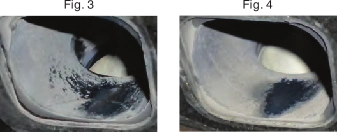
Oil residue visible at the exhaust port can decrease as the piston rings seat and form a tighter seal against the cylinder walls.
Other methods used by engine builders to evaluate ring seating include leak-down testing and monitoring horsepower measurements over time. The appropriate method and break-in procedure will depend on the engine.
Once break-in is complete, drain the Break-In Oil and refill the engine with an AMSOIL high-performance synthetic engine oil that meets the specifications required by the engine builder or manufacturer.
- Quickly seats piston rings
- Increased zinc and phosphorus protect against wear
- Maximizes compression and power
Available Pack Sizes
Typical Technical Properties
Typical technical properties for AMSOIL BRK are shown below.
| Technical Property | BRK |
|---|---|
| Kinematic Viscosity @ 100°C (ASTM D445), cSt | 11.4 |
| Kinematic Viscosity @ 40°C (ASTM D445), cSt | 94.5 |
| Viscosity Index (ASTM D2270) | 107 |
| Flash Point (ASTM D92), °C (°F) | 234 (453) |
| Fire Point (ASTM D92), °C (°F) | 250 (482) |
| Pour Point (ASTM D97), °C (°F) | -34 (-29) |
| Four-Ball Wear Test (ASTM D4172B @ 40kg, 75°C, 1200 rpm, 1 hr) | 0.45 |
| Total Base Number (ASTM D2896) | 6.6 |
| High-Temperature/High-Shear Viscosity @ 150°C (ASTM D5481), cP | 3.5 |
Be The First To Review This Product!
Help other Amsoil Australia users shop smarter by writing reviews for products you have purchased.
We Also Recommend
Others Also Bought
More From This Category