Dirt bikes place unusual demands on their engines, clutches and transmissions. High engine speeds, repeated acceleration, aggressive clutch engagement and constantly changing traction create operating conditions that differ considerably from everyday road riding.
These demands help explain why specialised dirt bike lubricants exist, and why selecting the correct oil involves more than choosing a familiar viscosity grade.
What Makes Dirt Bike Lubrication Different?
Off-road motorcycles are frequently subjected to rapid changes in engine speed and load. Hard acceleration, sudden deceleration, wheelspin, wheel hop and impacts can place considerable stress on the drivetrain.
Clutch operation is particularly demanding. Riders may deliberately slip the clutch to control power delivery, maintain momentum or launch the motorcycle. This generates heat and places additional demands on the lubricant's friction characteristics.
In motorcycles with a shared oil system, the lubricant must protect the engine and transmission while also providing suitable friction performance for the wet clutch. These requirements can differ from those of an automotive engine oil.
How AMSOIL Tests Experimental Dirt Bike Oils
Lubricant development involves more than measuring viscosity and other properties in a laboratory. Engineers also need to understand how experimental formulations behave when subjected to demanding mechanical conditions.
In the following AMSOIL development demonstration, an older dirt bike with separate engine and transmission oil compartments is mounted on a dynamometer and subjected to 20 simulated race starts.
Each test involves aggressive, high-RPM clutch engagement followed by acceleration through several gears. The dynamometer provides heavy, repeatable resistance, allowing the clutch and transmission to be evaluated under controlled conditions.
What Does the Testing Reveal?
A real motocross race start involves wheelspin, wheel hop and sudden changes in traction. These events introduce shock loads that are not fully reproduced by a dynamometer.
Instead, the dyno provides severe, controlled loading without those additional drivetrain shocks, making it useful for evaluating lubricant behaviour under repeatable conditions.
Following the 20 simulated starts, the clutch is disassembled and its plates inspected for uneven wear, damage and smearing of the friction material.
The presenter explains that further development would include full engine testing, illustrating how individual component evaluations form part of a broader lubricant development process.
Development testing: The lubricant shown in this demonstration is an experimental formulation, not a finished retail product. The video illustrates AMSOIL's testing process rather than establishing the performance of a particular commercially available oil.
Engine Oil and Transmission Oil: Why the Difference?
Not all dirt bikes use the same lubrication arrangement. Some motorcycles share one oil supply between the engine, gearbox and wet clutch, while others have separate engine and transmission oil compartments.
Where a shared oil system is used, the lubricant must satisfy the requirements of all the components it serves. In a separate-sump design, the engine and transmission can use different lubricants formulated for their respective operating requirements.
AMSOIL Synthetic Dirt Bike Engine Oils
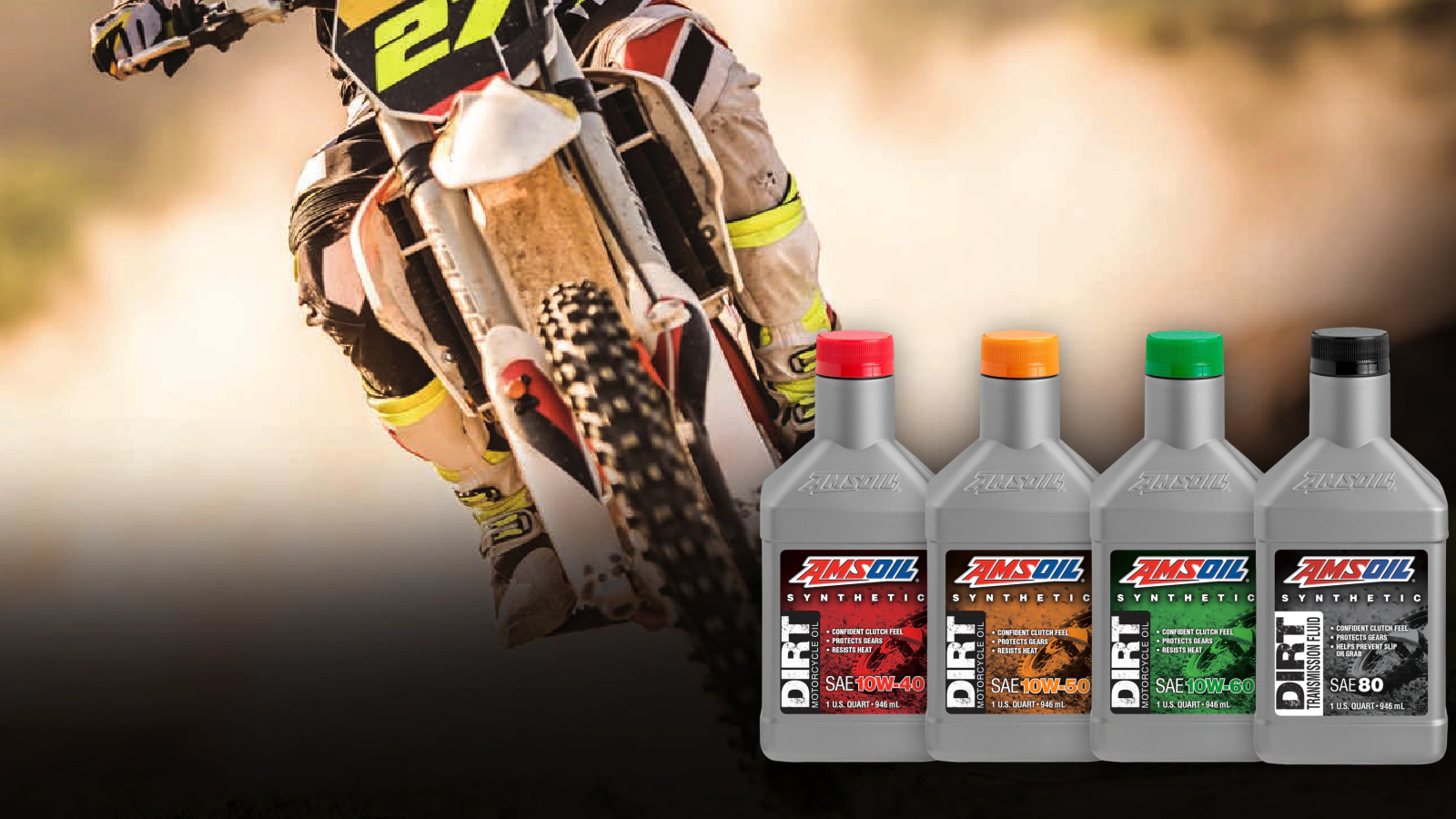
AMSOIL offers specialised synthetic dirt bike engine oils in 10W-40, 10W-50 and 10W-60 viscosity grades. These provide different viscosity options for compatible motorcycles and operating requirements.
The higher viscosity number does not automatically mean better protection. The correct grade depends on the motorcycle manufacturer's recommendations and the conditions in which the machine operates.

Consistent clutch feel. Protects gears. Resists heat.
VIEW PRODUCT →
Consistent clutch feel. Protects gears. Resists heat.
VIEW PRODUCT →
Consistent clutch feel. Protects gears. Resists heat.
VIEW PRODUCT →AMSOIL Synthetic Dirt Bike Transmission Fluid
For compatible dirt bikes with separate transmission oil compartments, AMSOIL Synthetic Dirt Bike Transmission Fluid (DBTF) provides a dedicated lubricant for the gearbox and clutch system.
Its formulation addresses the lubrication and friction requirements of these components without needing to perform the additional functions of an engine oil.
DBTF carries an SAE 80 viscosity designation on its packaging. This uses the gear oil viscosity classification system, which differs from the SAE system used for engine oils. An SAE 80 gear oil should therefore not be interpreted as having the same viscosity as an SAE 80 engine oil.

Delivers confident clutch feel. Protects against gear and clutch wear. Helps prevent slip or grab.
VIEW PRODUCT →Why Dirt Bike Oil Development Never Stands Still
Dirt bike technology continues to evolve. Changes in engine performance, clutch systems, transmission design and riding demands can introduce new challenges for lubricant development.
As the AMSOIL testing demonstration illustrates, developing a specialised lubricant involves evaluating how experimental formulations interact with real mechanical components, inspecting the results and progressing through further testing.
Ultimately, the goal is not to create one oil for every motorcycle, but to develop lubricants suited to the specific requirements of the engines, clutches and transmissions they are designed to protect.
For more information about motorcycle oil specifications and wet-clutch compatibility, see our JASO Motorcycle Oil Standards Guide.