
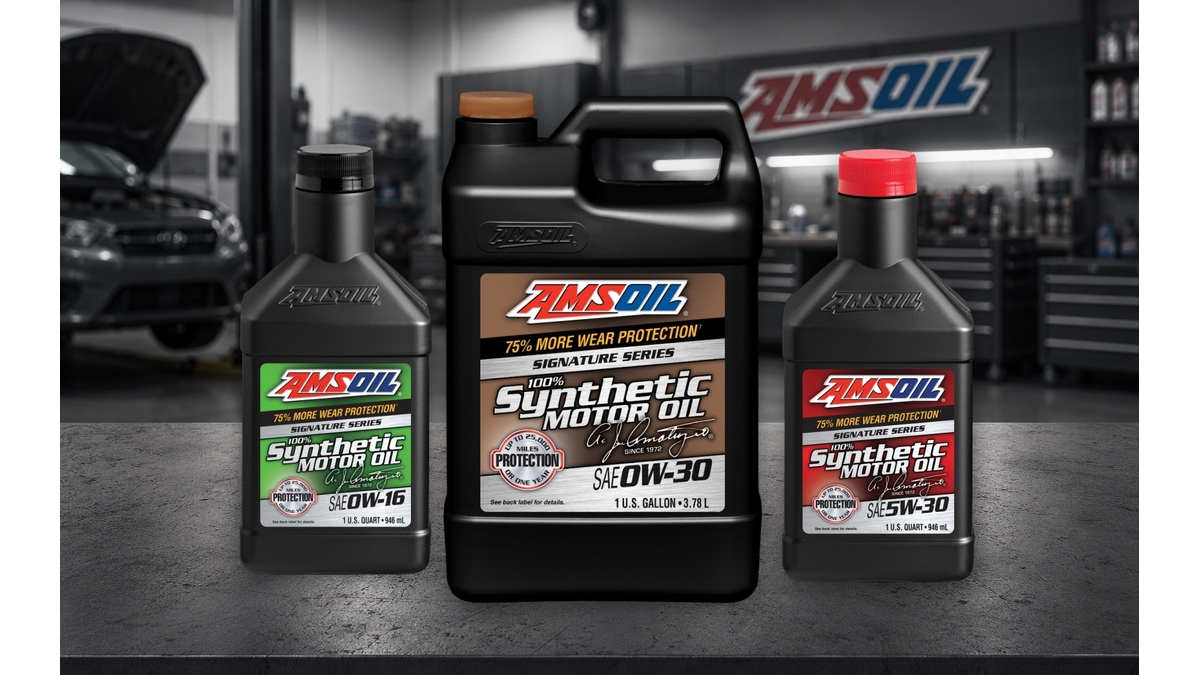
AMSOIL Signature Series 100% Synthetic Motor Oil is the flagship passenger-car motor oil range from AMSOIL. It is engineered for drivers who want more than simply meeting the minimum requirements of an engine-oil specification, with advanced protection against wear, deposits, oil consumption and the demands placed on modern turbocharged engines.
The latest generation of Signature Series meets the newest API SQ and ILSAC GF-7A performance requirements in applicable viscosity grades, while AMSOIL testing demonstrates performance beyond several of the minimum limits established by current industry standards.
Built for the Latest API SQ and ILSAC GF-7A Standards
API SQ and ILSAC GF-7A represent the latest generation of passenger-car engine-oil standards. Introduced in 2025, they address many of the challenges facing modern engines, including low-speed pre-ignition (LSPI), timing-chain wear, high-temperature piston and turbocharger deposits, sludge and varnish formation, fuel economy and low-temperature performance.
One particularly important change is protection against aged-oil LSPI. Previous standards addressed LSPI using fresh oil, but GF-7A also evaluates how effectively an oil continues to protect against LSPI after it has aged in service.
Meeting these standards establishes an important performance baseline. Signature Series is engineered to go further.
Protects Against Oil Volatility
Engine oil is exposed to extreme temperatures, particularly around piston rings, cylinder walls and turbochargers. At high temperatures, the lighter components of an oil can evaporate. This characteristic is known as volatility.
Excessive volatility can contribute to oil consumption, increased top-ups and deposits inside the engine. A lubricant that resists evaporation is better able to maintain its intended viscosity and remain in the engine where it is needed.
In the ASTM D5800 NOACK volatility test, AMSOIL Signature Series 0W-20 demonstrated 2X better protection against volatility compared with the API SQ limit.
Protects Against LSPI – Even as the Oil Ages
Low-speed pre-ignition, or LSPI, is an abnormal combustion event that can occur in some modern turbocharged, direct-injected petrol engines. Unlike ordinary spark knock, LSPI can create extremely high cylinder pressures before the spark plug is intended to ignite the air-fuel mixture, potentially damaging pistons and other engine components.
The challenge does not disappear simply because an oil protects against LSPI when new. Lubricant chemistry changes as oil accumulates kilometres, heat cycles and contaminants, which is why modern GF-7A testing also evaluates LSPI protection using aged oil.
AMSOIL Signature Series 5W-30 was tested after a 25,000-mile (approximately 40,000 km) service interval using the Sequence IX aged-oil LSPI test. It delivered 4X more piston protection against LSPI than the industry standard requires.
Keeps Pistons Clean
Pistons operate in one of the hottest areas of an engine. Oil exposed to these temperatures can oxidise and form deposits, particularly around piston rings. Heavy deposits can interfere with ring movement, increase oil consumption and reduce engine efficiency.
The Sequence IIIH engine test evaluates an oil's ability to resist oxidation, viscosity increase and high-temperature piston deposits.
In Sequence IIIH testing, AMSOIL Signature Series 5W-30 provided 72% more protection against piston deposits than required by the industry standard.
AMSOIL then extended the test to twice its normal duration. Even after the double-length Sequence IIIH test, Signature Series still provided 31% better protection than required.
Helps Prevent Sludge
Not every deposit forms under extreme heat. Moisture, combustion by-products, oxidation and contaminants can combine to form sludge throughout an engine. If sludge becomes severe enough, it can restrict oil circulation and interfere with the oil pickup screen.
AMSOIL evaluated Signature Series during a 125,000-mile (approximately 200,000 km) accumulation study using a 2025 Ford F-150 Raptor. At the conclusion of the study, the engine demonstrated 0% oil-screen plugging.
Preserves Horsepower and Torque
Lubrication is not only about preventing catastrophic engine failure. Wear, deposits and increased friction can gradually affect how an engine performs over a long service life.
The same 2025 Ford F-150 Raptor was used to evaluate horsepower and torque over the 125,000-mile accumulation study. AMSOIL compared engine output at the beginning and end of the test to demonstrate Signature Series' ability to help protect against performance loss over extended use.
Designed for Extended Protection
Long drain intervals place demands on an oil that cannot be demonstrated simply by testing a fresh lubricant. The oil must continue controlling deposits, maintaining viscosity and protecting critical components after thousands of kilometres of exposure to heat, fuel dilution, combustion by-products and mechanical stress.
AMSOIL Signature Series is designed for extended service intervals when used in accordance with AMSOIL recommendations. Its aged-oil LSPI testing is particularly significant because the 5W-30 test oil had already completed a 25,000-mile service interval before being subjected to the Sequence IX aged-oil LSPI test.
Always follow the applicable AMSOIL service interval for your vehicle and operating conditions. Severe-service applications may require shorter oil-change intervals.
Why Go Beyond the Minimum?
Specifications such as API SQ and ILSAC GF-7A are extremely important. They establish defined minimum performance requirements that allow vehicle manufacturers and consumers to identify oils suitable for particular applications.
But passing a specification does not mean every oil that carries that specification performs identically. An oil can meet a required test limit, while another formulation can provide substantially greater performance margin in the same test.
That is where Signature Series is positioned. It combines compliance with current industry standards with a formulation engineered to deliver additional protection in areas such as volatility, piston cleanliness, LSPI and long-term engine performance.
Is Signature Series Right for Your Vehicle?
The correct engine oil should always begin with the viscosity and performance specification required by the vehicle manufacturer. Signature Series is available in several viscosity grades for modern petrol engines and selected diesel applications.
If your vehicle calls for an API SQ, ILSAC GF-7A or earlier backwards-compatible passenger-car specification, an appropriate Signature Series viscosity may provide a significant step beyond simply satisfying the minimum oil requirement.
Find the Right AMSOIL for Your Vehicle
Use the AMSOIL Vehicle Product Finder to check the recommended viscosity and lubricant specifications for your vehicle.
Find Oil for Your VehicleLearn More About Engine Oil Standards
Not sure what API SQ, ILSAC GF-7A or other engine-oil classifications mean? Visit our Engine Oil Standards guide to learn how the major industry specifications work, what has changed between generations and which standards are backwards compatible.
Explore Engine Oil Standards →
Test Information
Performance claims in this article are based on testing published by AMSOIL. The 2X volatility claim is based on AMSOIL Signature Series 0W-20 compared with the API SQ limit using ASTM D5800 NOACK testing. The aged-oil LSPI claim is based on Signature Series 5W-30 following a 25,000-mile service interval in the Sequence IX aged-oil LSPI test.
Piston-deposit results are based on Signature Series 5W-30 in the Sequence IIIH test and a double-length Sequence IIIH test. Long-term engine-performance and oil-screen results are based on a 125,000-mile accumulation study using Signature Series 5W-30 in a 2025 Ford F-150 Raptor.