A boat's lower unit spends much of its working life submerged in water while transferring engine power through a compact set of heavily loaded gears and bearings. It is a demanding environment for any lubricant — and one where a small amount of neglected maintenance can eventually become a very expensive repair.
Lower-unit gear oil has to maintain a protective film between highly loaded gear teeth, protect bearings, resist foaming and help prevent corrosion. At the same time, the seals keeping water out of the gearcase are operating only centimetres away from the surrounding water.
That combination makes regular lower-unit inspection and gear-oil servicing particularly important. Changing the oil does more than replace an ageing lubricant: it also provides an opportunity to discover water intrusion, abnormal wear or seal problems before serious damage occurs.
What Does the Lower Unit Actually Do?
On an outboard or sterndrive, engine power travels down the drive shaft into the lower unit. A set of gears changes the direction of that rotation and transfers power through the propeller shaft to the propeller.
Those gears operate under substantial pressure. Acceleration, high engine output and sudden changes in propeller load can place extremely high loads on the contact area between gear teeth.
The gear oil forms a protective film between these surfaces. Its job is to prevent direct metal-to-metal contact while also protecting bearings, gears and other internal components against wear, heat and corrosion.
When that protective film is compromised, the consequences can be considerably more serious than simply having "old oil".
The Biggest Enemy: Water
Cars have differentials and gearboxes that operate in comparatively dry environments. A marine lower unit has to perform essentially the same fundamental job while regularly being submerged.
The gearcase is sealed, but seals are not invincible. Age, wear, damage and debris around the propeller shaft can create a path for water to enter the lower unit.
Fishing line is a particularly good example. Line wrapped tightly around the propeller shaft can work its way against the seal and damage it. The lower unit may continue operating normally while small quantities of water gradually contaminate the lubricant.
This is why water contamination can be easy to miss until the gear oil is drained.
What Happens When Water Gets Into Gear Oil?
Water contamination can interfere with several properties the gear oil relies on to protect the lower unit.
Viscosity can be reduced. The lower unit is designed to operate with lubricant of an appropriate viscosity. Contamination can compromise the oil's ability to maintain the required protective film between loaded components.
Foaming can increase. Gear oil needs to form a continuous lubricant film between gear teeth. Foam contains air and water bubbles that can collapse as they pass through heavily loaded contact areas, weakening that protective film and increasing the possibility of metal-to-metal contact.
Sludge can form. Water and degraded lubricant can contribute to sludge formation, interfering with lubrication and heat transfer while accelerating deterioration of the oil.
Rust and corrosion become possible. Once water is present inside the gearcase, steel gears, bearings and other internal surfaces are exposed to an environment in which corrosion can develop. Corrosion products can then circulate through the lubricant and contribute to further wear.
In other words, the lubricant does not simply become a little less effective. Water can attack several of the mechanisms the oil relies upon to keep the lower unit alive.
Milky Gear Oil Is a Warning Sign
One of the most recognisable signs of water contamination is gear oil that drains with a milky, cloudy or grey appearance.
This appearance can occur when water has become mixed or emulsified with the lubricant. Depending on how long the lower unit has been sitting, free water may also settle to the bottom of the gearcase and appear separately when the drain plug is first removed.
Milky oil should therefore not be treated as simply an indication that the lubricant was due for replacement. It can indicate that water is entering the gearcase.
If significant water contamination is found, replacing the oil addresses the contaminated lubricant but not necessarily the reason the water entered. Seals, sealing washers and other possible leak paths should be inspected and the gearcase pressure-tested where appropriate.
What About Metal on the Drain Plug?
Draining the lower-unit oil also gives you an opportunity to look for evidence of internal wear.
A small quantity of very fine metallic material may be produced through normal operation, particularly where the drain plug incorporates a magnet. What matters is the amount and type of material present.
Large particles, chips or an unusual quantity of metallic debris can indicate abnormal wear to gears, bearings or other internal components and deserve further investigation.
This is another reason a lower-unit oil change is useful as an inspection procedure rather than simply a lubricant replacement.
Don't Forget to Check Behind the Propeller
While servicing the lower unit, removing the propeller and inspecting the propeller shaft is worthwhile.
Fishing line, rope and other debris can become tightly wrapped around the shaft where it may not be immediately visible with the propeller installed. If that material reaches or damages the propeller-shaft seal, water can enter the gearcase and lubricant can escape.
Finding and removing a piece of fishing line during routine maintenance is considerably cheaper than discovering it after water has damaged bearings and gears.
Why Marine Gear Oil Has a Different Job
A lower unit requires the correct viscosity and lubricant specification recommended by its manufacturer, just like any other gearbox. However, marine operation adds another important requirement: the lubricant may have to continue protecting components even when some water contamination is present.
Marine-specific gear lubricants can therefore be formulated with water resistance, foam control and corrosion protection in mind, in addition to the extreme-pressure protection required by heavily loaded gears.
This does not mean that water in a lower unit is acceptable. A leaking seal still needs to be repaired. Instead, a marine gear lubricant provides an additional margin of protection if contamination occurs before the problem is discovered.
AMSOIL Synthetic Marine Gear Lube
AMSOIL 75W-90 100% Synthetic Marine Gear Lube is formulated specifically for marine gear applications including compatible outboard lower units, sterndrives, V-drives, bow thrusters and marine transmissions.
Its extreme-pressure formulation is designed to protect heavily loaded gears against wear and shock loading while resisting rust, corrosion and foam in the presence of water.
In AMSOIL testing, Synthetic Marine Gear Lube continued to provide advanced protection against power loss and gear wear with up to 15% water contamination. That does not make 15% water contamination desirable — it demonstrates the lubricant's ability to continue protecting the lower unit when water intrusion occurs before it is detected.
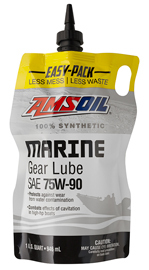
AMSOIL 75W-90 100% Synthetic Marine Gear Lube
Marine-specific synthetic gear lubricant designed for extreme-pressure protection, foam resistance and protection against rust and corrosion in the presence of water.
View ProductHow Often Should Lower-Unit Gear Oil Be Changed?
The correct service interval is always the interval specified by the manufacturer of the outboard or sterndrive, and that recommendation should take priority.
As a general maintenance practice, lower-unit gear oil is commonly inspected and serviced at least seasonally or annually. Boats operated frequently, under severe loads or in demanding environments may require more frequent attention.
More importantly, the lubricant should not simply be forgotten until the calendar says it is due. If there is evidence of water intrusion, leakage, propeller-shaft seal damage or abnormal operation, the lower unit should be inspected regardless of when the oil was last changed.
Why Changing the Oil Before Storage Makes Sense
For boats that are stored for an extended period, changing or inspecting the lower-unit lubricant before storage has an important advantage: you do not want the gearcase sitting for months with contaminated oil inside it.
If water has entered during the boating season, discovering it before storage allows the cause to be investigated and removes contaminated lubricant that could otherwise remain against gears and bearings for an extended period.
It also means the drained lubricant can be inspected for metal or other signs of trouble while there is time to repair the lower unit before the boat is needed again.
Can You Use Automotive Gear Oil in a Marine Lower Unit?
The first requirement is always compatibility with the viscosity and specification required by the equipment manufacturer. An automotive gear lubricant that meets those requirements may be technically suitable for some applications.
However, a marine-specific gear lubricant provides additional advantages for an application that operates in constant proximity to water. Resistance to foaming in the presence of water, corrosion protection and the ability to maintain a protective lubricant film during contamination are particularly valuable in a lower unit.
The important distinction is not simply whether the bottle says "gear oil". The lubricant must meet the requirements of the particular lower unit and be capable of protecting the gears under the conditions in which they actually operate.
The Bottom Line
A marine lower unit contains expensive, heavily loaded gears and bearings separated from the surrounding water by a relatively small number of seals. That makes its gear oil both a lubricant and an important early-warning system.
Regular servicing removes used lubricant, but just as importantly it gives you the opportunity to look for water contamination, metal debris, damaged seals and fishing line around the propeller shaft before those problems develop into a failed lower unit.
If the drained oil is milky, contains excessive metal or shows other signs of contamination, do not simply refill the gearcase and forget about it. Find the cause.
A few minutes spent inspecting and servicing a lower unit is cheap insurance compared with replacing gears, bearings — or the entire gearcase.