Choosing the right grease can be confusing. Customers often search by application, such as wheel-bearing grease, chassis grease, trailer grease, excavator grease, marine grease or simply a good general-purpose grease. However, not every grease is suitable for every application.
Grease selection depends on the component being lubricated, operating temperature, load, speed, water exposure, consistency and compatibility with any grease already in service. Understanding these differences helps prevent lubrication problems and makes it easier to select the correct product.
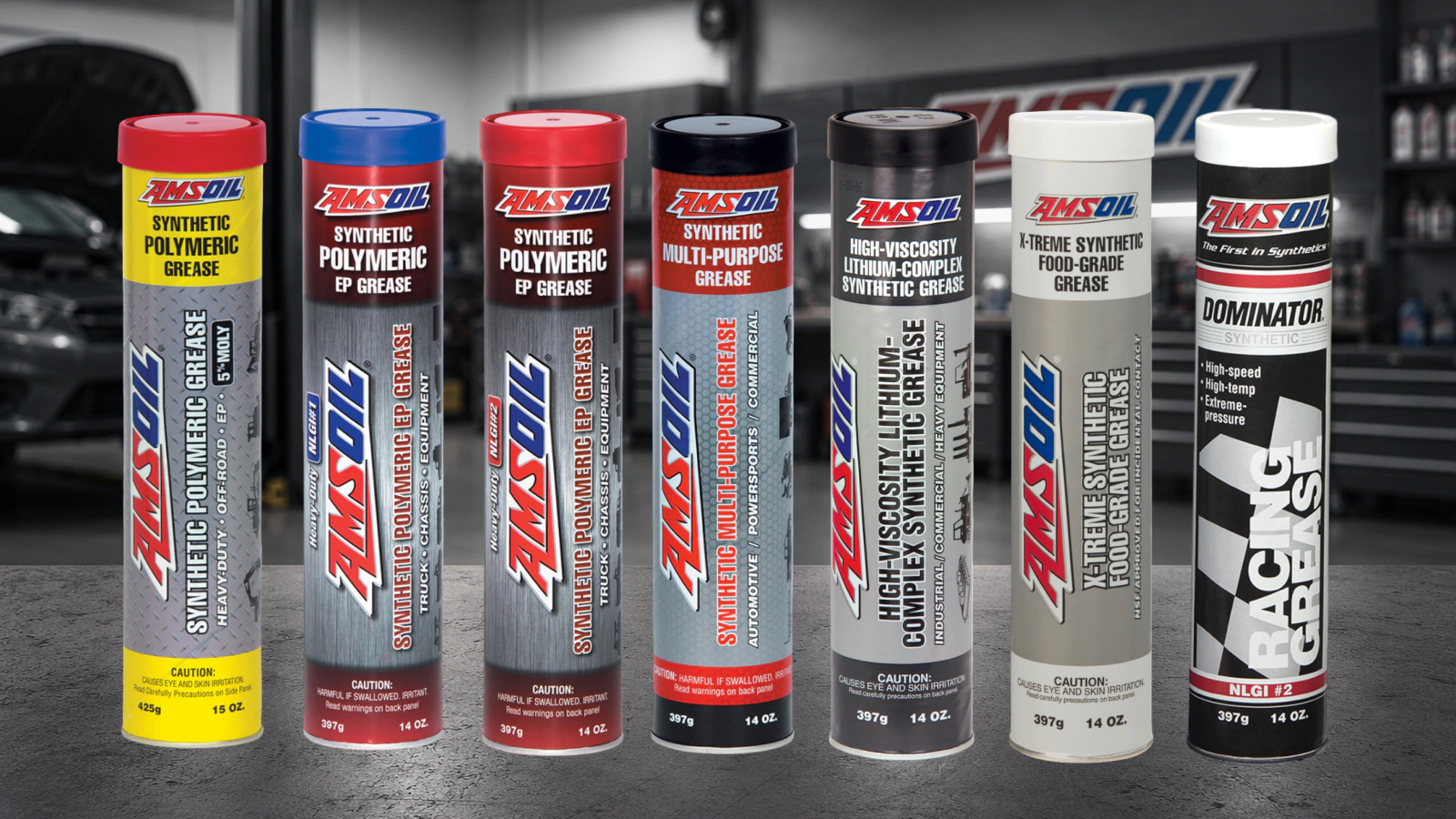
AMSOIL offers synthetic and specialised greases for automotive, commercial, industrial, agricultural and equipment applications. This guide explains the main factors to consider and where each product fits within the range.
Which AMSOIL Grease Should I Use?
The following table provides a starting point for selecting an AMSOIL grease according to its intended application.
| Application | Recommended AMSOIL Grease |
|---|---|
| Automotive wheel bearings and general chassis lubrication | AMSOIL Synthetic Multi-Purpose Grease (GLC) |
| Boat trailers, wet environments and frequent water exposure | AMSOIL Synthetic Water-Resistant Grease (GWR) |
| Racing wheel bearings and chassis components | AMSOIL DOMINATOR Synthetic Racing Grease (GRG) |
| Trucks, U-joints, kingpins, ball joints and chassis components | AMSOIL Polymeric Truck, Chassis & Equipment Grease (GPTR1 / GPTR2) |
| Construction, agricultural, mining and off-road equipment | AMSOIL Polymeric Off-Road Grease (GPOR1 / GPOR2) |
| Fifth-wheel hitches and heavily loaded sliding applications | AMSOIL Polymeric Off-Road Grease (GPOR1 / GPOR2) |
| Severe industrial and slow, heavily loaded applications | AMSOIL High-Viscosity Lithium-Complex Grease (GVC) |
| Food-processing and pharmaceutical equipment | AMSOIL X-Treme Food-Grade Grease (GXC) |
| Hinges, latches, springs, cables and difficult-to-reach lubrication points | AMSOIL Spray Grease (GSP) |
Important: This table is a general selection guide. Always consider the equipment manufacturer's grease specification, required NLGI grade, operating conditions and compatibility with any grease already in the component.
Choosing Grease for Automotive Applications
Wheel-Bearing and Chassis Grease
There is no single grease that is automatically the best choice for every wheel bearing. The operating environment determines which formulation is most appropriate.
For normal automotive wheel bearings and general chassis lubrication, AMSOIL Synthetic Multi-Purpose Grease (GLC) is a logical starting point. It is an NLGI #2 grease suited to common automotive bearing and chassis applications.
Where wheel bearings are regularly exposed to water, such as on boat trailers or equipment operating in wet environments, AMSOIL Synthetic Water-Resistant Grease (GWR) is generally the more appropriate choice because resistance to water washout becomes an important part of the lubrication requirement.
Competition vehicles can place considerably greater loads, temperatures and speeds on bearings and chassis components. AMSOIL DOMINATOR Synthetic Racing Grease (GRG) is intended for these demanding racing applications rather than as the default recommendation for an ordinary road vehicle.
AMSOIL Greases for Automotive and Recreational Use

Resists thermal and oxidation degradation for long-term performance. Outstanding low-temperature pumpability and torque value, improving cold-season operability. Adhesive and shear-stable to prevent squeeze out. Excellent load-carrying and EP performance
VIEW PRODUCT →
Superior Lubrication and Protection in Automotive, Powersports and Industrial Applications. Specially formulated for wet-duty performance. Excellent water-washout resistance to stay in place longer. Exceptional protection from corrosion. Outstanding load-
VIEW PRODUCT →
Exceptional High-Speed/High-Temperature Performance. Excellent for high-speed, high-heat and heavily loaded bearings. Superior friction-reducing properties. Exceptional mechanical stability. Outstanding low-temperature pumpability.
VIEW PRODUCT →Understanding NLGI Grease Grades
The National Lubricating Grease Institute (NLGI) consistency grade describes how firm or soft a grease is. It is not a quality rating, and a higher number does not necessarily mean better lubrication or greater protection.
What Is the Difference Between NLGI #1 and #2?
NLGI #2 is the familiar consistency used in many general automotive, bearing and chassis applications. It has a relatively firm texture and is commonly used where grease must remain in place within a component.
NLGI #1 is softer and more pumpable. This can be advantageous in colder conditions, centralised lubrication systems or equipment where the manufacturer specifies a softer grease.
AMSOIL offers both NLGI #1 and #2 versions of its Polymeric Truck, Chassis & Equipment Grease and Polymeric Off-Road Grease. The correct choice depends on the equipment's requirements rather than automatically selecting the firmer NLGI #2 grade.
Why Base-Oil Viscosity Matters
Grease contains lubricating oil held within a thickener system. While the thickener gives grease its semi-solid consistency, the oil performs much of the actual lubrication between moving surfaces.
The viscosity of this base oil is therefore an important consideration. A heavy base oil can help maintain a lubricating film under high loads and relatively low speeds, while a lower-viscosity base oil may be more appropriate for certain faster-running bearings.
This means an NLGI #2 grease is not necessarily suitable for every application requiring another NLGI #2 grease. Two products can have the same consistency grade but very different base-oil viscosities, thickener systems and intended uses.
For example, AMSOIL High-Viscosity Lithium-Complex Grease (GVC) is designed for severe, heavily loaded industrial and off-road applications. Its high-viscosity formulation should not be interpreted as a universal upgrade over general-purpose grease, particularly in applications where bearing speed or other operating requirements favour a different formulation.
Grease for Trucks and Heavy Equipment
Commercial vehicles and heavy equipment expose lubricated components to high loads, vibration, shock loading, contamination and long operating periods. U-joints, kingpins, ball joints, steering linkages, pins and bushes may demand more from a grease than a typical passenger-vehicle application.
Truck, Chassis and Equipment Grease
AMSOIL Polymeric Truck, Chassis & Equipment Grease is intended for heavy-duty truck, fleet and equipment lubrication. It is available in NLGI #1 and #2 grades to accommodate different operating and lubrication-system requirements.
Off-Road Equipment Grease
Construction, agricultural, mining and other off-road machinery can expose grease to severe loads, shock loading, dirt and demanding operating conditions.
AMSOIL Polymeric Off-Road Grease is designed for these environments, including heavily loaded pins, bushes and other grease-lubricated equipment components. Like the truck and chassis formulation, it is available in both NLGI #1 and #2 grades.
Fifth-Wheel and Sliding Applications
Fifth-wheel hitches present a different lubrication challenge from rolling bearings. They rely on sliding contact under substantial loads, requiring grease with suitable load-carrying characteristics and the ability to remain on exposed surfaces.
AMSOIL Polymeric Off-Road Grease is a suitable current option for heavily loaded sliding applications such as fifth-wheel hitches, subject to the equipment manufacturer's requirements.
AMSOIL Greases for Commercial and Off-Road Equipment

Heavy-duty synthetic grease for trucks, commercial vehicles and equipment. NLGI #1 consistency provides improved pumpability for suitable centralised lubrication systems while protecting heavily loaded chassis and equipment components.
VIEW PRODUCT →
Formulated for medium- and heavy-duty applications. Superior extreme-pressure and corrosion protection. Excellent wear protection over extended service intervals. Helps seal out contaminants. Calcium-sulfonate complex thickener.
VIEW PRODUCT →
Formulated for medium- and heavy-duty applications. Superior extreme-pressure and corrosion protection. Excellent wear protection over extended service intervals. Helps seal out contaminants. Calcium-sulfonate complex thickener.
VIEW PRODUCT →
Outstanding extreme-pressure protection. Stays in place to help seal out contaminants. Resists impact from shock loads. Extends greasing intervals. Excellent water resistance.
VIEW PRODUCT →Water-Resistant Grease for Marine and Wet Environments
Water contamination can displace grease, encourage corrosion and reduce lubrication performance. Boat trailers, marine equipment, agricultural machinery and equipment routinely cleaned with water can therefore benefit from a grease specifically formulated to resist water washout.
AMSOIL Synthetic Water-Resistant Grease is designed for applications where exposure to water is a major consideration. It is particularly useful for boat-trailer wheel bearings and other equipment operating in wet or muddy conditions.
However, water resistance is only one part of grease selection. Bearing speed, operating temperature, load, required consistency and manufacturer specifications must also be considered.
Specialised Greases for Demanding Applications
High-Viscosity Industrial Grease
Slow-moving, heavily loaded machinery may require a grease formulated with a particularly high-viscosity base oil to maintain a protective lubricating film.
AMSOIL High-Viscosity Lithium-Complex Grease (GVC) is intended for severe industrial and equipment applications where high loads and relatively low operating speeds place substantial demands on lubrication.
Food-Grade Grease
Food-processing and pharmaceutical machinery can require lubricants suitable for applications where incidental food contact may occur. Ordinary automotive or industrial grease should not be substituted simply because the mechanical component appears similar.
AMSOIL X-Treme Food-Grade Grease (GXC) is designed for food-processing and other applications requiring an appropriate food-grade lubricant while also providing wear protection and resistance to water exposure.
Always confirm the relevant food-grade classification and any additional equipment or facility requirements before selecting a lubricant.
Spray Grease for General Maintenance
Some lubrication points do not require a conventional grease cartridge or grease gun. Hinges, latches, springs, cables and difficult-to-reach mechanisms can be more conveniently lubricated using an aerosol product.
AMSOIL Spray Grease (GSP) is designed to penetrate into hard-to-reach areas before leaving behind a grease film, making it useful for automotive, workshop and general maintenance applications.
AMSOIL Specialised Greases

Formulated with EP additives and high-viscosity base oil for excellent protection. Protects against thermal and oxidative degradation. Resists water washout. Excels in extreme temperatures.
VIEW PRODUCT →
NSF-Approved Formula (formerly USDA H-1). Designed for use in food service and pharmaceutical industry equipment. Promotes maximum equipment performance and life. Exceptional performance over a wide temperature range. Resists water washout and protects ag
VIEW PRODUCT →
White lithium grease protects against wear and corrosion. Lubricates moving parts for smooth, squeak-free operation. Adheres to metal surfaces for long-lasting performance. Quick, convenient spray gets into hard-to-reach places. Excellent water resistance
VIEW PRODUCT →Can Different Greases Be Mixed?
Greases should not automatically be assumed to be compatible simply because they have the same NLGI grade, colour or intended application.
Different thickener systems can interact when mixed, potentially changing grease consistency, oil separation, mechanical stability or temperature performance. These changes can reduce the effectiveness of the lubricant and, in some circumstances, contribute to component lubrication problems.
When changing from one grease to another, check compatibility wherever possible. In critical equipment, removing or purging the existing grease before introducing a different formulation is preferable to repeatedly topping up an unknown or potentially incompatible product.
Where complete removal is impractical, follow the equipment manufacturer's lubrication and changeover recommendations.
Does Grease Colour Matter?
Grease colour is often used by manufacturers to distinguish products, but it does not provide a reliable indication of grease chemistry, quality or suitability.
Two greases of the same colour may be designed for entirely different applications, while two greases intended for similar service may have different colours.
Grease should be selected according to its specifications, consistency, base-oil viscosity, thickener system, operating temperature, water resistance and load-carrying requirements rather than appearance.
How to Choose the Right Grease
The best starting point is the application. An ordinary automotive wheel bearing, a boat-trailer hub, an excavator pivot pin and a racing wheel hub may all require grease, but they place very different demands on the lubricant.
Before choosing a grease, consider the following:
- Application: Is the grease lubricating a bearing, chassis joint, sliding surface or heavy-equipment component?
- NLGI grade: What consistency does the equipment manufacturer require?
- Base-oil viscosity: Is the component operating at high speed, low speed or under heavy loads?
- Temperature: What operating temperatures will the grease encounter?
- Water exposure: Will the component be exposed to rain, washdown, immersion or muddy conditions?
- Compatibility: Is there an existing grease in the component, and can the products be safely mixed?
- Manufacturer specifications: Are particular grease classifications or performance requirements specified?
If the equipment manufacturer specifies a particular grease classification, consistency grade or performance requirement, follow that specification first. Where the requirement is more general, use the application guide above to identify the AMSOIL grease best suited to the operating conditions.
Selecting the correct grease is not simply about choosing the most expensive or heaviest-duty product. It is about matching the lubricant's characteristics to the component and the conditions in which it operates.