

Wind turbines are among the most recognisable forms of renewable energy infrastructure, but the machinery inside them is less familiar. Behind the enormous blades and towers are gearboxes, bearings, hydraulic systems and electrical equipment that rely on specialised lubricants to operate reliably.
How much oil does a wind turbine use? A geared wind turbine can contain anywhere from approximately 150 litres to more than 3,000 litres of gearbox oil, depending on its size and drivetrain design. According to AMSOIL Industrial, typical gearbox oil capacities range from 300–475 litres for 1.5–2.5 MW turbines to 1,135–3,000+ litres for large offshore turbines.
These quantities refer to the oil held within the gearbox lubrication system, not the amount consumed each year. Wind turbines may also require lubricants for bearings, pitch and yaw mechanisms, and hydraulic systems. Oil-filled electrical transformers contain additional insulating fluid, which serves a completely different purpose.
How Much Oil Does a Wind Turbine Gearbox Hold?
In a conventional geared wind turbine, the main gearbox transfers mechanical power from the slowly rotating rotor to the generator. The gearbox increases rotational speed through multiple gear stages and must transmit substantial torque under continuously changing operating conditions.
The gearbox contains industrial gear oil that lubricates gears and bearings, removes heat and helps protect internal components against wear and corrosion.
AMSOIL Industrial publishes the following typical oil capacities for different wind turbine classes:
| Wind Turbine Class | Typical Gearbox Oil Capacity |
|---|---|
| Sub-MW / legacy turbines (under 1 MW) | 150–285 litres |
| Utility-scale turbines (1.5–2.5 MW) | 300–475 litres |
| High-capacity onshore turbines (3 MW+) | 570–950+ litres |
| Offshore turbines (6–15 MW) | 1,135–3,000+ litres |
Source: AMSOIL Industrial – Wind Turbine Lubrication . These are indicative ranges published by AMSOIL, not specifications for individual turbine or gearbox models.
Oil capacity is influenced by the gearbox manufacturer, internal design, lubrication circuit and associated cooling equipment. Two turbines with similar power ratings may require different quantities of lubricant.
The correct oil capacity and lubricant specification must always be confirmed against the equipment manufacturer's maintenance documentation.
Do All Wind Turbines Have Gearboxes?
No. Wind turbines generally use either geared or direct-drive drivetrains.
Geared turbines use a gearbox to increase rotor speed before transferring mechanical power to the generator. These turbines require a dedicated main gearbox lubrication system.
Direct-drive turbines use generators designed to operate at lower rotational speeds, eliminating the main speed-increasing gearbox.
However, direct-drive turbines still contain bearings, pitch and yaw mechanisms, and other components that may require lubrication. Eliminating the main gearbox does not eliminate the need for lubricants throughout the turbine.
Where Are Lubricants Used in Wind Turbines?
Wind turbines contain several mechanical systems with different lubrication requirements. Gear oils, greases and hydraulic fluids may all be used within the same turbine.
The following AMSOIL illustration provides a generic, simplified overview of common lubrication points in a geared wind turbine.
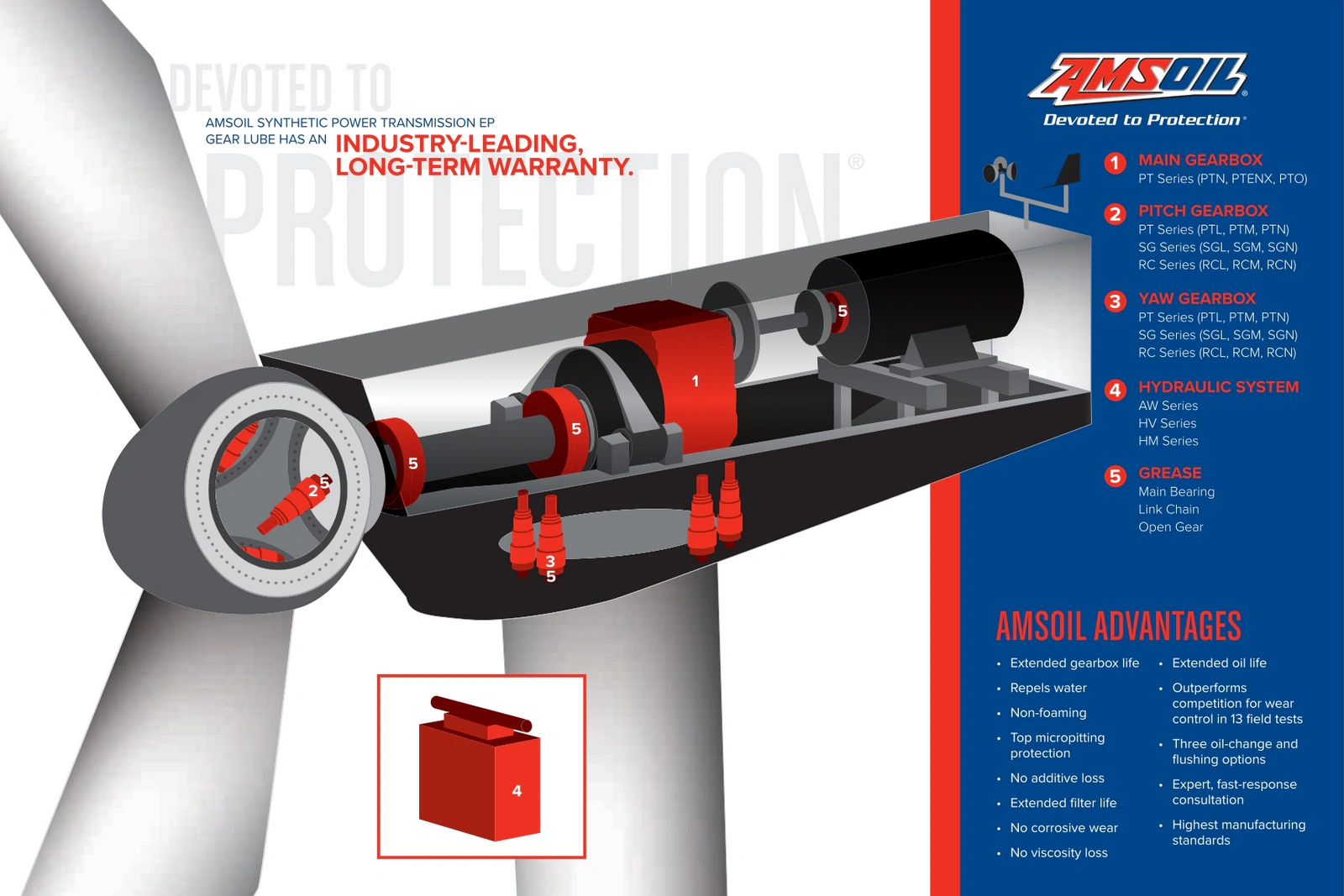
Main Gearbox
The main gearbox is one of the most demanding lubrication applications in a geared wind turbine. Its gears and bearings operate under substantial loads while experiencing fluctuating torque, vibration and changing temperatures.
Specialised industrial gear oils are formulated to protect against wear, scuffing, micropitting, oxidation and corrosion. Synthetic lubricants are commonly used where extended service life and reliable performance across a broad operating temperature range are required.
Main Shaft and Generator Bearings
Main shaft bearings support the rotor and transfer mechanical loads into the drivetrain. These large bearings may operate at relatively low rotational speeds while experiencing substantial and changing loads.
Depending on the turbine design, main shaft and generator bearings may use specialised greases or circulating oil lubrication. Suitable lubrication helps protect against wear, corrosion and damage associated with repeated mechanical loading.
Pitch Systems
The pitch system adjusts the angle of the turbine blades to regulate power generation and manage aerodynamic loads.
Pitch mechanisms may include bearings, gears and electric or hydraulic actuators. These components can experience repeated small movements, vibration and changing loads, making appropriate wear and fretting protection important.
Yaw Systems
The yaw system rotates the nacelle to keep the rotor aligned with the wind.
Yaw drives use geared mechanisms, while large yaw bearings support the rotating nacelle. These components require suitable lubricants to protect against wear, corrosion and heavy loading.
Depending on the design, yaw systems may use enclosed gear oils, bearing greases and open gear lubricants.
Hydraulic Systems
Some wind turbines use hydraulic systems for braking, blade-pitch control or other auxiliary functions.
Hydraulic fluids transmit power while lubricating pumps, valves and other internal components. Fluid selection depends on operating temperature, equipment design, material compatibility and manufacturer requirements.
What Type of Oil Is Used in Wind Turbine Gearboxes?
Wind turbine gearboxes commonly use specialised industrial gear oils, frequently formulated with synthetic base oils. These products are designed for enclosed industrial gearing rather than automotive engine lubrication.
Important lubricant performance characteristics include:
- Wear protection: Maintaining a protective lubricant film between heavily loaded gears and bearings.
- Micropitting resistance: Helping protect gear tooth surfaces against fatigue-related damage.
- Oxidation stability: Resisting lubricant degradation during extended service.
- Viscosity performance: Maintaining suitable lubricant film thickness across operating temperatures.
- Water separation and corrosion protection: Managing moisture contamination and protecting internal components.
- Foam control and filterability: Supporting reliable oil circulation, filtration and lubrication system operation.
The correct lubricant must satisfy the gearbox manufacturer's requirements. Viscosity grade, performance specifications, approvals and compatibility requirements can differ between gearbox models.
A lubricant suitable for one wind turbine gearbox should not automatically be assumed suitable for another.
How Often Is Wind Turbine Gearbox Oil Changed?
There is no universal oil-change interval for every wind turbine.
Service requirements depend on the gearbox design, lubricant formulation, operating conditions, contamination levels and maintenance programme.
AMSOIL Industrial reports that some synthetic wind turbine gearbox lubricant applications can achieve oil-change intervals of 7–15 years when supported by appropriate condition monitoring. This is an application-dependent possibility, not a guaranteed service interval.
Because wind turbines can be difficult and expensive to service, operators often use lubricant condition monitoring to assess oil health and identify developing equipment problems.
Oil analysis may examine:
- Viscosity changes and oxidation
- Water and moisture contamination
- Wear metals and other particles
- Lubricant cleanliness
- Changes in additive condition
Filtration, contamination control and correct oil handling are also important parts of gearbox maintenance.
Replacing oil unnecessarily increases maintenance costs, while leaving degraded or contaminated lubricant in service may increase the risk of component damage. Maintenance decisions should follow manufacturer requirements and an appropriate condition-monitoring programme.
Do Wind Turbine Transformers Also Contain Oil?
Yes. In addition to the lubricants used in mechanical components, wind farms may contain substantial quantities of transformer insulating oil.
However, transformer oil is not the same as gearbox oil.
Transformers change voltage levels so electricity generated by wind turbines can be transmitted efficiently. Where oil-filled transformers are used, the fluid performs two primary functions:
- Electrical insulation: Helping prevent electrical breakdown between energised components.
- Cooling: Transferring heat away from transformer windings and other internal components.
Transformer insulating fluids may be mineral-based oils or alternative dielectric fluids, including certain natural and synthetic esters.
Transformers Associated with Individual Turbines
Individual wind turbines commonly use step-up transformers to increase the voltage of their electrical output. Depending on the design, these may be installed within the tower, in the nacelle or externally.
Some transformers are oil-filled, while others use dry-type technology.
As an Australian example, environmental assessment documentation for Sapphire Wind Farm in New South Wales identified the possibility of oil-filled turbine transformers containing approximately 1,000 litres of oil each. This was a planning-stage equipment allowance, not a confirmed capacity for every installed transformer.
Wind Farm Substation Transformers
Wind farms also require larger electrical transformers at substations to connect their electricity output to the transmission or distribution network.
These transformers can contain tens of thousands of litres of insulating fluid, considerably more than the gearbox oil capacity of an individual turbine. The exact quantity depends on the transformer design and electrical rating.
Importantly, this is oil contained in the wind farm's electrical infrastructure, not additional lubricant inside each turbine gearbox.
Transformer insulating fluids and mechanical gear lubricants have fundamentally different performance requirements and are not interchangeable.
Does a Wind Turbine Consume Oil While Operating?
The amount of oil held by a wind turbine should not be confused with its annual oil consumption.
Most wind turbine gearboxes use enclosed lubrication systems. Oil circulates through the gearbox, lubricating components before returning to the reservoir or circulation system.
Unlike fuel, the oil is not deliberately consumed to generate electricity.
Some oil may be lost through leakage, maintenance procedures or other equipment-related issues, and top-ups may occasionally be required.
Oil is also removed and replaced during scheduled changes or when its condition no longer meets the equipment's requirements.
Consequently, a gearbox holding 500 litres of oil does not necessarily use 500 litres every year. Its annual replacement requirement depends on the actual maintenance interval, oil condition and operating circumstances.
Why Is Wind Turbine Lubrication So Demanding?
Wind turbines operate in environments where maintenance can be difficult, expensive and time-consuming.
Changing wind speeds and directions produce fluctuating torque, vibration and repeated mechanical loading. These conditions place significant demands on gears, bearings and lubrication systems.
Environmental exposure creates further challenges. Offshore turbines may encounter salt-laden air and high humidity, while inland installations can experience substantial seasonal and daily temperature variations.
Maintenance access is another important consideration. Servicing machinery high inside a turbine tower may require specialist technicians, pumping equipment and periods of turbine downtime.
Effective lubricant selection, contamination control and condition monitoring are therefore important parts of maintaining reliable wind turbine operation.

AMSOIL Lubricants for Wind Turbine Applications
AMSOIL offers specialised industrial lubricants for demanding wind energy applications, including main gearboxes, bearings, pitch and yaw systems, open gearing and hydraulic equipment.
AMSOIL Synthetic Power Transmission EP Gear Lubricants
AMSOIL Synthetic Power Transmission EP Gear Lubricants, including the PT Series, are designed for heavily loaded industrial power transmission applications.
These synthetic gear lubricants are formulated to provide protection against gear wear and micropitting while supporting reliable performance under demanding operating conditions.
Different PT Series formulations and generations may have different technical characteristics, specifications and approvals.
Lubricant selection must be based on the requirements of the particular gearbox. A newer product generation should not automatically be assumed to be an approved replacement for an earlier formulation.
Other Wind Turbine Lubrication Applications
Beyond the main gearbox, the AMSOIL Industrial range includes specialised greases, gear oils and other lubricants for components such as main bearings, pitch and yaw mechanisms and hydraulic systems.
The appropriate product depends on the equipment manufacturer's requirements, operating conditions and lubricant compatibility.
For information about the AMSOIL wind turbine lubricant range available in Australia, including industrial gear oils and other lubrication applications, visit our dedicated wind energy page.
Explore AMSOIL Wind Turbine Lubricants →
How Much Oil Does a Wind Turbine Use? The Bottom Line
There is no single oil capacity that applies to every wind turbine.
According to AMSOIL Industrial's published indicative figures, smaller geared turbines may contain approximately 150–285 litres of gearbox oil, while large offshore turbines may require more than 3,000 litres.
Additional lubricants may be used in bearings, pitch and yaw mechanisms, hydraulic systems and other mechanical components.
Oil-filled electrical transformers can contain substantial quantities of insulating fluid, particularly at wind farm substations, but this is separate from the oil used to lubricate turbine machinery.
Finally, oil capacity should not be mistaken for annual oil consumption. Gearbox lubricants circulate within enclosed systems and are maintained or replaced according to equipment requirements and lubricant condition.
Understanding these distinctions is essential when comparing wind turbine oil capacities, planning maintenance and selecting appropriate industrial lubricants.
Sources and Further Reading
- AMSOIL Industrial – Wind Turbine Lubrication – published gearbox oil-capacity ranges, lubrication applications and maintenance information.
- NSW Planning Portal – Sapphire Wind Farm – project environmental assessment and electrical infrastructure documentation.
Image credits: Crookwell 2 Wind Farm photograph by Nick-D, via Wikimedia Commons . Licensed under CC BY-SA 4.0 . Converted to WebP. Wind turbine lubrication diagram courtesy of AMSOIL.