
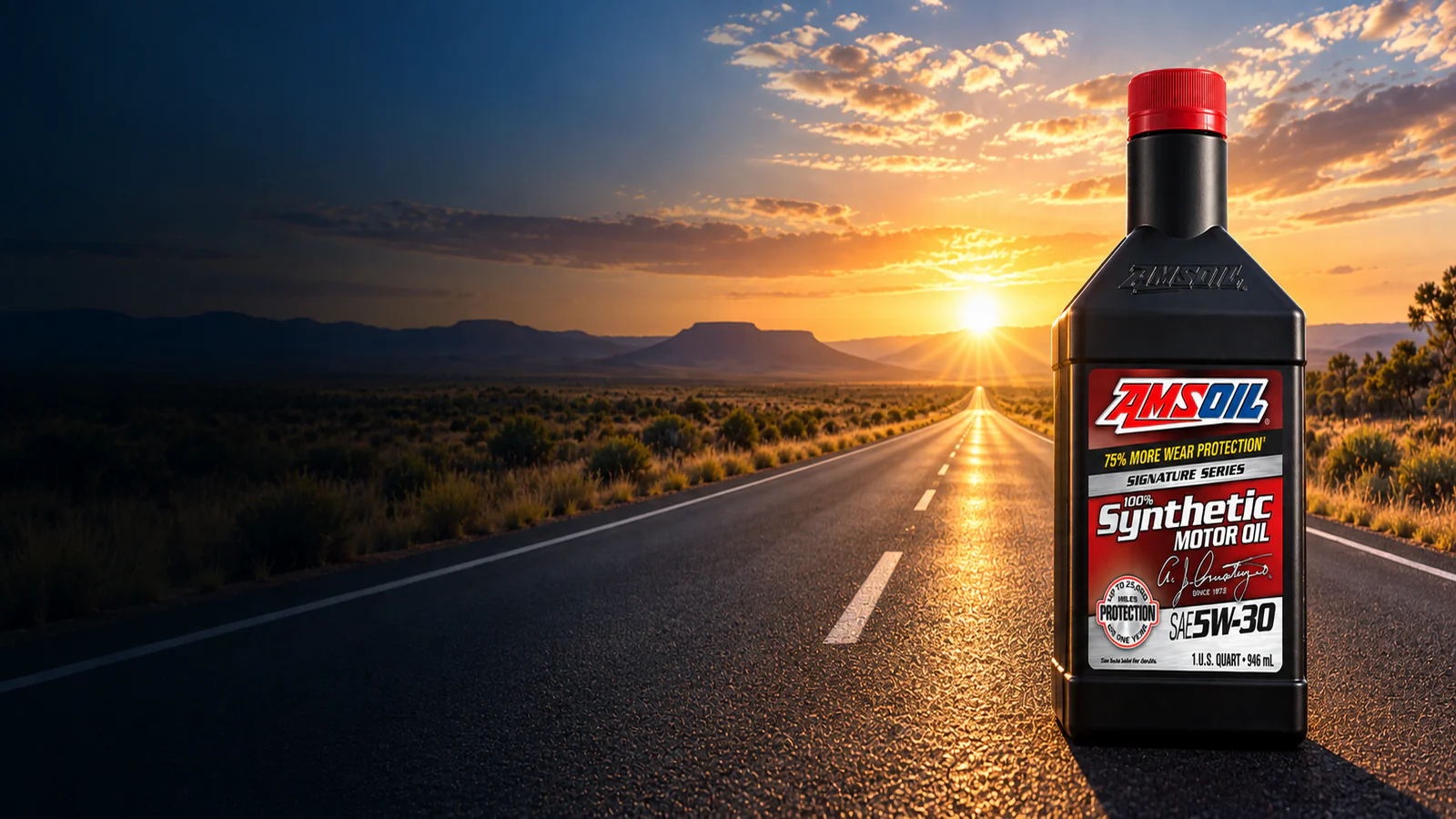
Most Australian drivers are accustomed to changing engine oil somewhere around the service interval specified by their vehicle manufacturer. So when an engine oil carries a recommendation of up to 25,000 miles (40,200 km) or one year, the obvious question is: how can an oil possibly remain in service that long?
The answer is not simply "because it is synthetic". Engine oil does not suddenly expire when the odometer reaches a particular number. Its useful service life depends on whether it can continue controlling wear, deposits, oxidation, acids and contaminants while maintaining the viscosity and other properties required to protect the engine.
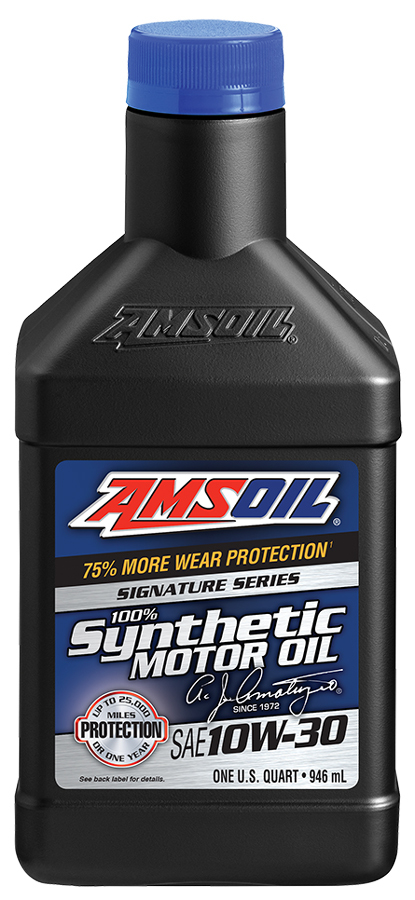
AMSOIL Signature Series 100% Synthetic Motor Oil is formulated for extended drain intervals of up to 25,000 miles (40,200 km) or one year under qualifying normal-service conditions. Understanding how that is possible requires looking at what actually happens to engine oil as it ages.
What Actually Wears Engine Oil Out?
Engine oil works in an extremely hostile environment. It is repeatedly heated and cooled, exposed to oxygen and combustion by-products, subjected to mechanical stress and contaminated by material entering the crankcase.
Over time, several processes can limit the oil's useful service life.
- Oxidation: Heat and oxygen chemically degrade the oil, potentially increasing viscosity and contributing to varnish, sludge and deposits.
- Additive depletion: Detergents, dispersants, anti-wear additives, antioxidants and other components perform specific jobs and can be consumed or degraded during service.
- Fuel dilution: Fuel entering the crankcase can reduce viscosity and alter the lubricant's performance.
- Water and condensation: Moisture can accumulate, particularly during repeated short trips where the engine may not remain hot long enough to evaporate it.
- Combustion contaminants: Blow-by introduces combustion products that the oil must suspend and control.
- Viscosity change: Mechanical and chemical processes can cause an oil to become thinner or thicker during service.
An extended-drain oil therefore needs to do considerably more than provide good lubrication when it is first poured into the engine. It needs to retain the required performance after thousands of kilometres of heat cycles, contamination and engine operation.
Why Doesn't Synthetic Oil Oxidise as Quickly?
One advantage of high-quality synthetic base oils is their resistance to oxidation and thermal breakdown. Their more controlled molecular structure can provide greater stability than less highly refined conventional base stocks when exposed to prolonged high-temperature service.
Base oil is only part of the formulation, however. Extended service also places greater demands on the additive system. Antioxidants must help resist degradation, detergents and dispersants must continue controlling deposits and contaminants, and anti-wear chemistry must remain effective throughout the intended service interval.
It is not enough for an oil to meet its performance requirements when new. An oil intended for extended service must be formulated to continue protecting after substantial time and mileage in the engine.
Does Oil Suddenly Go Bad at the Service Interval?
No. A service interval is a maintenance limit, not a point where the lubricant suddenly changes from good oil to bad oil.
Manufacturers establish service intervals with appropriate margins for the vehicle, lubricant requirements and expected operating conditions. Different oils can also be formulated with different intended service lives.
This is why simply comparing two bottles labelled 5W-30 does not tell you how long each oil is designed to remain in service. SAE viscosity describes viscosity behaviour; it does not describe oxidation resistance, additive reserve, deposit control or intended drain interval.
How Does AMSOIL Test an Oil for 40,200 km?
AMSOIL has tested Signature Series using both standardised engine tests and extended real-world engine operation rather than relying solely on the properties of fresh oil.
One of its earlier demonstrations used Signature Series 5W-30 in a Ford F-150 EcoBoost, accumulating 100,000 miles (approximately 161,000 km) while using extended oil-change intervals of up to 25,000 miles. The programme included performance measurements and an engine teardown to examine wear and deposits.
AMSOIL demonstrates Signature Series extended-drain performance using a Ford F-150 EcoBoost.
A Newer 200,000 km Test
AMSOIL has since performed a more recent accumulation study using a 2025 Ford F-150 Raptor equipped with the high-output 3.5-litre EcoBoost engine.
The vehicle accumulated 125,000 miles (201,168 km), with Signature Series 5W-30 oil changes performed at 25,000-mile (40,234-km) intervals. AMSOIL measured horsepower and torque before and after the programme and reported that the engine maintained its horsepower and torque throughout the test.
AMSOIL also reports that the engine experienced no oil-screen plugging during the 125,000-mile accumulation study.
Five 25,000-mile oil-change intervals in a high-output 3.5L EcoBoost provide a useful demonstration of repeated extended-drain operation rather than a single unusually long oil change.
But What Does the Oil Look Like After 40,000 km?
The condition of used oil cannot be reliably judged by colour. Detergents and dispersants are designed to keep contaminants suspended in the lubricant, so an oil can become dark while continuing to perform its intended functions.
More useful measurements include viscosity, oxidation, contamination, additive condition and wear metals. Used-oil analysis can provide information about both lubricant condition and what is occurring inside a particular engine.
AMSOIL's recent testing also examined performance after ageing. In one modified Sequence IX test, Signature Series 5W-30 was first aged for 25,000 miles in the high-output Raptor engine before being evaluated for low-speed pre-ignition protection. AMSOIL reports that the used oil still delivered four times the piston protection against LSPI required by the industry benchmark used for the comparison.
What About Deposits and Sludge?
Keeping an oil in service longer would provide little benefit if the extended interval allowed excessive deposits to form.
AMSOIL evaluates Signature Series using standardised deposit tests as well as extended testing. In the Sequence IIIH test, AMSOIL reports that Signature Series 5W-30 provided 72% more protection against piston deposits than required by the applicable industry standard.
AMSOIL also ran the test for twice its standard duration. After the double-length test, it reported 31% better deposit protection than the standard requirement.
That distinction matters for extended drains: the challenge is not merely passing a test when the oil is fresh, but maintaining cleanliness and protection as the lubricant ages.
Does 40,200 km Mean Everyone Should Drive 40,200 km Between Oil Changes?
No. The words "up to" are important.
AMSOIL Signature Series is recommended for up to 25,000 miles (40,200 km) or one year under qualifying normal-service conditions. The correct interval depends on the product, vehicle, application and operating conditions.
Vehicles operated under severe service can require shorter intervals. Frequent towing or hauling, extensive idling, commercial or fleet operation and dusty environments can place additional demands on the lubricant.
Always follow the applicable AMSOIL product recommendations for the vehicle and operating conditions. Where warranty or manufacturer servicing requirements apply, those requirements should also be considered.
Normal Service vs Severe Service
How a vehicle accumulates kilometres can be just as important as the number on the odometer.
Long periods of stable-temperature highway driving can be comparatively easy on engine oil. Repeated short trips, excessive idling, towing, heavy loads and dusty operation can expose the oil to very different conditions.
This is why an extended-drain recommendation should never be interpreted as simply "this oil lasts 40,000 km in every engine".
What About the Oil Filter?
An extended oil interval also requires an appropriate filtration strategy. The engine continues producing and collecting contaminants regardless of how slowly the lubricant itself degrades.
The oil filter therefore needs sufficient efficiency, capacity and service life for the intended interval. AMSOIL Ea Oil Filters are designed for extended service, with applicable EaO filters carrying recommendations that complement Signature Series extended drain intervals.
Where a filter has a shorter recommended service life than the engine oil, the filter must be changed at its required interval rather than simply being left in place because the oil remains serviceable.
Can Used-Oil Analysis Help?
Yes. Used-oil analysis can be particularly useful for enthusiasts, fleets and equipment owners who want to understand how a lubricant is performing in their specific application.
Analysis can track viscosity, wear metals, contamination and other indicators over time. Rather than guessing from oil colour or relying on anecdotal impressions, trend analysis can provide evidence about both the lubricant and the mechanical condition of the engine.
It is especially valuable when operating conditions are unusual or when establishing a maintenance programme for a fleet or heavily used vehicle.
Why Signature Series?
AMSOIL Signature Series sits at the top of the AMSOIL passenger-vehicle engine-oil range because it is formulated not only for high levels of protection, but also for long-term performance.
AMSOIL attributes its extended-drain capability to higher-quality base oils and a more robust additive system than products intended primarily for manufacturer-recommended oil-change intervals.
That distinction is important. Extended drain intervals should be supported by the formulation and its demonstrated performance - not assumed simply because an oil is labelled "full synthetic".
The Bottom Line
An extended oil-change interval is not about leaving old, worn-out oil in an engine for as long as possible. It is about using a lubricant specifically formulated to resist the processes that normally bring an engine oil to the end of its useful service life.
Oxidation resistance, viscosity stability, deposit control, additive durability and contamination management all contribute to how long an oil can remain in service.
AMSOIL Signature Series is designed and tested around that principle, with qualifying applications carrying recommendations of up to 25,000 miles (40,200 km) or one year. The appropriate interval still depends on the vehicle and how it is used - but the engineering behind extended drains is considerably more sophisticated than simply "changing the oil less often".
Choose Your Signature Series Motor Oil
AMSOIL Signature Series 100% Synthetic Motor Oil is available in a range of viscosity grades to suit different engines and manufacturer requirements. Each is formulated around the same premium Signature Series approach to wear protection, deposit control, oxidation resistance and extended-drain performance.
Always use the viscosity and specifications appropriate for your engine. If you're unsure which product is suitable for your vehicle, use the AMSOIL Vehicle Lookup below.
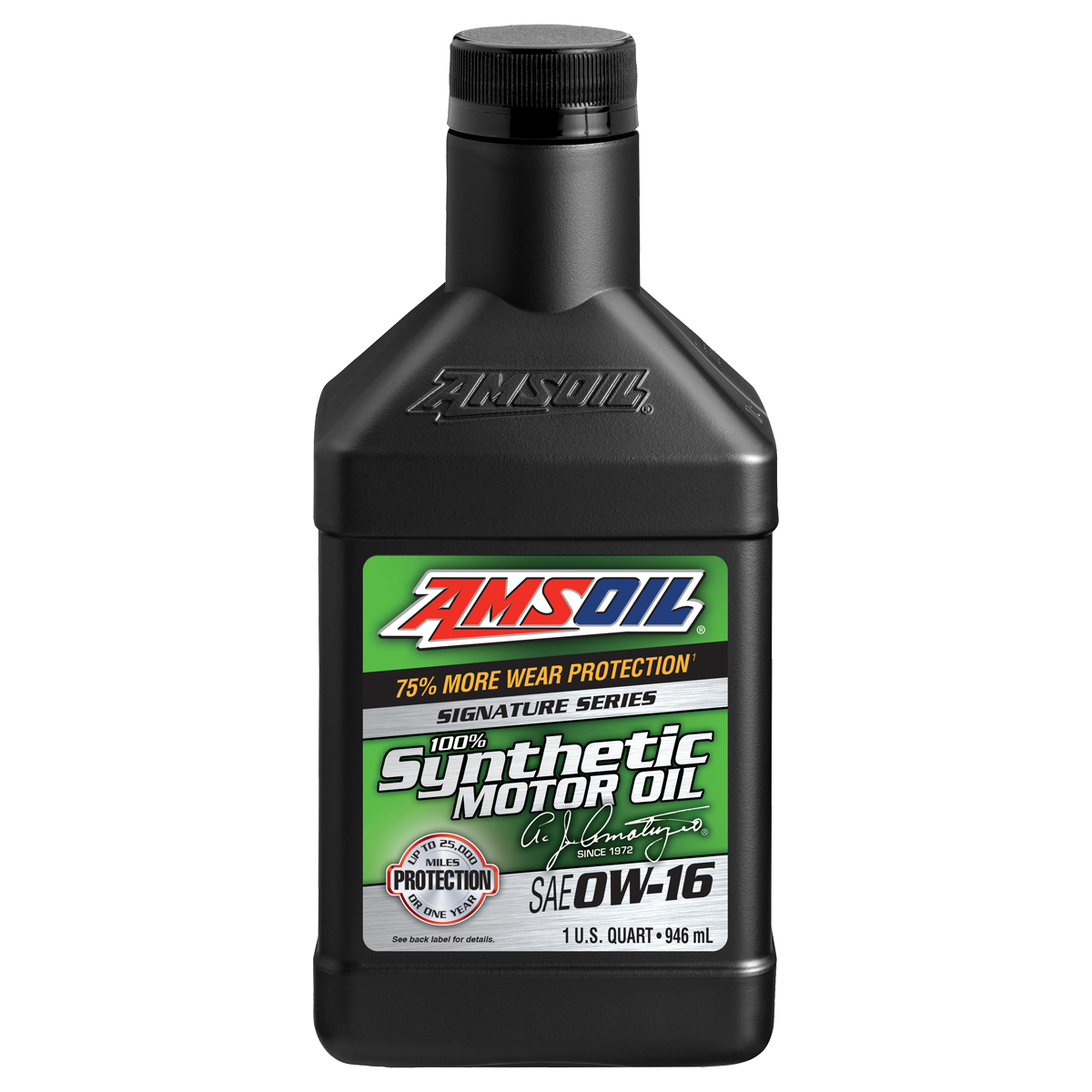
100% Synthetic Motor Oil View Product ›
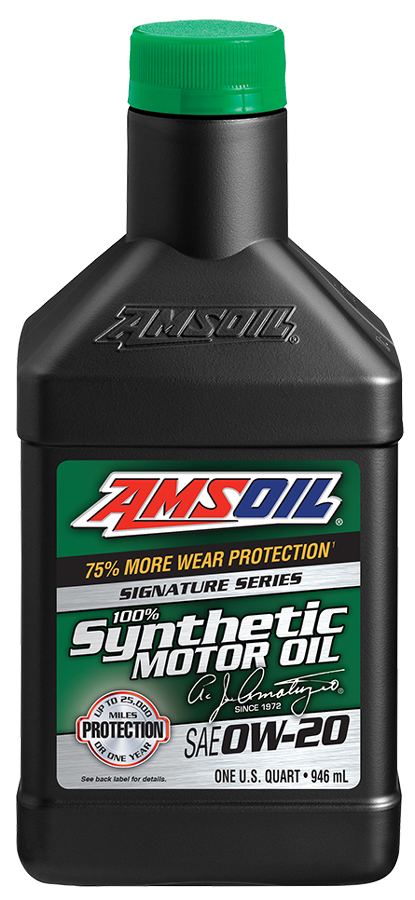
100% Synthetic Motor Oil View Product ›
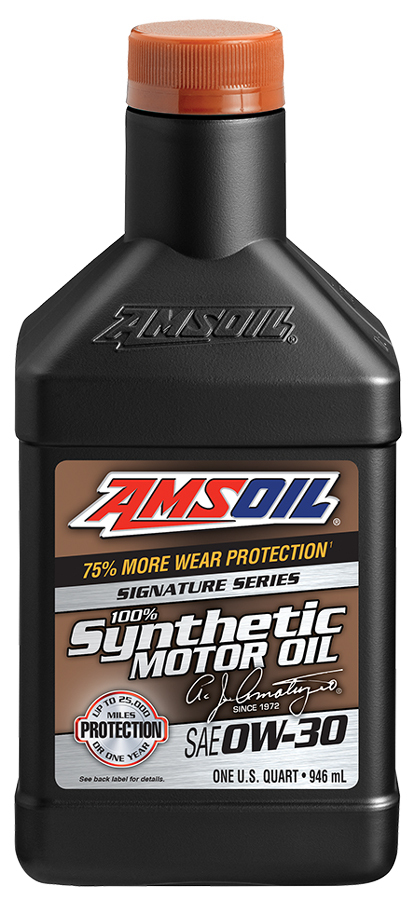
100% Synthetic Motor Oil View Product ›
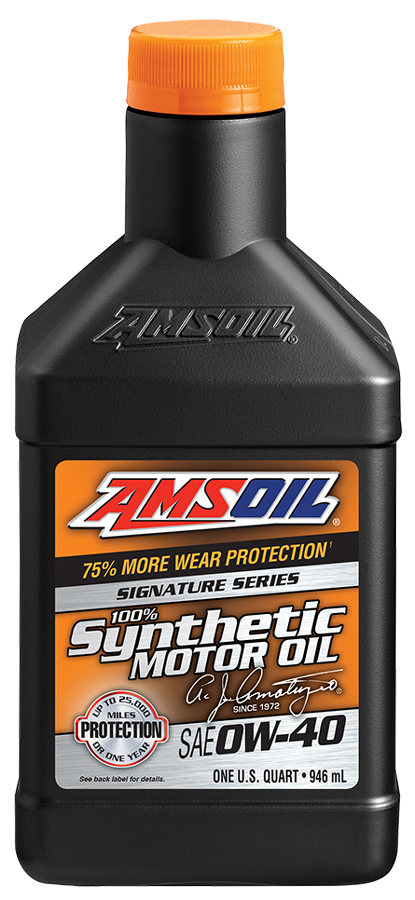
100% Synthetic Motor Oil View Product ›
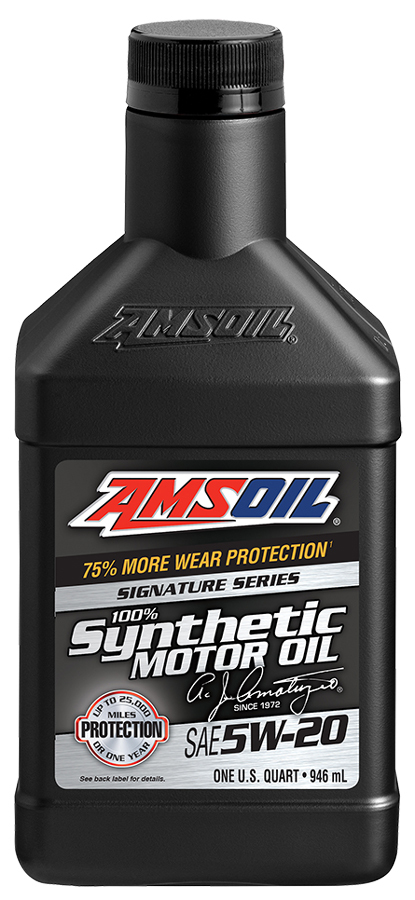
100% Synthetic Motor Oil View Product ›
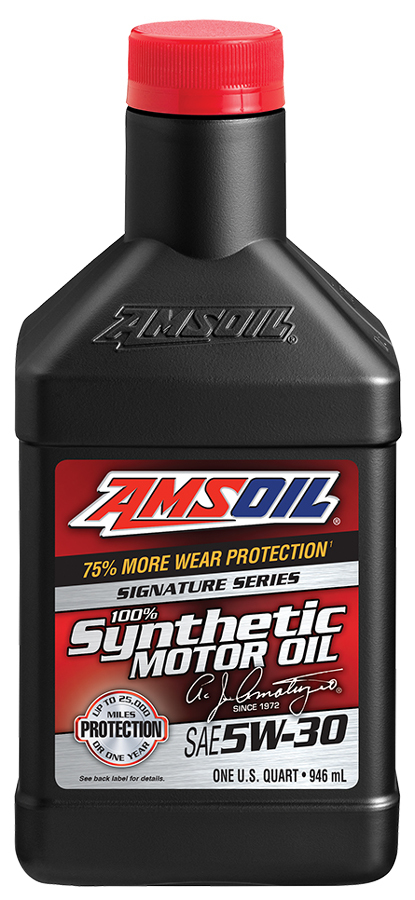
100% Synthetic Motor Oil View Product ›
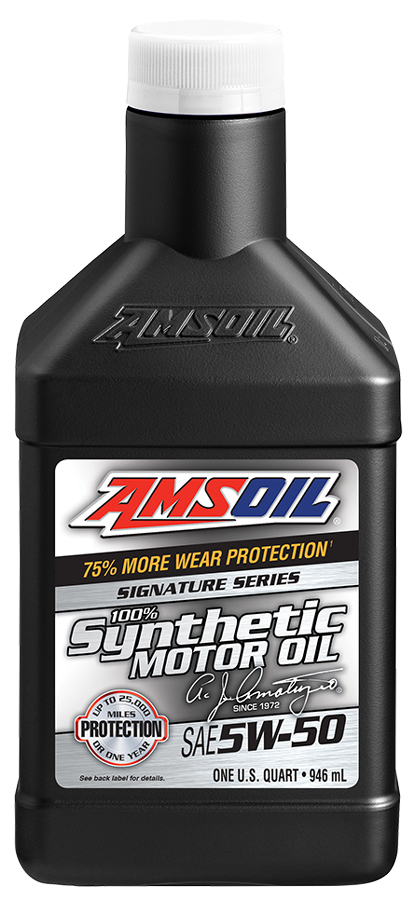
100% Synthetic Motor Oil View Product ›
100% Synthetic Motor Oil View Product ›