
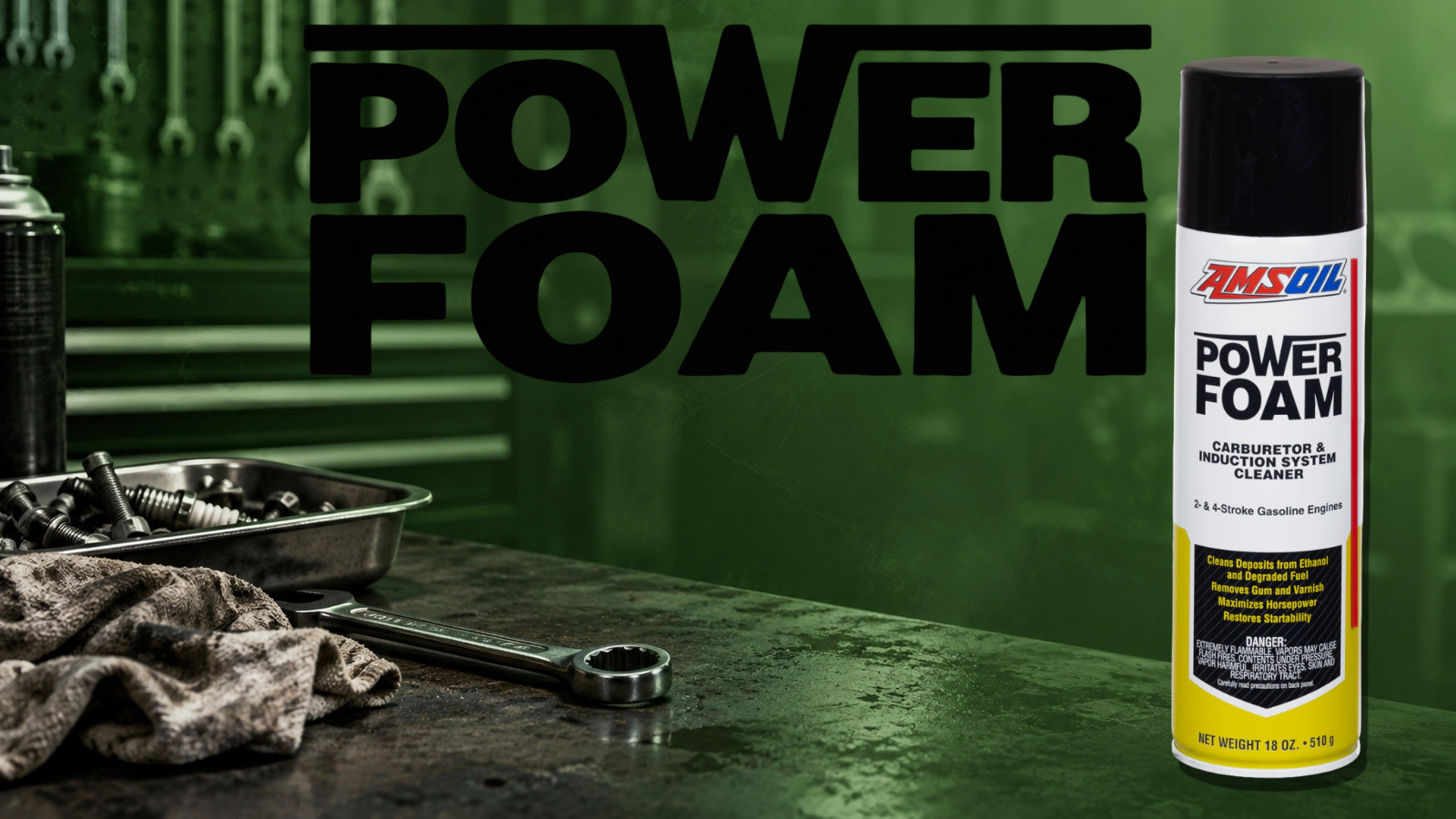
AMSOIL Power Foam is easy to mistake for a product intended mainly for lawn mowers and other small engines. In reality, its uses extend much further. Power Foam is a foaming carburettor and induction-system cleaner designed to attack stubborn deposits, gum and varnish in two- and four-stroke petrol engines.
It can be used to clean dirty carburettors and suitable induction systems, but it is also useful when working on an engine that has already been pulled apart. Carbon-covered pistons, valves, combustion chambers and cylinder-head ports are all examples of components where Power Foam can help soften stubborn deposits during an engine rebuild.
What Is AMSOIL Power Foam?
AMSOIL Power Foam Carburetor and Induction-System Cleaner uses powerful foaming agents to attack deposits left behind by fuel, combustion and extended periods of storage.
Unlike a conventional liquid cleaner that can quickly run away from the area being treated, Power Foam expands and clings to surfaces. This gives the cleaner time to work on deposits before the material is flushed, wiped or carried through the engine during the appropriate cleaning procedure.
AMSOIL specifically identifies gum and varnish from degraded fuel and ethanol-related deposits among the contaminants Power Foam is designed to remove.
What Can You Use Power Foam For?
Although small engines are one of its most useful applications, Power Foam is not simply a lawn mower carburettor cleaner. Depending on the engine and whether it is assembled or disassembled, Power Foam can be useful for several different cleaning jobs.
- Cleaning gum and varnish from carburettors
- Cleaning suitable petrol-engine induction systems
- Removing deposits associated with degraded or stale fuel
- Cleaning combustion deposits using the prescribed running-engine treatment
- Cleaning carbon from disassembled cylinder heads and ports
- Softening carbon deposits on valves and pistons during an engine rebuild
- Cleaning two-stroke equipment affected by fuel and combustion deposits
Cleaning Carburettors and Fuel Deposits
Carburettors are particularly vulnerable to fuel deposits. Petrol that sits for extended periods can deteriorate and leave gum and varnish behind. Small passages and moving components inside a carburettor do not need much contamination before starting, idling and throttle response begin to suffer.
This is one reason Power Foam is particularly useful for motorcycles, lawn equipment, generators, chainsaws and other equipment that may spend weeks or months between uses.
A dirty carburettor is not the cause of every hard-starting engine, of course. Ignition problems, mechanical faults, blocked filters and old fuel can produce similar symptoms. Power Foam is a cleaner, not a substitute for diagnosing a mechanical problem.
Cleaning the Induction System
Power Foam can also be used as an induction-system cleaner in suitable petrol engines. The foam helps loosen deposits as it passes through the intake and combustion process.
This is an important distinction from simply pouring a cleaner into the fuel tank. Power Foam is introduced directly through the induction system according to the AMSOIL application procedure.
Using Power Foam During an Engine Rebuild
One of the less obvious uses for Power Foam is cleaning engine components while an engine is apart.
We have used Power Foam ourselves during an engine rebuild to help clean deposits from a removed cylinder head. This is also a documented professional use of the product rather than simply an improvised workshop trick.
AMSOIL has documented a professional Supercross team using Power Foam during engine teardown. On a disassembled engine, the team applies it to cylinder-head ports and combustion chambers as well as valves and pistons, allowing carbon deposits to be removed with less scrubbing and less reliance on aggressive abrasives.
Why Carbon Deposits Matter
Combustion deposits are more than a cosmetic problem. Carbon can accumulate on piston crowns and around combustion chambers, while deposits in two-stroke engines can restrict exhaust ports and spark-arrestor screens.
AMSOIL also notes that carbon can contribute to problems such as stuck piston rings and abnormal combustion. The exact effect depends on the engine and where the deposits have accumulated, but excessive deposits can contribute to poor starting, rough operation and reduced engine performance.
What About Small Engines?
Small engines remain one of the best applications for Power Foam, particularly because many spend long periods sitting unused. Lawn mowers, generators, chainsaws, blowers and brushcutters commonly experience problems associated with old fuel and deposits.
In a two-stroke engine there is another consideration: combustion deposits can gradually restrict the exhaust port or spark-arrestor screen. Enough restriction can substantially affect engine operation.
Preventing these problems also means looking after the fuel itself. Fresh petrol, appropriate fuel stabilisation during storage and a suitable two-stroke oil are all part of keeping equipment clean and reliable.
Power Foam vs Sea Foam
AMSOIL Power Foam is frequently compared online with Sea Foam and other popular engine-cleaning products. The comparison makes sense because both products are commonly discussed in relation to removing engine deposits, but Power Foam is specifically formulated and delivered as a foaming carburettor and induction-system cleaner.
One of the better-known independent comparisons comes from Project Farm, which tested AMSOIL Power Foam alongside Sea Foam and Marvel Mystery Oil. The video provides a useful visual demonstration of the cleaning process and the condition of engine components before and after treatment.
Independent testing by Project Farm comparing AMSOIL Power Foam with Sea Foam and Marvel Mystery Oil. Third-party test results should not be interpreted as a guarantee of identical results in every engine.
How Do You Use AMSOIL Power Foam?
The correct procedure depends on what you are cleaning. Cleaning a removed cylinder head is obviously very different from treating the induction system of a running engine.
For an assembled engine, follow the current AMSOIL directions for the particular application rather than simply spraying cleaner into the intake. The engine should be prepared as directed, Power Foam introduced through the appropriate intake location, and the treatment allowed to work before the engine is restarted.
A considerable amount of exhaust smoke can occur as the treatment is burned through the engine. This is expected during the cleaning procedure.
Power Foam Is Not a General-Purpose Degreaser
The ability to clean carbon from a cylinder head does not make Power Foam the right product for every dirty engine part.
Its job is attacking deposits such as carbon, gum and varnish in appropriate engine applications. If the problem is ordinary oil, grease and road grime covering the outside of an engine, a purpose-made engine or heavy-duty degreaser is the more appropriate product.
AMSOIL specifically states that Power Foam is not recommended as a general-purpose degreaser.
Where Shouldn't Power Foam Be Used?
Power Foam is useful, but it is not a universal engine cleaner. AMSOIL specifically excludes several applications.
- GDI petrol engines: Power Foam is not recommended for GDI applications.
- Diesel engines: Power Foam is not recommended for diesel engines.
- General degreasing: Use an appropriate degreaser for external grease, oil and workshop grime.
If you are unsure whether an engine is suitable, identify the fuel and induction system before applying the product.
The Bottom Line
AMSOIL Power Foam is much more than a cleaner for lawn mower carburettors. Its foaming action makes it useful for attacking stubborn carbon, gum and varnish in a range of petrol-engine applications, from carburettors and suitable induction systems to carbon-covered components during an engine rebuild.
That versatility is also why it is important to understand what the product is designed to do. Power Foam is a specialised engine deposit cleaner - not a universal solvent, diesel treatment or general-purpose degreaser.
Used in the right application, it is one of those products that can be surprisingly useful to have on the workshop shelf.