
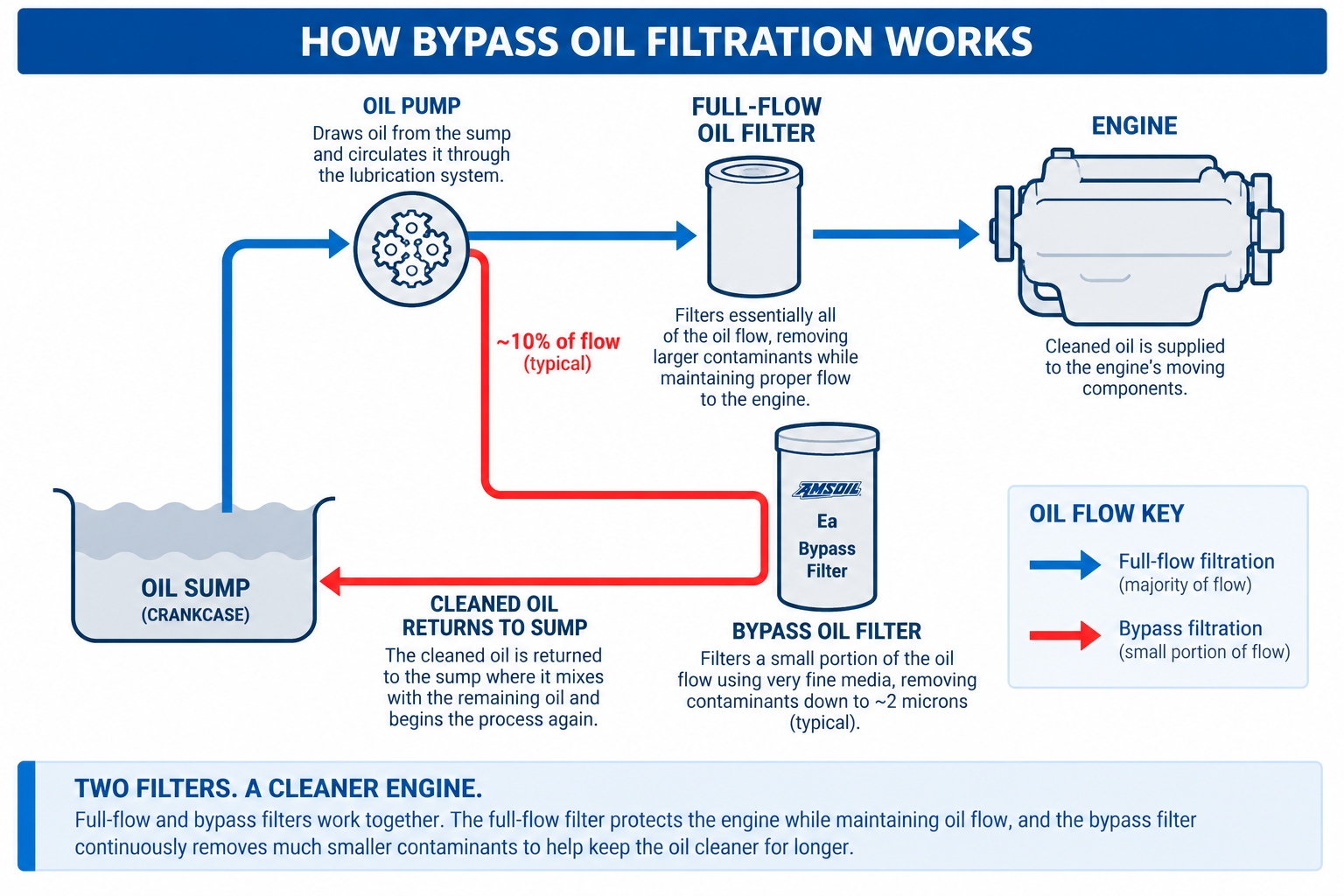
Bypass oil filtration adds a secondary, high-efficiency filtration circuit to an engine lubrication system. Instead of forcing all of the engine oil through an extremely fine filter, a bypass system diverts only a small portion of the oil flow through a much more restrictive filter before returning the cleaned oil to the sump. Over time, the entire oil volume is repeatedly filtered, allowing contaminants far smaller than those typically captured by a conventional full-flow oil filter to be removed.
AMSOIL bypass filtration systems are designed for applications where improved contamination control, extended component life and greater oil cleanliness are priorities. They are particularly well suited to high-use vehicles, commercial equipment, diesel engines, generators, agricultural machinery and other applications where engine replacement or downtime carries a substantial cost.
This guide explains how bypass filtration works, how it differs from conventional oil filtration, which AMSOIL bypass system is best suited to different applications and what needs to be considered before purchasing or installing a universal bypass filtration system.
Every engine relies on a full-flow oil filter to remove harmful contaminants from the lubricant. As the name suggests, a full-flow filter must allow essentially the entire lubrication flow required by the engine to pass through it. This creates an unavoidable design compromise: the filter must remove contamination while still maintaining sufficient oil flow under cold-start conditions, high engine speeds and heavy loads.
A bypass filter performs a different job. Rather than supplying oil directly to the engine, it filters only a small portion of the oil pump's output at any one time. Because flow through the bypass filter is deliberately much slower, the filter media can be significantly finer and more restrictive than the media used in a conventional full-flow oil filter.
AMSOIL states that its bypass filtration systems can remove contaminants down to approximately 2 microns. Once oil passes through the bypass filter, it is returned to the sump where it mixes with the remaining oil and begins the process again.
The full-flow filter continues to supply the engine with the oil flow it requires, while the bypass filter continuously cleans a smaller portion of the lubricant. The two systems operate together rather than one replacing the other.
A common misunderstanding is that a bypass filter is simply a “better” oil filter. In reality, full-flow and bypass filters are designed around completely different priorities.
| Feature | Full-Flow Oil Filter | Bypass Oil Filter |
|---|---|---|
| Primary purpose | Protect the engine while maintaining the required oil flow | Remove extremely fine contamination |
| Oil flow | Essentially the engine's full lubrication flow | A small portion of total pump flow |
| Restriction | Relatively low | Deliberately higher |
| Filtration priority | Balance of filtration efficiency and flow | Very fine filtration |
| Feeds engine directly | Yes | No |
| Can be used alone | Yes | No — bypass filtration must be used with full-flow filtration |
The finer media used in a bypass filter creates significantly more restriction than a normal oil filter. The bypass filter is designed to clean a small amount of oil at a time, while the full-flow filter continues supplying the engine with the oil flow it requires.
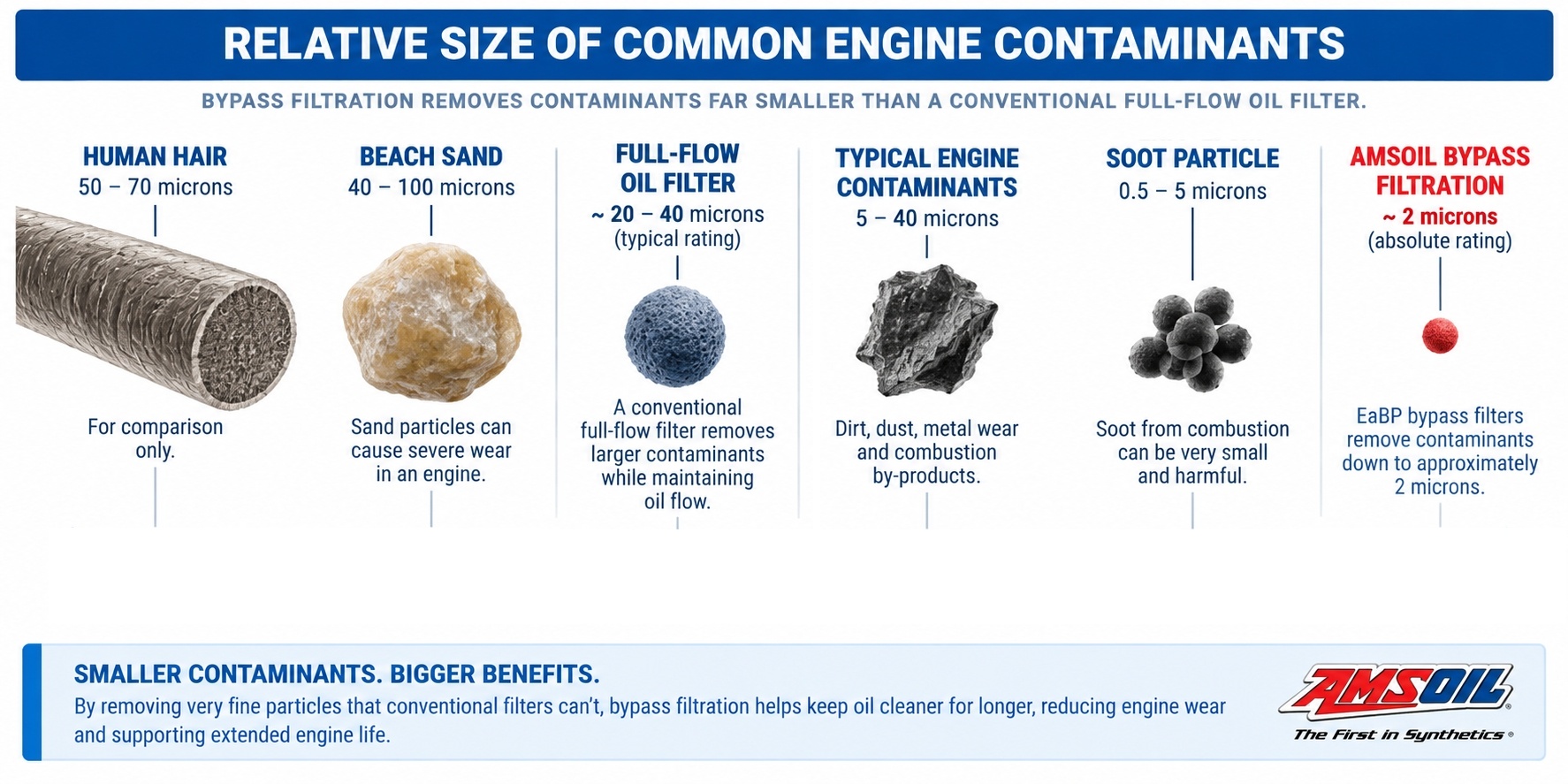
Engine contamination does not need to be visible to contribute to wear. Very small particles of airborne dirt, wear metals, combustion by-products and soot can remain suspended in engine oil and repeatedly circulate through bearings, journals, piston-ring areas and other highly loaded components.
Many of these particles are small enough to pass through conventional full-flow filtration but large enough to contribute to abrasive wear over time. Bypass filtration is designed to remove much finer contamination and help maintain a cleaner lubricant throughout the engine's service life.
See Bypass Filtration in Action
The difference between full-flow and bypass filtration is particularly easy to see in a controlled demonstration. In the video below, AMSOIL introduces soot contamination into an oil sample and circulates it through a bypass filtration test rig, demonstrating how fine contamination can be progressively removed from the oil.
AMSOIL demonstration showing bypass filtration removing fine soot contamination from circulating engine oil.
Bypass filtration is not limited to diesel engines, but diesel applications are particularly well suited to it. Diesel combustion can introduce fine soot into the engine oil, especially in engines that operate under heavy load, accumulate high kilometres or hours, spend significant time idling or operate in dusty environments.
A high-efficiency bypass filter can remove extremely fine solid contamination, including soot particles that may remain suspended in the oil. This can help maintain oil cleanliness and reduce the amount of abrasive contamination circulating through the engine.
Bypass filtration should not, however, be viewed as a cure for abnormal engine conditions. Excessive soot loading, fuel dilution, coolant contamination or unusual wear-metal levels may indicate mechanical or operating issues that should be diagnosed rather than simply filtered.
Finer Contamination Control
Removes much smaller particles than conventional full-flow filtration can consistently capture.
Cleaner Oil
Continuously processes a portion of the engine oil and returns it to the sump, helping maintain a cleaner lubricant.
Reduced Abrasive Wear
Lower concentrations of fine solid contaminants can help reduce long-term abrasive wear in lubricated components.
Greater Oil Capacity
The filter and oil lines increase the total lubricant volume in the system, spreading the workload across a larger quantity of oil.
Potentially Longer Drain Intervals
Improved contamination control can support longer oil service life, particularly when combined with used-oil analysis.
Ideal for High-Value Equipment
Particularly attractive where engine wear, downtime or replacement costs are substantial.
Bypass filtration is a substantial investment compared with a conventional oil filter. For that reason, it makes the most sense where improved contamination control provides a meaningful benefit over the long term.
Applications that accumulate high kilometres or operating hours, expensive diesel engines, commercial vehicles, generators, agricultural machinery, construction equipment, towing vehicles and long-term ownership vehicles can be particularly good candidates.
For a lightly used passenger vehicle that is serviced at conventional intervals and replaced regularly, the financial case may be much harder to justify. Bypass filtration is best viewed as an investment in engine cleanliness and long-term contamination control rather than a routine service upgrade that every vehicle requires.
AMSOIL Australia currently stocks three universal bypass filtration systems: the BMK21 Universal Single-Remote, BMK22 DUAL-GARD and BMK23 Universal Dual-Remote. Each system performs a different role and requires separate filter elements.
BMK21 — Universal Single-Remote
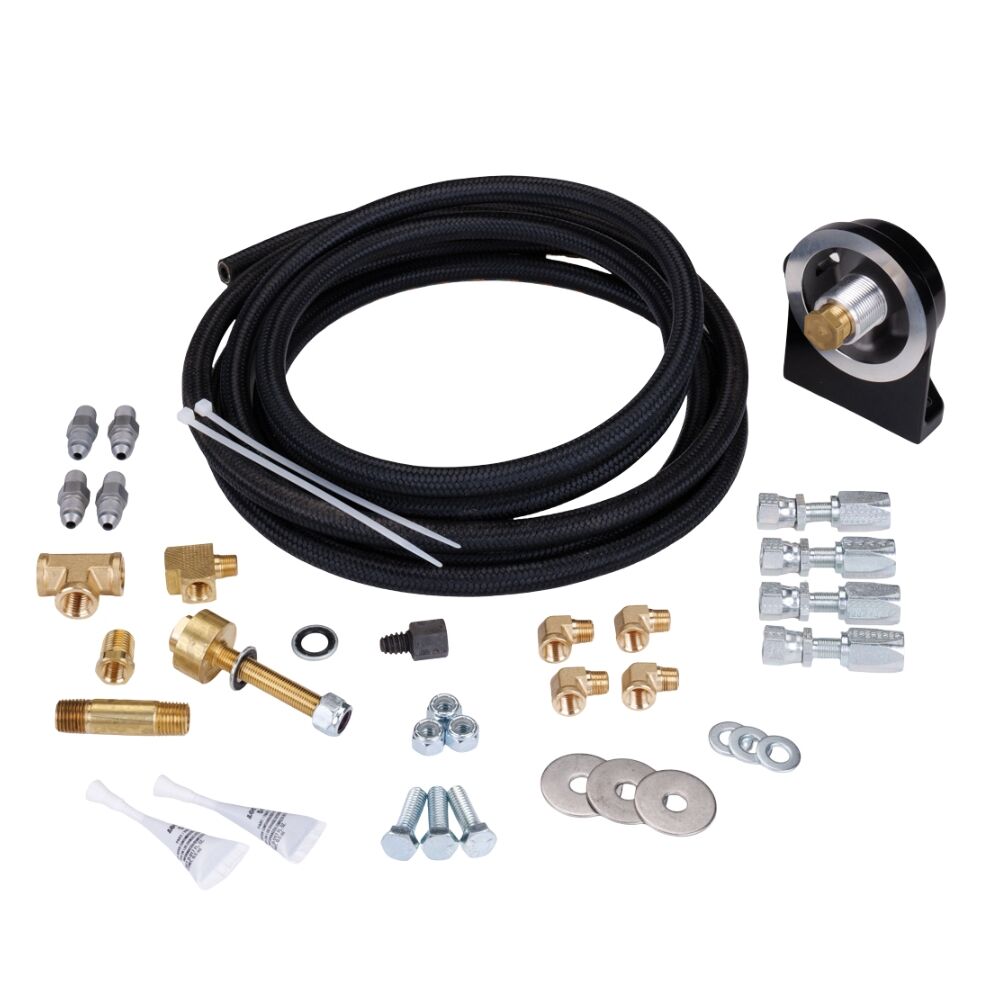
The BMK21 adds a single remotely mounted AMSOIL EaBP bypass filter while retaining the engine's existing full-flow oil filter in its original location.
- Retains the existing full-flow filter arrangement
- Requires 1 × compatible EaBP bypass filter
- Suitable where only one remote filter needs to be mounted
- Useful for custom passenger-car, 4WD and equipment installations
BMK22 — DUAL-GARD Bypass Filtration
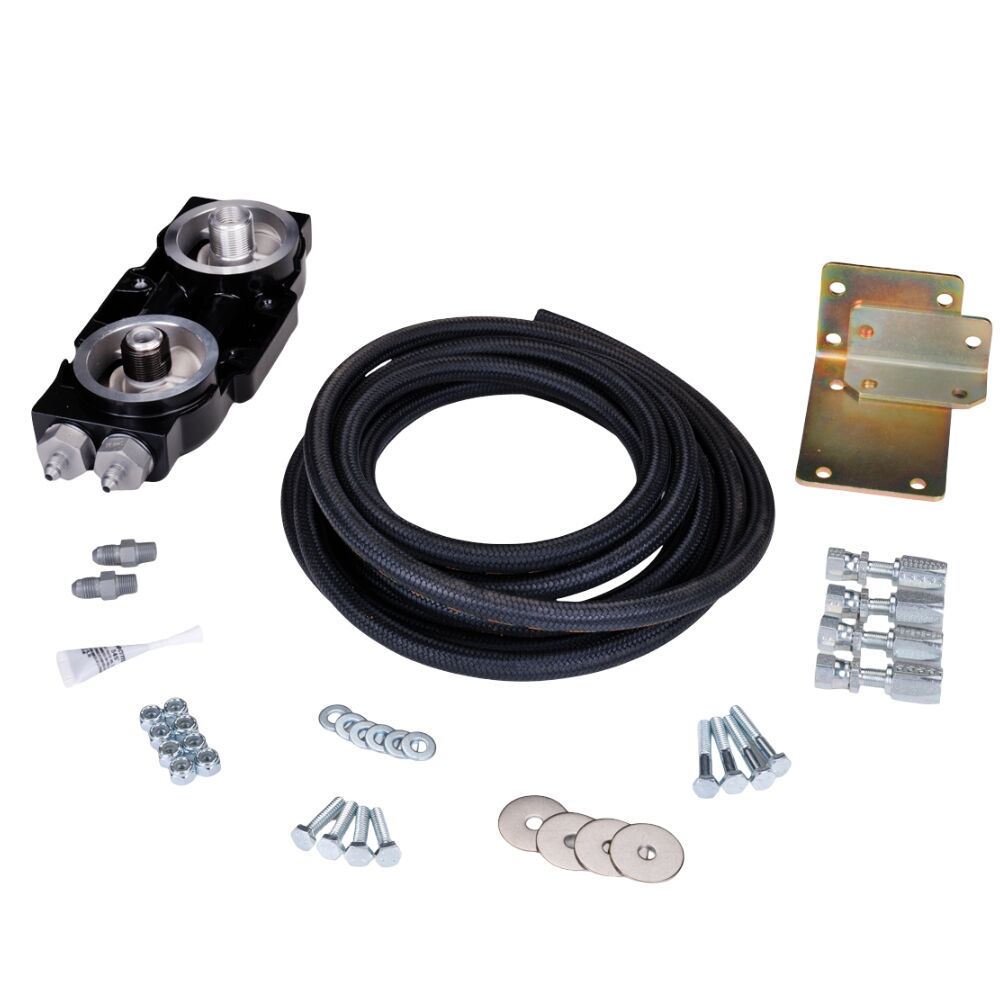
The BMK22 DUAL-GARD system uses two bypass filters in parallel to provide greater filtration capacity for high-demand and heavy-duty applications.
- Uses 2 × bypass filters in parallel
- Designed for high-capacity bypass filtration
- Well suited to commercial, heavy-duty and high-hour applications
- Requires significantly more mounting space than the BMK21
BMK23 — Universal Dual-Remote

The BMK23 relocates both the full-flow and bypass filters to a remote mounting location. One filter handles normal full-flow filtration while the second provides high-efficiency bypass filtration.
- Relocates both full-flow and bypass filters
- Convenient for servicing both filters in one location
- Can improve access where the factory oil filter is difficult to reach
- Requires adequate room for two filters and associated hose routing
AMSOIL product images often show a completed filtration system with filters installed for illustration. The bypass filtration kits contain the filtration hardware, hoses, fittings and mounting components, while the required EaBP bypass filter — and full-flow filter where applicable — must be purchased separately.
The BMK21, BMK22 and BMK23 are universal bypass filtration systems, but universal should not be interpreted as direct-fit or vehicle-specific.
A universal installation requires the installer to identify a suitable location for the filter assembly, an appropriate source of pressurised engine oil, a suitable oil-return point and safe routing for the oil lines. Depending on the vehicle or equipment, additional fittings, adapters, hose or fabricated mounting hardware may be required.
Before purchasing a bypass filtration system, the complete installation should be planned rather than assuming everything required for a particular vehicle will be supplied in the kit.
These systems are designed to provide installation flexibility across a wide range of engines and equipment. The exact plumbing, mounting and adapter requirements depend on the application.
Physical size is one of the most important considerations when planning a bypass filtration installation. AMSOIL EaBP bypass filters are considerably larger than many conventional passenger-car oil filters, and even the smallest filter in the range requires substantial mounting room once the filter head, fittings and hose bends are taken into account.
The installation must also allow sufficient clearance for the filter to be removed during servicing. A filter may technically fit in a space but still be impractical if it cannot be unscrewed without removing surrounding components.
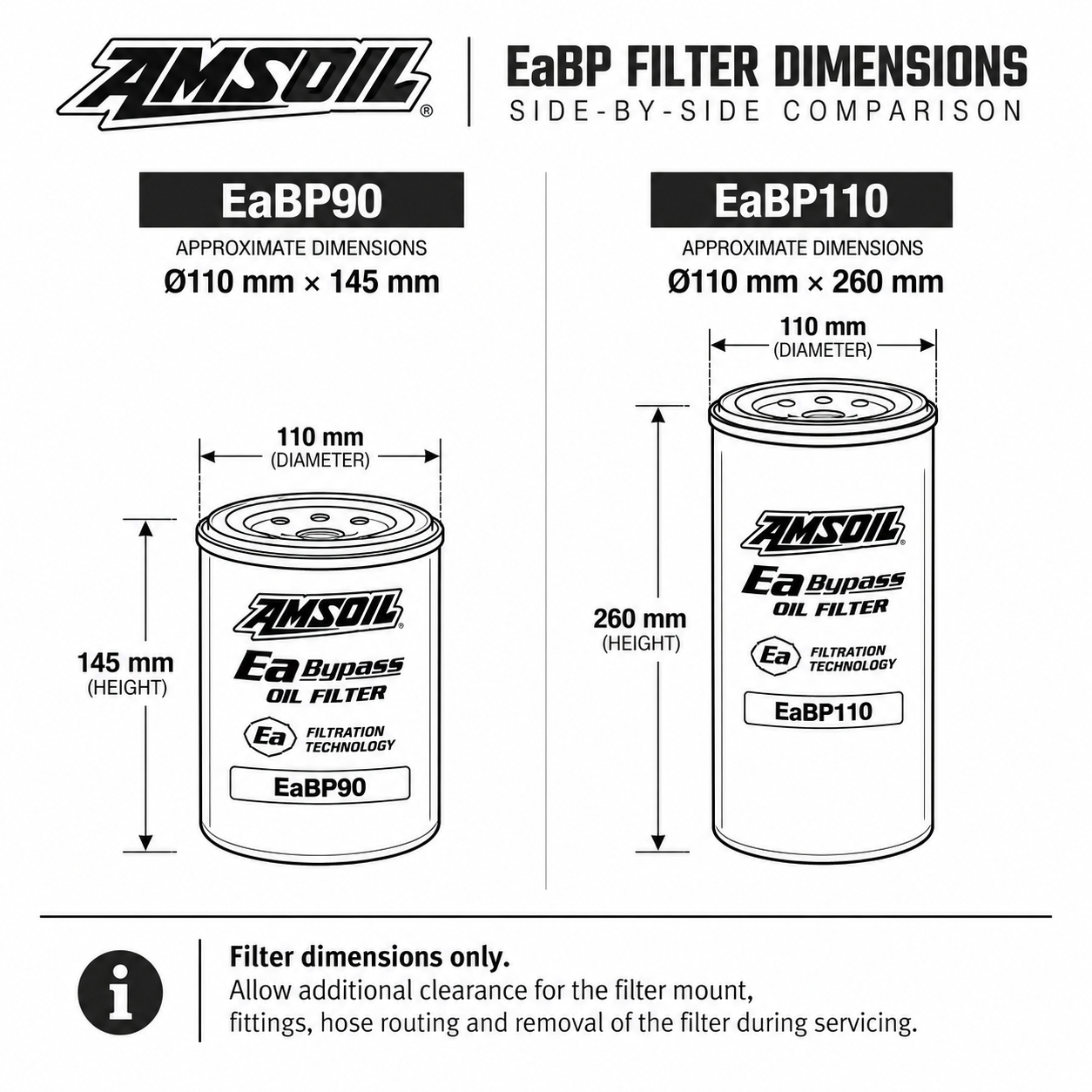
- Overall filter height and diameter
- Additional height of the remote filter head
- Hose and fitting clearance
- Filter removal and service clearance
- Distance from exhaust components and other heat sources
- Suspension, steering and engine movement
- Protection from road debris and impact
- Safe hose routing
- A strong and practical mounting structure
AMSOIL bypass systems use EaBP bypass filters in several sizes. The larger filters offer greater contaminant capacity and longer potential service intervals, but they also require more physical mounting space.
The correct filter should therefore be selected based on system compatibility, operating conditions and available space rather than simply choosing the largest option.
Even the EaBP90 is a substantial filter by passenger-car standards. Always confirm actual dimensions and mounting clearance before ordering.
Maximum EaBP Filter Service Intervals
AMSOIL Ea bypass filters are designed for long service life. The maximum service interval varies by filter size and is determined by distance, operating hours or time — whichever occurs first. Actual service requirements may vary with operating conditions and application.
| Bypass Filter | Maximum Distance | Maximum Hours | Maximum Time |
|---|---|---|---|
| EaBP90 | Approx. 96,500 km | 600 hours | 2 years |
| EaBP100 | Approx. 112,500 km | 800 hours | 2 years |
| EaBP110 | Approx. 128,700 km | 1,200 hours | 2 years |
Distance, operating hours and elapsed time are maximum limits. For example, an EaBP110 that reaches 1,200 operating hours before reaching the distance limit should be replaced at 1,200 hours.
Installing a bypass filtration system is more involved than replacing a conventional spin-on oil filter. Universal systems may require planning, fabrication and adaptation to suit the specific engine and vehicle.
Determine where the filter assembly will be mounted and identify suitable pressurised-oil supply and return points.
Avoid road debris, exhaust heat, suspension movement, excessive vibration and areas where the filter could be struck or punctured.
Keep oil lines clear of sharp edges, moving components and excessive heat, while allowing for normal engine and chassis movement.
Use a strong mounting location and fabricate or adapt brackets where necessary.
Universal installations require suitable engine-specific connections for pressurised oil supply and cleaned-oil return.
The supplied hose is cut to suit the individual installation and reusable hose fittings are assembled onto the hose ends.
After installation, start the engine and carefully inspect every fitting and hose connection for leaks.
The filter and oil lines increase total system capacity, so the oil level must be checked again after the system has filled.
Always follow the instructions and servicing procedures applicable to the specific kit and engine being fitted.
Yes. The bypass filter, remote filter head and oil lines add additional internal volume to the lubrication system. A BMK23 installation also relocates the full-flow filter, potentially changing the total amount of oil contained within the filtration circuit.
The final oil capacity should always be established by checking the engine oil level after the system has been installed, filled and circulated. Do not rely solely on adding a fixed estimated quantity of extra oil.
Improved contamination control can support longer lubricant service life, but filtration and oil condition are not the same thing.
A bypass filter can remove fine solid contamination, but it cannot eliminate every reason engine oil may eventually need replacing. Oil can still be affected by oxidation, additive depletion, fuel dilution, coolant contamination, water and abnormal operating conditions.
For vehicles or equipment where significantly extended oil-drain intervals are being considered, used-oil analysis is the most reliable way to evaluate lubricant condition and establish an appropriate service interval.
Strong Candidates
- Commercial vehicles
- High-kilometre diesel vehicles
- Heavy towing applications
- Generators and stationary engines
- Agricultural equipment
- Construction and earthmoving machinery
- Fleet vehicles
- Long-term ownership vehicles
- High-value or difficult-to-replace engines
May Be Difficult to Justify
- Low-use passenger vehicles
- Vehicles replaced frequently
- Engines nearing the end of their service life
- Applications with very limited mounting space
- Owners who simply follow conventional oil-change intervals
Does a bypass filter replace my normal oil filter?
No. A bypass filter must operate alongside the engine's full-flow filtration system.
Does all of the oil eventually pass through the bypass filter?
Yes. Only a small portion of the oil is filtered at any one time, but the process continues while the engine is operating, repeatedly processing the oil in the sump.
Are bypass filters only for diesel engines?
No. Bypass filtration can be used on petrol and diesel engines where the lubrication system and installation allow it.
Do BMK21, BMK22 and BMK23 include filters?
No. The required filters are sold separately. BMK21 requires an appropriate EaBP bypass filter, BMK22 requires two appropriate EaBP bypass filters and BMK23 requires an appropriate EaBP bypass filter and full-flow oil filter.
Can I install a bypass system myself?
Possibly, but the installer should be comfortable working with pressurised engine-oil systems, hose and fittings, mounting hardware and application-specific plumbing. Professional installation may be the better option where suitable oil supply and return points are not obvious.
How much extra oil will I need?
This varies by system, filter size, hose length and installation layout. The final quantity should be determined by checking the oil level after the system has been filled and circulated.
Can I extend my oil-change interval?
Potentially, but bypass filtration does not monitor lubricant condition. Used-oil analysis is recommended where substantially extended drain intervals are being considered.